
“More realism about sea level rise needed in coastal infrastructure design”
Recent research shows that sea level projections are (significantly) higher than observations to date. This means that coastal infrastructure designs are generally over-dimensioned and therefore not cost-effective.

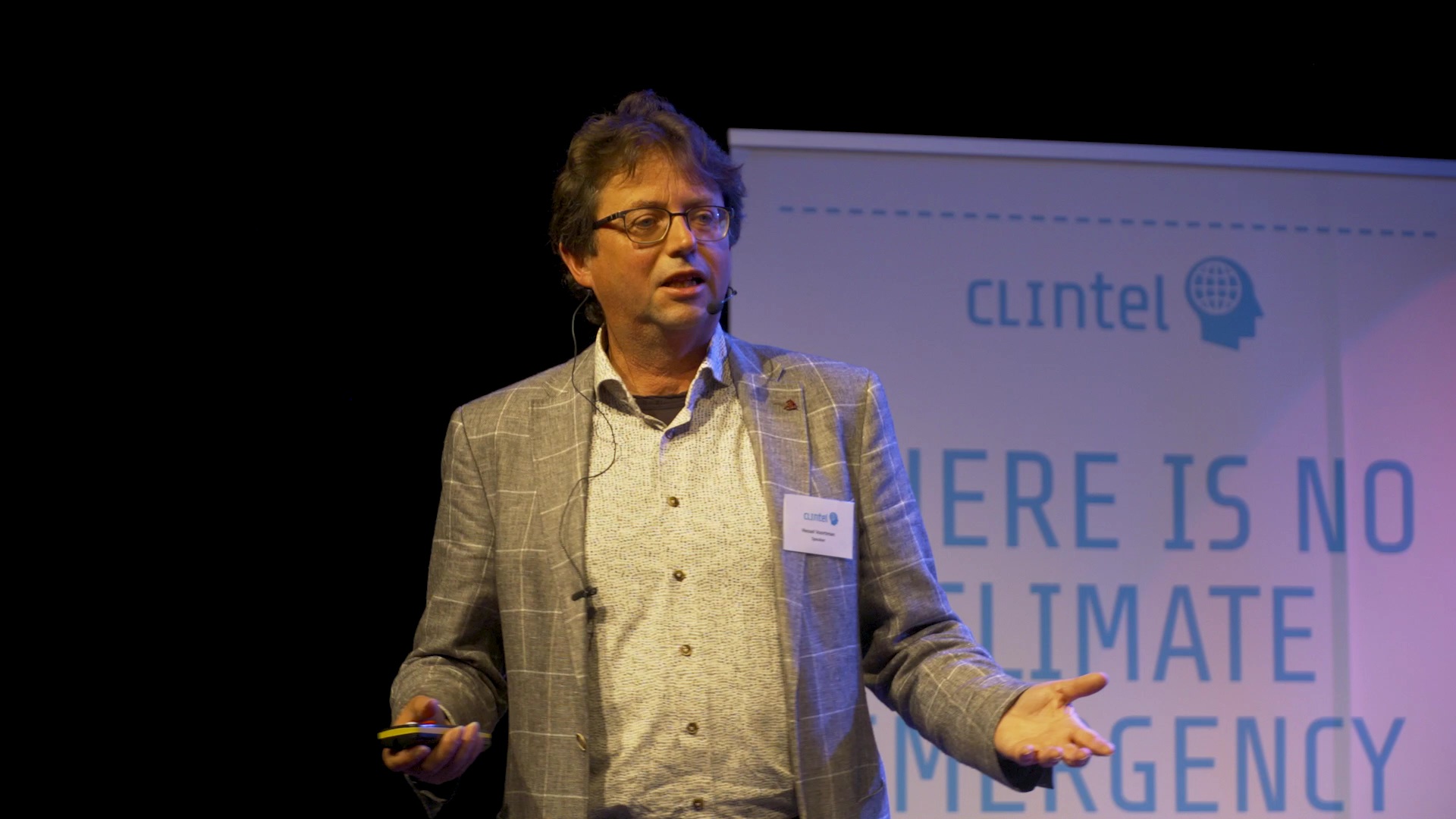
Hessel Voortman during his lecture at Clintel’s anniversary conference in June 2024
Peter Baeten
Date: 29 January 2026
This week, the British think tank GWPF (Global Warming Policy Foundation) published a new report, written by Dr. Hessel Voortman, entitled Sea-level: Evidence and Engineering. Voortman is a Dutch coastal engineer with more than 25 years of experience in feasibility studies, design, and implementation of hydraulic engineering projects.
Harry Wilkinson, head of policy at the GWPF, said at the presentation of the report: “Hessel has a pragmatic message that scientific authorities, policymakers, and engineers should take to heart. Good coastal defence requires a flexible consideration of various factors, and it is crucial for coastal communities that this is done correctly.”
One of Voortman’s conclusions is that sea level projections are generally associated with considerable uncertainty in the long term. More importantly, recent research shows that these projections are (significantly) higher than observations to date. This means that coastal infrastructure designs based on these projections are over-dimensioned and therefore not cost-effective.
No acceleration
Voortman refers, among other things, to important publications of his own from 2025 and 2023 on the difference between sea level observations and projections. Regarding the 2025 study: “We compared the simulated sea level rise in the climate models used by the IPCC for the year 2020 with the actual measured sea level rise. It turned out that the sea level values simulated by the IPCC are systematically too high, on average about 2 mm/year higher than the measured values, with large regional differences.”
According to Voortman’s research, there is also no acceleration in sea level rise, although this is commonly claimed, both for the Netherlands and globally. Hessel Voortman had already demonstrated that this is incorrect for the Netherlands in an earlier publication from 2023.
Voortman euphemistically says about the discrepancy between the forecasts and the actual observations: “There is room for improvement in terms of the agreement between the predicted and observed sea level rise.”
Looking locally
Other key observations from Voortman’s report:
- Observed sea level data are unclear and can easily be misinterpreted; tidal cycles, wind, land movements, and human activities can easily be mistaken for climate-related changes.
- Coastal infrastructure should be designed based on local relative sea level and intended lifespan, not on global or national averages. In this regard, there has been an improvement at the IPCC: “In its latest report in 2021, the IPCC published future sea level projections for many locations around the world. This was a commendable addition to previous reports, which only made global statements about sea level. After all, local information is crucial for practical purposes (protection against high water).”
Voortman concludes with a general recommendation: “Effective coastal adaptation is the result of collaboration between science, policy, and technology. Science must continue to improve local predictions and their consistency with observations, while policy must provide flexible frameworks that support timely renewal of critical coastal infrastructure. Engineers use the input from science and work within the frameworks established by policy.”
The report was launched on Monday, January 26, at an event in London, of which you can see a recording below.


more news

The Berlin Blackout and the Fragility of Germany’s Energy Transition
This article is the English translation of an analysis originally published in the German newsletter of Professor Fritz Vahrenholt. It examines how the Berlin blackout exposes structural weaknesses in Germany’s energy transition.

Trump Cuts Funding to UN and Global Agencies
Jo Nova reports that President Trump has announced the withdrawal of U.S. funding from the United Nations and 66 international agencies — a move that could significantly reshape global institutions and accountability.

Climate Alarmism’s Credibility Sinks Under Weight of Ecological Evidence
Ecological data increasingly challenge the climate alarmism narrative. Real-world trends in forests, wildlife and agriculture tell a very different story.

