
South Korea’s Net Zero Boast Crumbles
South Korea must end sacrificing growth, stability, and innovation at the altar of unverifiable climate fantasy, says Vijay Jayaraj. The country remains dependent on fossil fuels by necessity.

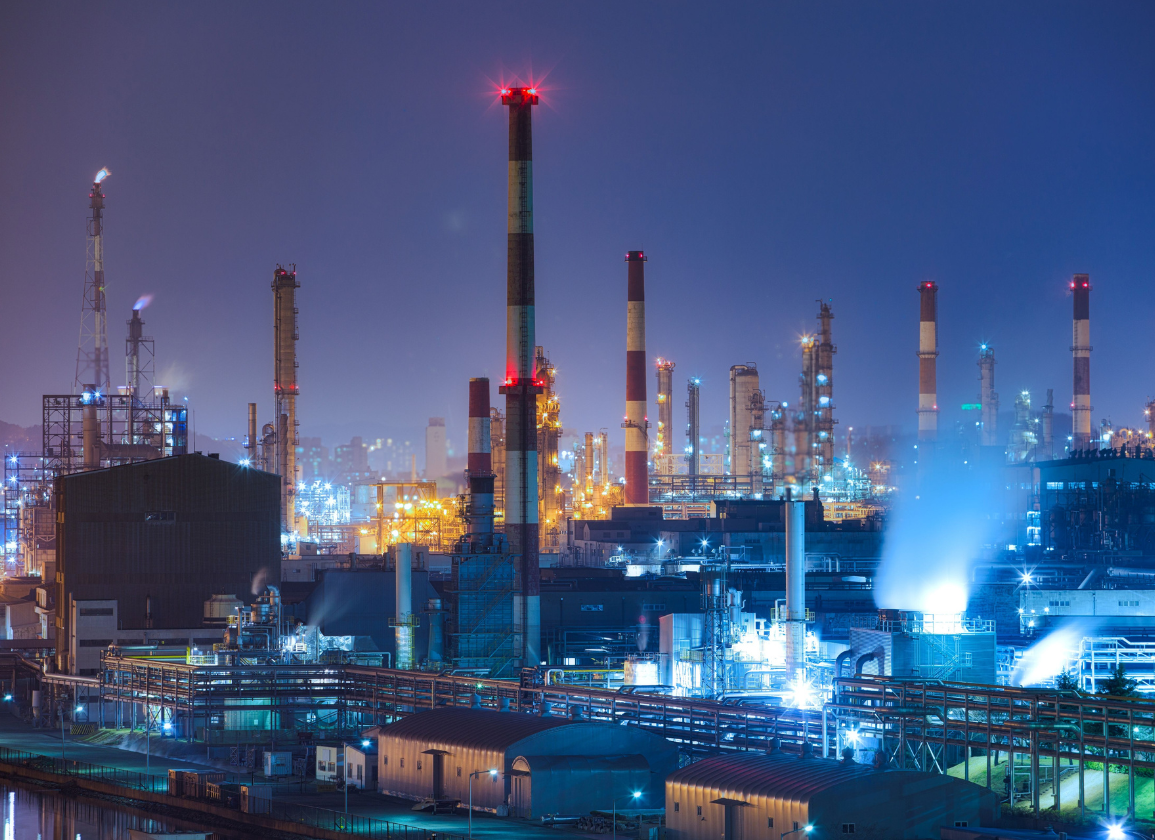
Refinery in Ulsan, South Korea. (Source: Shutterstock)
Vijay Jayaraj
4 May 2026
Just a few months ago, South Korean officials were busy boasting about extreme net zero targets. Fast forward to April 2026, and the country is scrambling to secure every vessel load of oil and natural gas available on the global market.
Last November, the Presidential Commission on Carbon Neutrality and Green Growth formalized its 2035 Nationally Determined Contribution, pledging a sweeping 53–61% cut in greenhouse gas emissions from 2018 levels (742 million metric tons of carbon dioxide equivalent).
The anti-fossil fuel lobby hailed this as proof of Asia’s fourth-largest economy decoupling growth from fossil fuels, an energy source that is often maligned as “poison” and relics of an unsustainable past.
Lifelines
Today, the same fuels are national lifelines. The government’s request to Gulf producers for “steady energy supply and safety assurances for Korean vessels” is a stunning reversal. The contrast could not be starker.
The desperation extends directly to the streets. On April 1, the South Korean government elevated its energy security alert, announcing strict conservation rules to save the fuels they had planned to tax into oblivion. Public-sector fleets — including 1.5 million vehicles across ministries, local governments, and schools — were to face alternate-day driving rules based on license plate numbers.
President Lee reportedly has called Indonesia’s stable LNG (liquefied natural gas) and coal supplies “very reassuring” amid the chaos — a statement that reveals a recognition of fossil fuels as cornerstones of national security.
So, why does a wealthy nation codify a net zero mandate for 2035 and then follow up by begging global suppliers to send massive loads of hydrocarbons?
Unforgiving physics
The answer lies in the unforgiving physics of energy. Wind turbines, solar panels, and battery storage cannot power, produce, or sustain a modern manufacturing base. They lack the energy density and reliability required to replace electricity from fossil fuels.
South Korea’s three major refineries — SK Energy’s Ulsan complex, GS Caltex in Yeosu, and S-Oil’s Onsan plant — rank among the largest globally. Combined, they process millions of barrels per day into both fuels and industrial feedstocks exported to nations.
Naphtha from these refineries serves as the vital feedstock for South Korea’s petrochemical plants, the fourth-largest producers of ethylene and propylene on Earth.
These chemicals create the plastics, synthetic fibers, and resins that make up automobile interiors, electronic device casings, clothing fabrics, food packaging, medical tubing, and construction. Without them, South Korea’s export engines for semiconductors, shipbuilding, automobiles, and textiles don’t exist. Oil does not merely move goods; it sustains entire industries.
South Korea’s economy cannot operate without imported hydrocarbons. The country imports more than 97% of its energy, with crude oil and natural gas accounting for the lion’s share. South Korea must spend its resources on diversifying oil and gas imports while expanding LNG partnerships in Southeast Asia, not on unachievable political vanity projects.
Moral imperatives
Climate policies, framed as moral imperatives, cannot withstand the scrutiny of real-world performance. The science around catastrophic climate predictions remains unsettled, and the historical record shows that nations have often thrived during periods of moderate warming. Increased atmospheric CO2 has correlated with agricultural productivity, greening large parts of the world and benefiting food security in South Korea.
The net zero agenda requires a deliberate ignorance of how the modern world functions. South Korea rose from the ashes of war to become a global economic titan because it embraced the power of energy-dense, reliable fossil fuels. Turning away from this proven model in favor of unproven, weather-dependent technologies is a recipe for economic ruin.
South Korea must end sacrificing growth, stability, and innovation at the altar of unverifiable climate fantasy. The country remains dependent on fossil fuels by necessity.
This article was originally published on California Globe on 28 April 2026.

Vijay Jayaraj
Vijay Jayaraj is a Science and Research Associate at the CO2 Coalition, Fairfax, Virginia. He holds an M.S. in environmental sciences from the University of East Anglia and a postgraduate degree in energy management from Robert Gordon University, both in the U.K., and a bachelor’s in engineering from Anna University, India. He served as a research associate with the Changing Oceans Research Unit at University of British Columbia, Canada.

more news

Fire Fighting in the European Union: Don’t Forget The Decade of Policy Failures in California
Whether in the Mediterranean or the American West, the narrative around wildfires has become a convenient shield for policymakers: blame “climate change,” ignore the structural rot, and then demand more taxpayer money to sustain a broken status quo.
Climate.us: A Sign That the Climate Debate Is Far From Over
Many commentators have suggested that recent political changes represent some sort of permanent turning point in the climate debate. That would be a mistake, says Anthony Watts. The Climate.us project for instance, demonstrates that there remains a substantial network committed to maintaining the climate narrative.

ICSF/Clintel lecture by Roger Pielke Jr.: RCP8.5 is Retired – What Now?
In his recent ICSF/Clintel Lecture, Roger Pielke Jr. acknowledges that the scientific community is now correcting a long-standing problem regarding extreme climate scenarios like RCP8.5. But he warns that the consequences of past reliance on these scenarios will continue for many years.

