
The EU’s Nuclear Phase-Out Was a Blunder
Following Friedrich Merz in January, Ursula von der Leyen has now also admitted that the phase-out of nuclear energy was a major ‘strategic mistake’, not only for Germany but for the EU as well. American researcher Roger Pielke Jr. uses some simple calculations to demonstrate the magnitude of the EU’s strategic blunder.

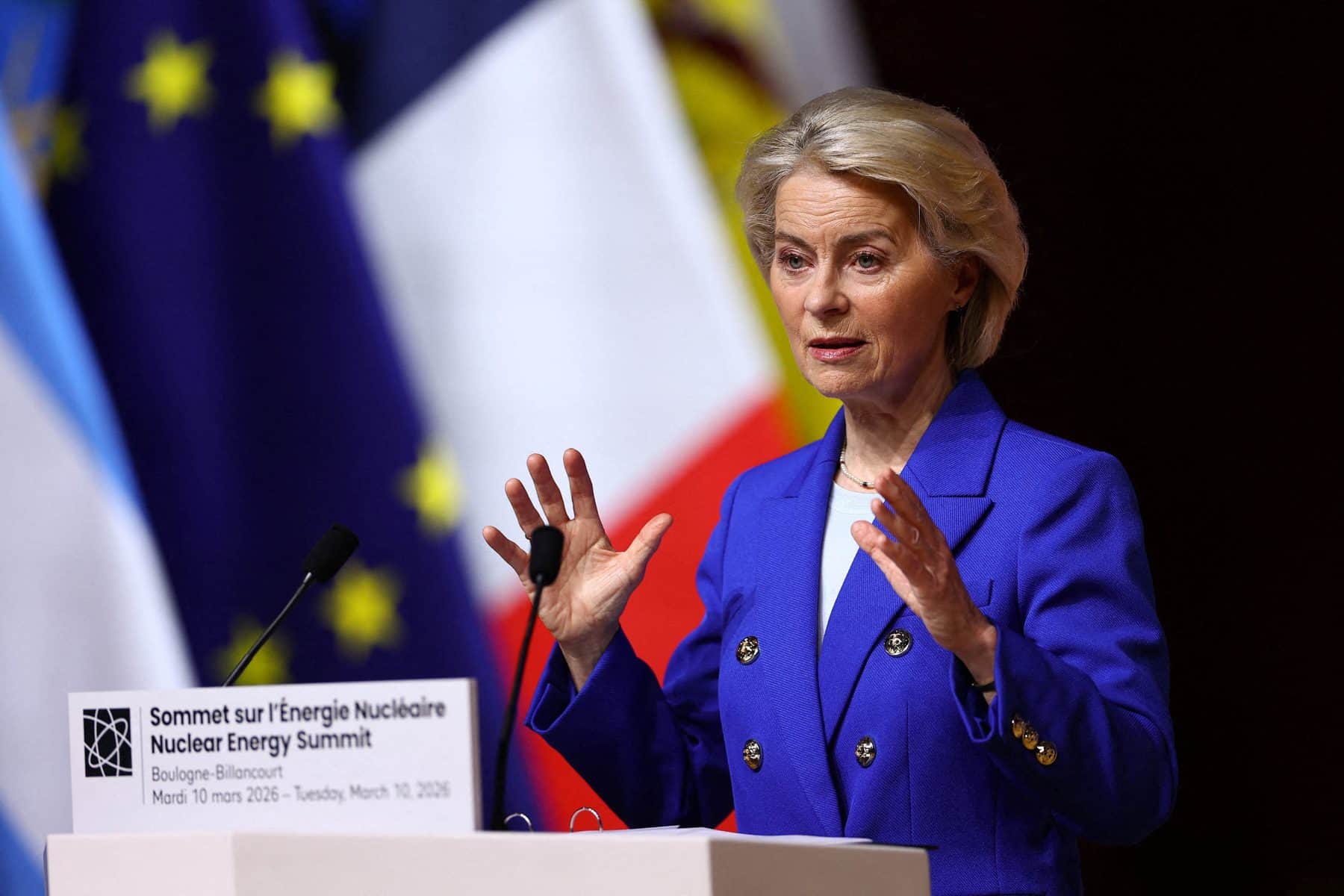
Ursula von der Leyen. Source: Shutterstock.
Marcel Crok
Date: 23 March 2026
What a remarkable turn of events. Ursula von der Leyen, President of the European Commission, admitted at the Nuclear Energy Summit near Paris that phasing out nuclear energy had been a “strategic mistake.” Sound familiar? Indeed, German Chancellor Friedrich Merz used almost exactly the same words back in early January during a speech in Germany
(Indepen reported on that at the time as well). Von der Leyen said this: “This reduction in the share of nuclear was a choice. It was a strategic mistake for Europe to turn its back on a reliable, affordable source of low-emissions power.”
This is quite a turnaround. Think back to European Commissioner Frans Timmermans, the driving force behind the Green Deal, the EU’s flagship initiative to cut CO2 emissions , who repeatedly criticized nuclear energy. In a January 2020 interview with NRC, he called it “unsustainable and, moreover, extremely expensive.” While he grudgingly supported its inclusion in the EU Taxonomy for sustainable investments under tight restrictions, he insisted it could only serve as a temporary bridge to a fully renewable energy system, dominated by solar and wind.
Irreversible
In Germany, Ursula von der Leyen’s remarks quickly became the talk of the day. Chancellor Friedrich Merz himself now says he “regrets” the nuclear phase-out, but insists it is “irreversible,” adding bluntly: “That’s just the way it is.” By contrast, German Environment Minister Carsten Schneider (SPD) sharply condemned any revival of nuclear power, dismissing new construction of nuclear plants as a “backward strategy” and a “dead end.” According to Schneider, this approach would simply mean “new subsidies for nuclear power plants.”
Professor Fritz Vahrenholt—German ambassador for the Clintel Foundation and a former SPD politician, appeared on Welt-TV to point out that Ursula von der Leyen was Germany’s Minister of Labor in 2011, when Angela Merkel abruptly decided, in the wake of the Fukushima disaster, to shut down all nuclear power plants. “That decision has cost us 600 billion euros since then,” Vahrenholt said, “and it has led to the highest electricity prices in Europe and massive deindustrialization.” He then turned his fire on Environment Minister Carsten Schneider’s claim that solar and wind power are now cheaper: “That just shows he has no idea what he’s talking about. We’re spending €20 billion a year on subsidies for solar and wind. With that money, we could build two nuclear power plants every year—and enjoy reliable, cheap electricity for the next eighty years.” Vahrenholt concluded with a pointed appeal: “Dear Comrade Schneider: at the very least, don’t stand in the way of our neighbors as they build next-generation nuclear plants. One day we’ll be begging them for that electricity.”
The reactions of German politicians closely resemble what we’ve been hearing in recent weeks from politicians in the Netherlands regarding the Groningen gas fields. There, too, the word “irreversible” has been used, yet—with the ongoing war in Iran—an increasing number of energy experts are now advocating for keeping the Groningen gas available, at least as an emergency reserve. In the Netherlands, gas wells are being filled with concrete to permanently prevent future extraction. However, that process is far from complete and could therefore still be halted or reversed.
The situation in Germany mirrors this with regard to nuclear power plants. Although all of them have been shut down, a study published last year (December 2024) by the American consultancy Radiant Energy Group, presented at the Anschalt-Konferenz (Restart Conference) in Berlin, concludes that nine reactors could still be “saved” from irreversible demolition and potentially restarted, provided there is sufficient political will. Friedrich Merz, however, does not yet appear ready to pursue this option; instead, he is focusing on building new gas-fired power plants to ensure backup capacity amid the energy transition.
Renaissance
In her speech, Ursula von der Leyen acknowledged a global renaissance in nuclear energy and stated that Europe wants to be part of it. However, she appears to focus primarily on new-generation technologies, such as small modular reactors (SMRs), which remain under development.
In a compelling (though paywalled) article on his Substack, The Honest Broker, American researcher Roger Pielke Jr. uses straightforward calculations to demonstrate how far off course the EU’s energy policy has veered over recent decades—despite its stated goal of reducing CO2 emissions. He explores two counterfactual scenarios.
In the first, he reverses Europe’s actual decline in nuclear power between 2000 and 2024, turning it into an equivalent rate of growth. In the second, he assumes nuclear capacity expands at the same rapid pace seen between 1970 and 1990, when France aggressively built out more than 50 reactors in a state-driven program.
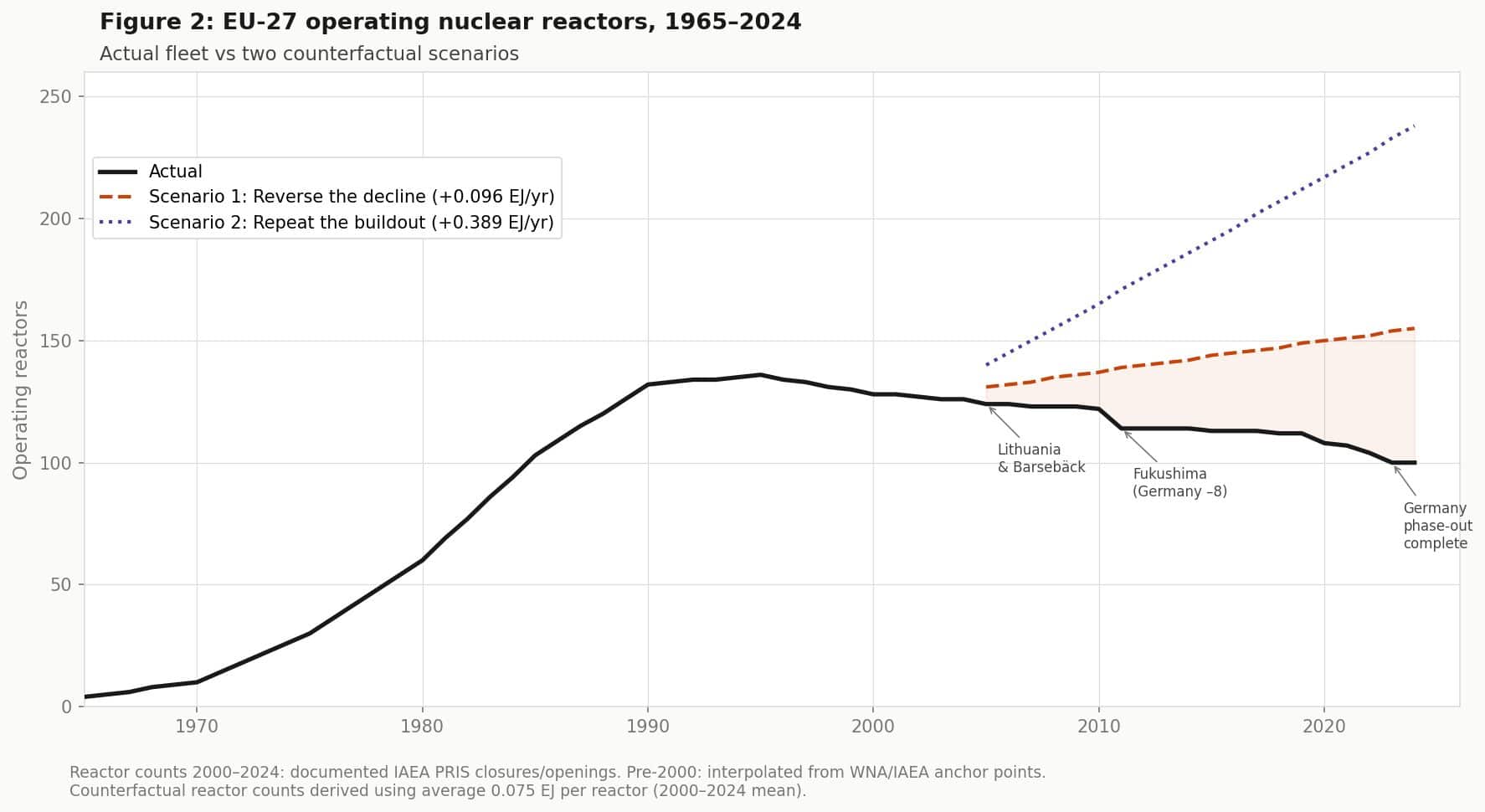
The number of operating nuclear power plants in Europe is shown in black. Source: Roger Pielke Jr.
Pielke then assesses how much these alternative scenarios could have reduced Europe’s dependence on Russian pipeline gas and Qatari LNG, as well as the potential decline in coal consumption. The table below summarizes the key results.
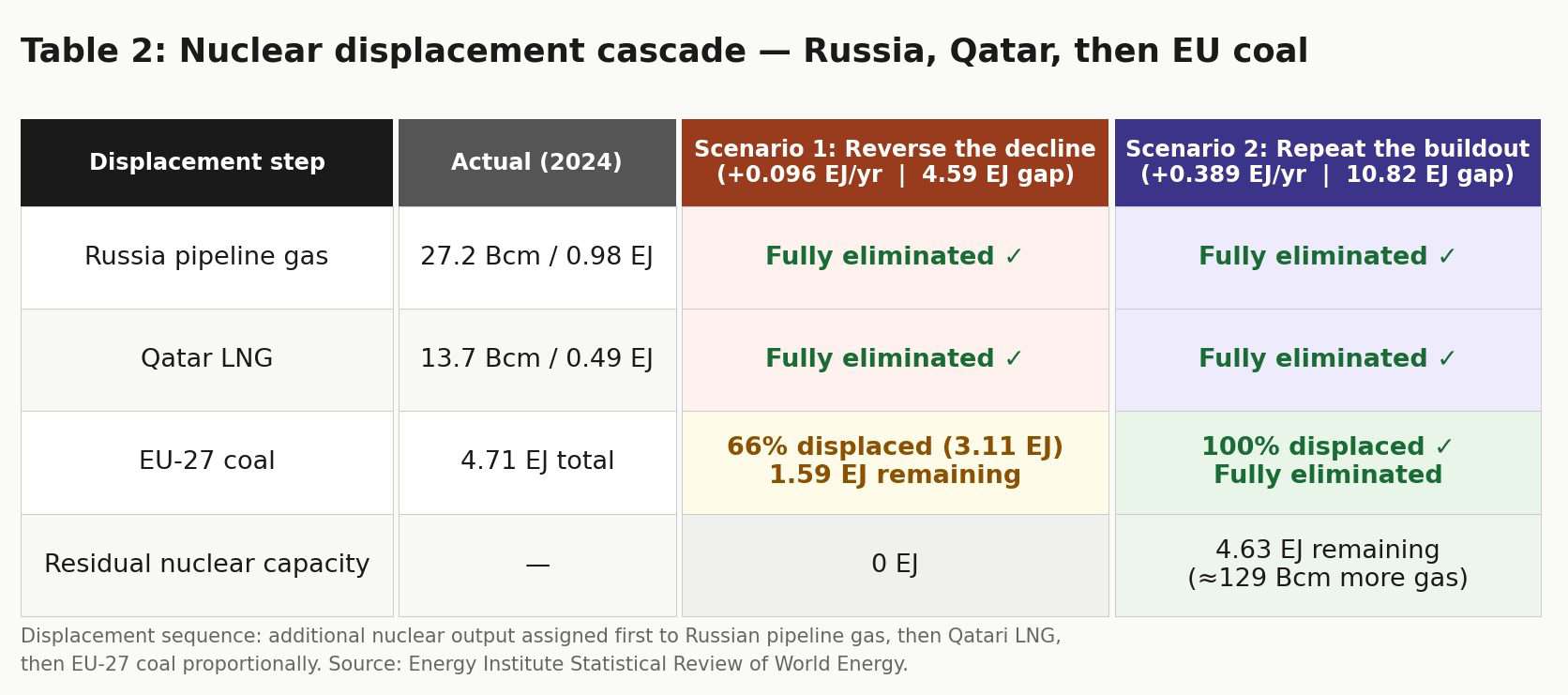
In both scenarios, Europe would have eliminated its need for any gas imports from Russia or Qatar entirely.
Under Scenario 1 (modest nuclear growth), coal use across the EU would have fallen by approximately 66%. In Scenario 2 (rapid buildout mirroring France’s 1970–1990 expansion), coal consumption would have been wiped out completely. What’s more, surplus nuclear capacity in Scenario 2 would have been sufficient to displace roughly 129 billion cubic meters of natural gas, equivalent to about four times the Netherlands’ annual consumption (typically 30–35 billion cubic meters).
These counterfactuals carry profound implications for the EU’s CO2 emissions. Had Europe pursued Scenario 1, emissions in 2024 would have been about 15% lower than they actually were. Under the more ambitious Scenario 2, the reduction would have reached as much as 21%.
European energy policy over the past four years has been dominated by two major crises: the Russian gas boycott following the invasion of Ukraine in 2022, and the recent transport problems caused by the war in Iran. Both crises could have been avoided, or at least significantly mitigated, if Europe had continued to build nuclear power plants at a steady pace after 2000. Fortunately, the tide is now beginning to turn, but much more will be needed before a true nuclear revival takes place.
This article By Marcel Crok was published first in Dutch on Indepen on 20 March, 2026.
Marcel Crok
Marcel Crok is a Dutch science journalist who has been writing full-time about the climate debate and climate policy since an award winning article about the notorious hockey stick graph in 2005. He published two books in Dutch (De Staat van het Klimaat (The State of the Climate) and was co-author of the book Ecomodernisme (Ecomodernism)). With the British independent researcher Nic Lewis he wrote an extensive report about climate sensitivity, titled A Sensitive Matter. He was asked by the Dutch government to become expert reviewer of the IPCC AR5 report. Together with the Dutch climate institutes KNMI and PBL, Crok set up an international discussion platform Climate Dialogue.
In 2019, Crok and emeritus professor Guus Berkhout founded the Clintel Foundation. They published the World Climate Declaration, which has now been signed by over 2000 scientists and experts. Together with Andy May and a team of scientists from the Clintel network, Crok contributed to and edited the book The Frozen Climate Views of the IPCC.

more news

BlackRock CEO Abandons Climate Delusion for Investor Needs
BlackRock CEO Larry Fink has publicly shifted toward what he calls energy pragmatism, admitting that society now demands a balanced approach to meeting power needs rather than adherence to rigid climate agendas. This could be a pivotal moment for global energy policy, as one of the planet's most powerful financial players steps back from decades of ill-advised “green” mandates.

The First Heatwave of the Year… and the Same Old Narrative
March heatwave climate data - How long term temperature records challenge the climate narrative
The Strait of Hormuz Crisis Shows the World Still Runs on Fossil Fuels
The Strait of Hormuz, one of the world’s most critical energy chokepoints, highlights the continued global dependence on oil and gas. Recent geopolitical tensions have disrupted energy flows, exposing vulnerabilities in global supply chains and triggering emergency responses across Asia. Despite decades of rhetoric about an energy transition, fossil fuels remain indispensable for modern economies, not only for energy but also for agriculture, plastics and pharmaceuticals. The crisis underscores that energy systems are shaped by geography and economics, and that a full transition away from hydrocarbons will be far slower and more complex than often assumed.

