
Two day Clintel conference in the Parliament of Prague
The CLINTEL Working Group in the Czech Republic organizes an International Scientific Conference in Prague, which will take place on 12 and 13 November 2024 in the premises of the Chamber of Deputies of the Czech Republic.

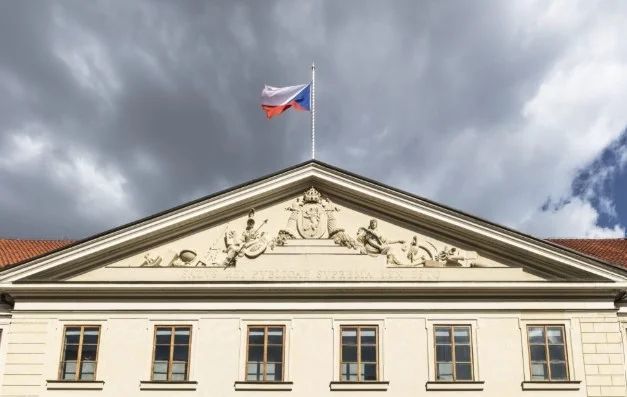
Climate change, facts and myths in the light of science
Conference topics:
- Meteorological and climatological observations
- Physical processes affecting the climate
- Sun, planets and climate
- Future climate developments
- CLINTEL vs IPCC
If you come from abroad and want to visit the conference, you can buy a day ticket (including lunch) at the conference location for € 20.00.
The conference will take place in the Parliament of the Czech Republic, Prague, Sněmovní 1, 118 00 Malá Strana.
Conference program
Tuesday November 12
8:30 – Registration of participants and preparation of the projection
9:00 – Introductory talk
9:10 – Scientific committee speech
9:20 – Presentation of the Program
9:30 – Coffee break
Meteorological and climatological observations
9:50 – Solheim (Norway) – Changes of the Position of the Barents Sea Ice Edge as a 442 yr Climate Indicator.
Physical processes affecting the climate
10:20 – Monckton (UK) – An error of temperature feedback analysis and its consequences.
10:50 – Fürst (Czech Republic) – Problems of mathematical modelling and inference of causality in climate processes.
11:10 – Kalenda (Czech Republic) – What was the first? Temperature or CO2?
11:30 – Koutsoyiannis (Greece)* – The relationship between atmospheric temperature and carbon dioxide concentration.
12:00 – Lunch
14:00 – Croll (UK)* – Does the geological evidence indicate a causal link between CO2 and climate change?
14:30 – Masson (Belgium) – From Correlations to Causalities between Climate Proxies at the Pacific Ocean-Atmosphere Interface.
15:00 – Nakládal (Czech Republic) – onlinear dynamical systems and their relation to climate.
15:30 – Coffee break
16:00 – Scafetta (Italy)* – Impacts and risks of “realistic” global warming projections for the 21st century.
16:30 – Pollock (Chile)* – Power grid electricity costs and CO2 emissions in the presence of renewables.
17:00 – Ratzer (Canada)* – Climate concepts.
17:30 – Nikolov (USA)* – Toward a New Theoretical Paradigm of Climate Science.
18:00 – End of the day 1
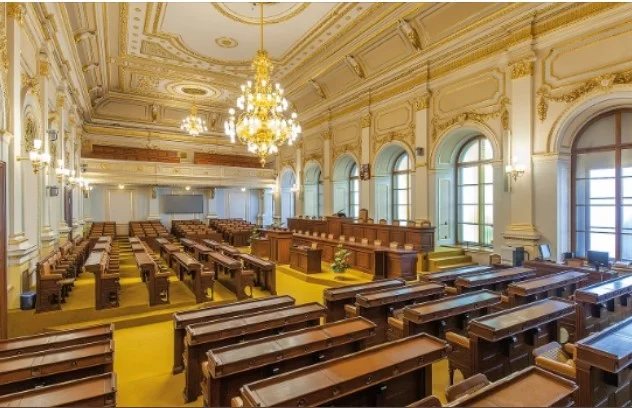
Inside the paliament building
Wednesday November 13
8:50 – Scientific committee speach
Sun, planets and climate – chairman Pavel Kalenda
9:00 – Mackey (Australia)* – Earth rotation regulates climate.
9:30 – Šír (Czech Republic) – The 60-year cycle of Earth’s climate and the eccentricity of Jupiter’s orbit.
9:55 – Coffee break
10:10 – Wandrol (Czech Republic) – Calculation of energy accumulation in the crust from the behavior of the temperature field in the subsurface layers.
10:40 – Šálek (Czech Republic) – Radiation data from CERES measurement – do they agree with current climate dogma?
11:10 – Mearns (UK)* – Bond Cycles and the Influence of The Sun on Earth’s Climate.
11:40 – Pokorný (Czech Republic) – Relationships “Sun –water –vegetation –climate”.
12:10 Lunch
Future climate developments – chairman Pavel Kalenda
14:00 – Abdussamatov (Russia)* – Self-amplifying feedback effects from long-term declines in solar radiation will trigger the 19th Little Ice Age around 2080
14:30 – Zharkova (UK)* – Modern grand solar minimum of solar activity derived from solar background magnetic field and its impact on the terrestrial environment.
CLINTEL vs IPCC – chairman Jiří Kobza
15:00 – Crok (The Netherlands) – How biased is the latest IPCC report?
15:30 – Szarka (Hungary) – Historical and recent publications in Hungary on climate change.
16:00 – Procházka (Czech Republic) – The carbon cycle, ‘renewable’ and ‘non-renewable’ resources: myths and reality.
16:30 – Coffee break
17:00 – Discussion and acceptance of the Communiqué, Conclusion of the conference. (17:30).
*The authors printed in italics will not be physically present and their presentations will take place online.
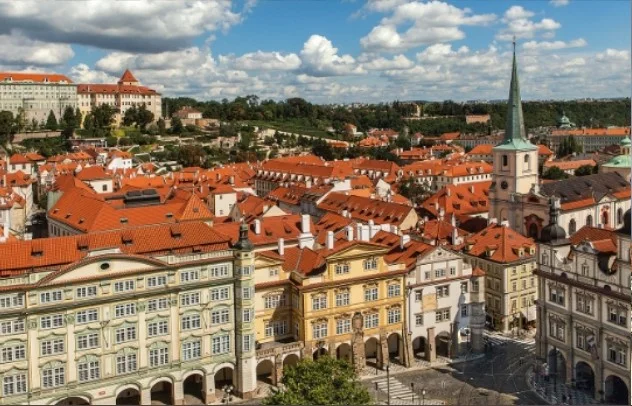
Czech Parliament Prague
The videos that will be taken from the conference will be dubbed into a second language so that they are accessible and understandable to a wider professional public not only in the Czech Republic, but also throughout Europe. Online broadcasts of the lectures will be available on the TV Bureš channel:
https://www.youtube.com/c/PetrBure%C5%A1TV/streams
Organizers: CLINTEL Working Group in the Czech Republic
Scientific Organizing Committee of the Conference: RNDr. Pavel Kalenda, CSc., Mgr. Miloš Faltus, Ph.D.; Mgr. Václav Procházka, Ph.D.; RNDr. Tomáš Fürst, Ph.D.; RNDr. Dobroslav Matějka, CSc.
Local Organizing Committee: Mgr. Jiří Kobza, Ing. Mgr. Tomáš Doležal
For more information you can contact Pavel Kalenda spokesman of CLINTEL working group in Czech Republic (clintel_cr@seznam.cz).
Source pictures: https://pspen.psp.cz/


more news

BlackRock CEO Abandons Climate Delusion for Investor Needs
BlackRock CEO Larry Fink has publicly shifted toward what he calls energy pragmatism, admitting that society now demands a balanced approach to meeting power needs rather than adherence to rigid climate agendas. This could be a pivotal moment for global energy policy, as one of the planet's most powerful financial players steps back from decades of ill-advised “green” mandates.

The First Heatwave of the Year… and the Same Old Narrative
March heatwave climate data - How long term temperature records challenge the climate narrative

The Strait of Hormuz Crisis Shows the World Still Runs on Fossil Fuels
The Strait of Hormuz, one of the world’s most critical energy chokepoints, highlights the continued global dependence on oil and gas. Recent geopolitical tensions have disrupted energy flows, exposing vulnerabilities in global supply chains and triggering emergency responses across Asia. Despite decades of rhetoric about an energy transition, fossil fuels remain indispensable for modern economies, not only for energy but also for agriculture, plastics and pharmaceuticals. The crisis underscores that energy systems are shaped by geography and economics, and that a full transition away from hydrocarbons will be far slower and more complex than often assumed.

