
You can’t be cancelled!
In a recent John Stossel interview, climate policy researcher Roger Pielke Jr. describes how he was professionally punished by the White House, Congress and his own University. He refused to abandon his views: “You can’t be cancelled.”

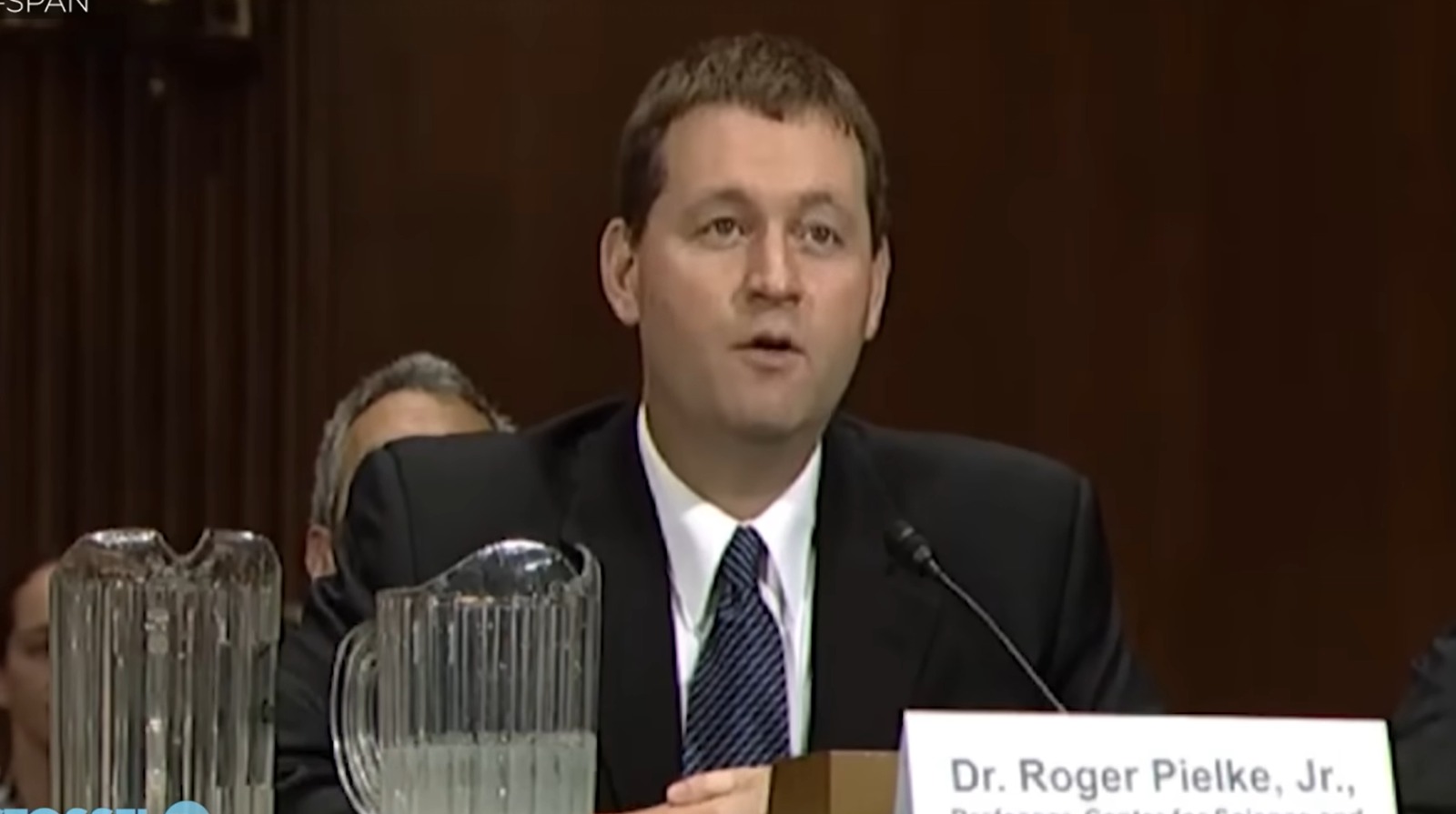
From the video: Pielke testifying before Congress
Clintel Foundation
Date: 21 May 2026
Climate policy researcher Roger Pielke Jr. recently achieved his greatest success. After a long and lonely battle, the IPCC admitted that the most commonly used climate scenarios are unrealistic (see, for example, here: Roger Pielke Jr.: The correction to RCP 8.5 came far too slowly). Pielke had been hammering home this important point for a decade but was, in practical terms, ostracized because of his views on climate change.
In a recent John Stossel interview, Roger Pielke Jr. describes how he was professionally punished despite holding views that he insists are well within mainstream climate science. The video argues that Pielke became a target not because he denied climate change, but because he challenged exaggerated claims linking climate change to extreme weather disasters (in addition to climate scenarios, another topic that Pielke is deeply involved in).
You can see the full video here:
Pielke repeatedly states that he accepts the scientific consensus that greenhouse gases warm the planet and that climate change is real. His work had been respected for decades, cited by the IPCC and praised internationally. However, he disagreed with activists and media figures who portrayed every hurricane, flood, or wildfire as proof of an unfolding climate apocalypse. According to Pielke, the data did not support claims that hurricanes and other disasters had become significantly more frequent or intense beyond natural variability.
Damage
His research focused on the economic damage caused by storms. He argued that rising disaster costs are largely explained by population growth, urban development, and increasing wealth in vulnerable areas. For example, a hurricane striking modern-day Miami would naturally cause far more damage than a similar storm a century ago because there are vastly more expensive buildings and infrastructure in its path. While warmer oceans can contribute to stronger storms, Pielke said the atmosphere is too complex to attribute every disaster trend directly to climate change.
The controversy escalated after environmental activists and progressive organizations decided to emphasize extreme weather as the central public face of climate change. Pielke says this placed him “on the wrong side” because his findings complicated that narrative. He recalls receiving warnings from fellow scientists who told him that even accurate research could be “misinterpreted” as minimizing climate change. Pielke says he refused to alter his conclusions to satisfy political expectations.
The interview describes how organizations associated with the environmental movement then targeted him aggressively. In particular, the left-leaning think tank Center for American Progress and its media arm ThinkProgress allegedly published repeated attacks accusing him of spreading misinformation and misleading the public. Pielke says leaked emails later revealed discussions celebrating efforts to “deplatform” him. He became a public enemy within activist circles despite relying on findings that were also included in IPCC reports.
Obama Administration
The situation intensified after Pielke testified before Congress that long-term disaster data did not show increases attributable to climate change. Following his testimony, officials in the Obama administration publicly attacked him. Stossel highlights that Barack Obama’s science advisor released a lengthy memo personally criticizing Pielke and calling his statements misleading and outside the mainstream. Pielke found this extraordinary because his work was directly supported by established scientific literature.
Soon afterward, members of Congress demanded investigations into whether Pielke and other researchers had secretly received money from fossil fuel companies. Although the investigation found no evidence of improper funding or scientific misconduct, Pielke says the accusation alone severely damaged his reputation. Invitations for speeches disappeared, media coverage focused on the allegations rather than the eventual exoneration, and suspicion lingered despite his vindication.
The most painful consequences, according to Pielke, came from his own university. After years of successful research and millions of dollars in grants, he says the University of Colorado Boulder gradually marginalized him. His research center was shut down, his teaching responsibilities became erratic, administrative support disappeared, and he was eventually relegated to a tiny office crammed with empty filing cabinets. Colleagues were reportedly afraid to defend him publicly because they worried they might also become targets.
Pielke describes the experience as a slow campaign of professional isolation rather than an outright firing. He says university administrators ignored repeated complaints and offered no meaningful explanation for their treatment of him. When he retired after 24 years, he says nobody from the university leadership contacted him.
Eventually, Pielke left academia for the American Enterprise Institute, where he says he now enjoys greater academic freedom than he had during his final years at the university. Despite the ordeal, he insists he was not truly “canceled” because he continued speaking publicly and refused to abandon his views. The interview ultimately presents his story as a warning about ideological conformity, political pressure, and the dangers of punishing scholars who question dominant narratives even while accepting the underlying science.

more news
Press release Clintel Foundation Pope Francis’ Climate Crusade or the erosion of faith in God, a tale of two encyclicals
Press release Clintel Foundation Pope Francis’ Climate Crusade or the erosion of faith in God, a tale of two encyclicals By uncritically embracing climate catastrophism, Pope Francis, perhaps unwittingly and most certainly unwillingly, rejects the God he clearly tries to serve wholeheartedly. That is the main conclusion of the essay Pope Francis’ Climate [...]
The Draghi report: A mistaken vision of the EU’s energy future
In this article, Samuel Furfari critiques Mario Draghi’s report on EU competitiveness, arguing that its narrow energy vision overlooks vital realities and risks undermining Europe’s prosperity.

Net Zero will be a disaster
Net Zero will be a disaster Net Zero policies will have a trivial effect on temperature, but disastrous effects on people worldwide. By William Happer and Richard Lindzen, reposted from CO2 Coalition publications Clintel Foundation Date: 31 July 2024 [...]

