The Economist Acknowledges Benefits of CO2!
The Economist deserves credit for its recent article, which acknowledges that portions of Africa long predicted to suffer relentless desertification due to climate change are becoming wetter and greener, instead. It is refreshing to see a major publication acknowledge correctly that climate change and rising atmospheric carbon dioxide produce benefits for plant life and ecosystems, says Anthony Watts.
Satellite observations have documented substantial greening across the planet for decades, and NASA has reported that rising atmospheric carbon dioxide is a major contributor. The recent article in The Economist (TE), “Climate change is making some African deserts greener,” begins with Lake Chad, once widely portrayed as a poster child for impending climate catastrophe. Drought, along with substantial diversion of water for irrigation, caused the lake to shrink dramatically between the 1960s and 1990s. With global temperatures rising and the Sahara supposedly advancing, the magazine notes Lake Chad “seemed destined to disappear.”
Then something inconvenient happened; rather than disappearing, it started to refill.
TE reports that Lake Chad now contains more water than it has in decades. A World Bank and International Water Management Institute study cited by the magazine found that its open-water area more than doubled after 2012, exceeding 8,300 square kilometers in 2025. Other major African water bodies, including Lakes Victoria, Malawi, Tanganyika, and Turkana, have also risen sharply.
Even more interesting is what is happening on land. TE acknowledges that satellite imagery shows substantial portions of the Sahel becoming greener as formerly parched areas revive. Increased rainfall is certainly an important contributor to the African greening described in the article.
NASA
But there is another major contributor to global greening that deserves considerably more attention: carbon dioxide.
NASA addressed this directly a decade ago in an article with the remarkably straightforward title, “Carbon Dioxide Fertilization Greening Earth, Study Finds.”
Using satellite observations from NASA’s Moderate Resolution Imaging Spectroradiometer and the National Oceanic and Atmospheric Administration’s Advanced Very High Resolution Radiometer, an international team of 32 researchers examined changes in leaf area between 1982 and 2015.
NASA reported that between one-quarter and one-half of Earth’s vegetated land had experienced significant greening during those 35 years. The increase in leaves on plants and trees was equivalent to adding a green area roughly twice the size of the continental United States.
Most importantly, the researchers attempted to determine what was causing it.
According to NASA, their estimates attributed about 70 percent of the observed greening effect to carbon dioxide fertilization. Nitrogen deposition was a distant second at 9 percent, while land-use and climatic changes also contributed.
The mechanism isn’t mysterious. It is basic plant biology.
As illustrated in the infographic below, plants consume carbon dioxide through photosynthesis, greening the planet in the process.
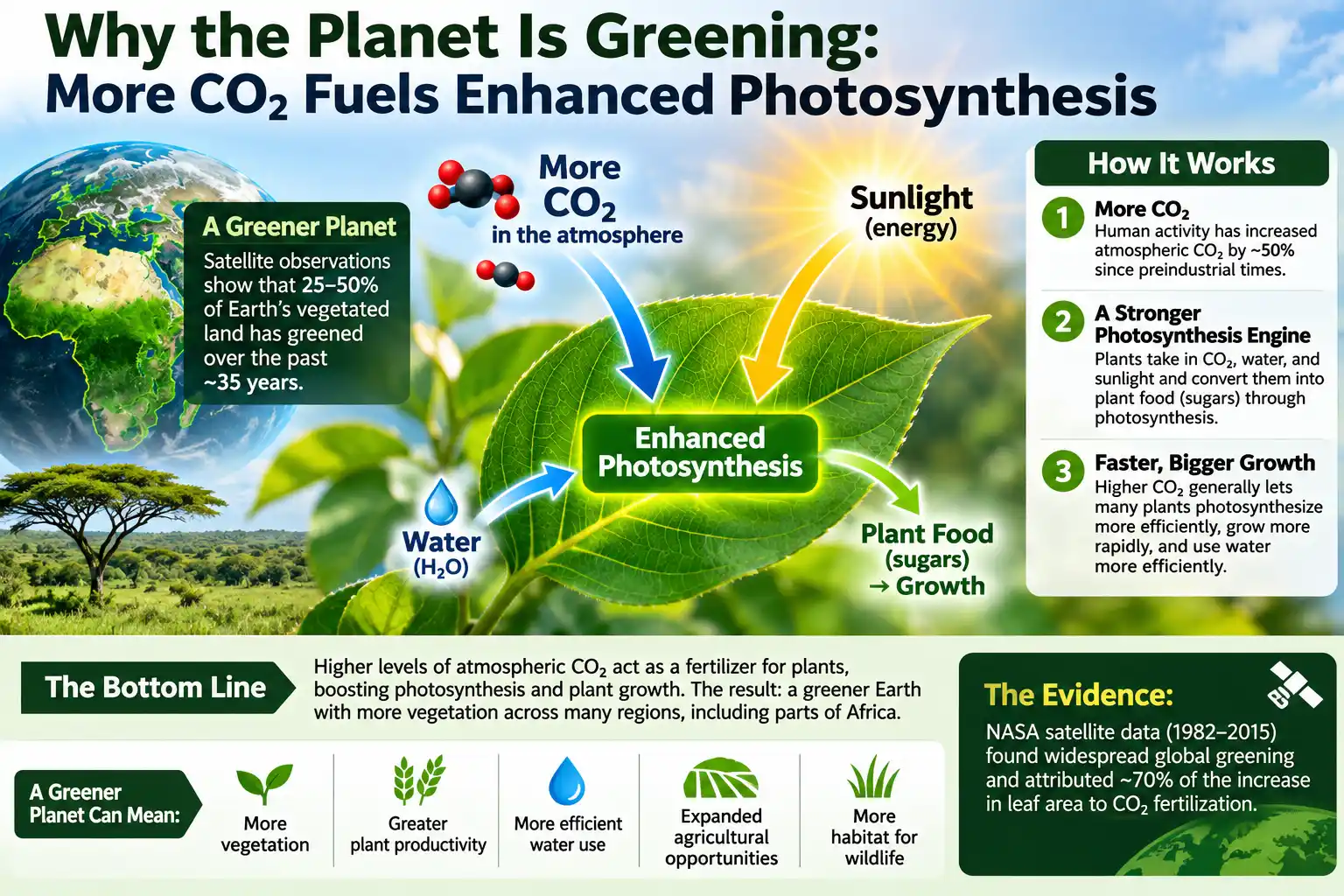
Increasing CO2 concentrations generally allow many plants to photosynthesize more efficiently, grow more rapidly, and use water more efficiently. NASA put it simply: “increased concentrations of carbon dioxide increase photosynthesis, spurring plant growth.”
Climate Realism has discussed this phenomenon. Far from the relentless desertification once predicted, satellite measurements show expanding vegetation in many dryland regions. Research cited by Climate Realism has found substantial greening in the Sahara and Sahel, precisely the region TE is now discussing.
Climate at a Glance likewise documents global greening as one of the measurable benefits associated with increased atmospheric carbon dioxide and recent climate conditions.
This is genuinely good news.
Obligatory climate downside
More vegetation means more potential wildlife habitat, greater plant productivity, improved water-use efficiency, additional forage, and potentially greater agricultural opportunities in places where water has historically been the limiting factor. TE itself acknowledges the possibility of better harvests, increased groundwater storage, expanded drinking-water access, and irrigated agriculture.
But apparently good climate news cannot simply be allowed to remain good news, because TE’s subtitle, all too predictably, goes on to warn:
“That could help farmers but will also bring dangerous floods.”
There it is. The obligatory climate downside.
Certainly, heavy rainfall can cause floods. If a particular region receives substantially more rainfall, especially over short periods, flood risk can increase. Floods can kill people and destroy homes, crops, roads, and infrastructure. Nobody should pretend otherwise.
But increased vegetation does not somehow require a corresponding climate catastrophe, and evidence does not support presenting worsening flooding as an inevitable global consequence of climate change. Indeed, increased plant life should mitigate some flooding since plants intercept rainfall, slow runoff, and increase water absorption. Dense vegetation acts as a natural sponge, allowing water to be processed and beneficially used across landscapes.
Climate at a Glance: Floods notes that the Intergovernmental Panel on Climate Change has expressed low confidence in observed changes in the magnitude or frequency of floods at the global scale. Studies of relatively undisturbed river systems likewise fail to demonstrate a simple worldwide increase in flooding.
Climate Realism has made the same point when discussing African floods and droughts. Africa is enormous, its climate regimes vary dramatically, and alternating periods of drought and heavy rainfall have always characterized large portions of the continent. Individual floods cannot simply be treated as proof of worsening climate change.
Indeed, TE’s own article contains a remarkably candid admission about just how uncertain Africa’s climatic future remains.
Discussing East African rainfall projections, climate scientist Caroline Wainwright tells the magazine:
“It’s not just that we don’t know the magnitude of the future change; the direction of change is also uncertain.”
That sentence deserves more attention than the doom-laden subtitle.
Climate models
TE also admits that climate models predicted East Africa would become wetter even while the region’s important March-to-May rains declined from the mid-1980s until about 2010. Scientists dubbed the disagreement between models and observations the “eastern African paradox.” More recently, those rains have recovered somewhat.
This is precisely why sweeping predictions of Africa’s climate future, especially those based on notably flawed climate models, should be treated cautiously.
For decades, the narrative was that global warming would expand deserts, dry the Sahel, shrink lakes, destroy agriculture, and accelerate desertification. Now rainfall has increased across portions of the Sahel, Lake Chad has expanded, other African lakes are rising, groundwater storage has increased in some areas, and satellites show vegetation spreading across formerly parched landscapes. And all this has happened even as the population has grown.
Those developments should cause journalists to reconsider the certainty with which earlier climate disasters were presented.
Instead, when reality produces an unmistakably beneficial development, the narrative often simply changes from “climate change will make Africa drier” to “climate change is making Africa wetter, and that’s dangerous too.” It’s like a loaded coin toss. Heads, climate change is dangerous. Tails, climate change is dangerous. There is no winning even when there clearly is.
TE nevertheless deserves an attaboy for reporting something Climate Realism has emphasized for years: the planet is greening, including places once predicted to succumb to advancing deserts. TE at least got halfway there, then stopped short with the obligatory unsupported warning of climate danger.
The bottom line is this: Africa is getting greener and water more plentiful. Formerly parched land is supporting more vegetation and lakes are refilling. Importantly, carbon dioxide, the molecule routinely portrayed only as pollution, is driving these beneficial ecosystem changes.
Sometimes good climate news really is good news, even if The Economist does try to tamp the celebratory mood down a bit.
This article was first published on ClimateRealism on 23 November 2026.

Anthony Watts
Anthony Watts is a senior fellow for environment and climate at The Heartland Institute. Watts has been in the weather business both in front of, and behind the camera as an on-air television meteorologist since 1978, and currently does daily radio forecasts. He has created weather graphics presentation systems for television, specialized weather instrumentation, as well as co-authored peer-reviewed papers on climate issues. He operates the most viewed website in the world on climate, the award-winning website wattsupwiththat.com.
The article you have just read was made possible by our donors.
Every day, Clintel publishes articles on climate, energy and science. We also translate and share international analyses in multiple languages, produce videos, publish reports and organize conferences and events around the world.
We receive no government funding and rely entirely on the support of our donors. Your support helps us promote independent research and contribute to a more open and balanced debate on climate and energy issues.
Would you like to support our work? Choose the option that suits you best:
• Become a Friend of Clintel – support us with an annual contribution
• Make a recurring donation – provide ongoing support and help us plan ahead
• Make a one-time donation – every contribution helps
Thank you for your support.

more news

COP31 Collides with Dangerous New “Stop Fossil Fuel” Movement
The Transitioning Away from Fossil Fuels (TAFF) movement is now firmly established as a major and dangerous force in international climate policy, says David Wojick.

COP31 Ends in a Trainwreck
For the first time in years there was no final agreement to announce at the end of a COP meeting. Jo Nova reflects on the failure of COP31. “The UN plan to advertise and promote more Chinese wind and solar products isn’t working this week.”
Absurd Climate Attribution ‘Science’: 0.00072 °C Kills 30 Million Corals?
Scientist Peter Ridd has taken aim at the “last frontier of climate pseudoscience”: attribution science. Questionable data are being used to build legal cases against fossil-fuel projects, like the proposed $100 billion Browse gas project (Woodside). The legal case rests on a claim that the Great Barrier Reef data have already disproved. The crucial question is whether Woodside will actually have the courage to defend the case on scientific grounds.