
America’s Irreversible Goodbye to Climate Governance
The United States’ relationship with international climate institutions has become increasingly unstable. In this article, Samuel Furfari argues that the latest move goes beyond political symbolism and represents a structural break with the system of global climate governance built around the UNFCCC.

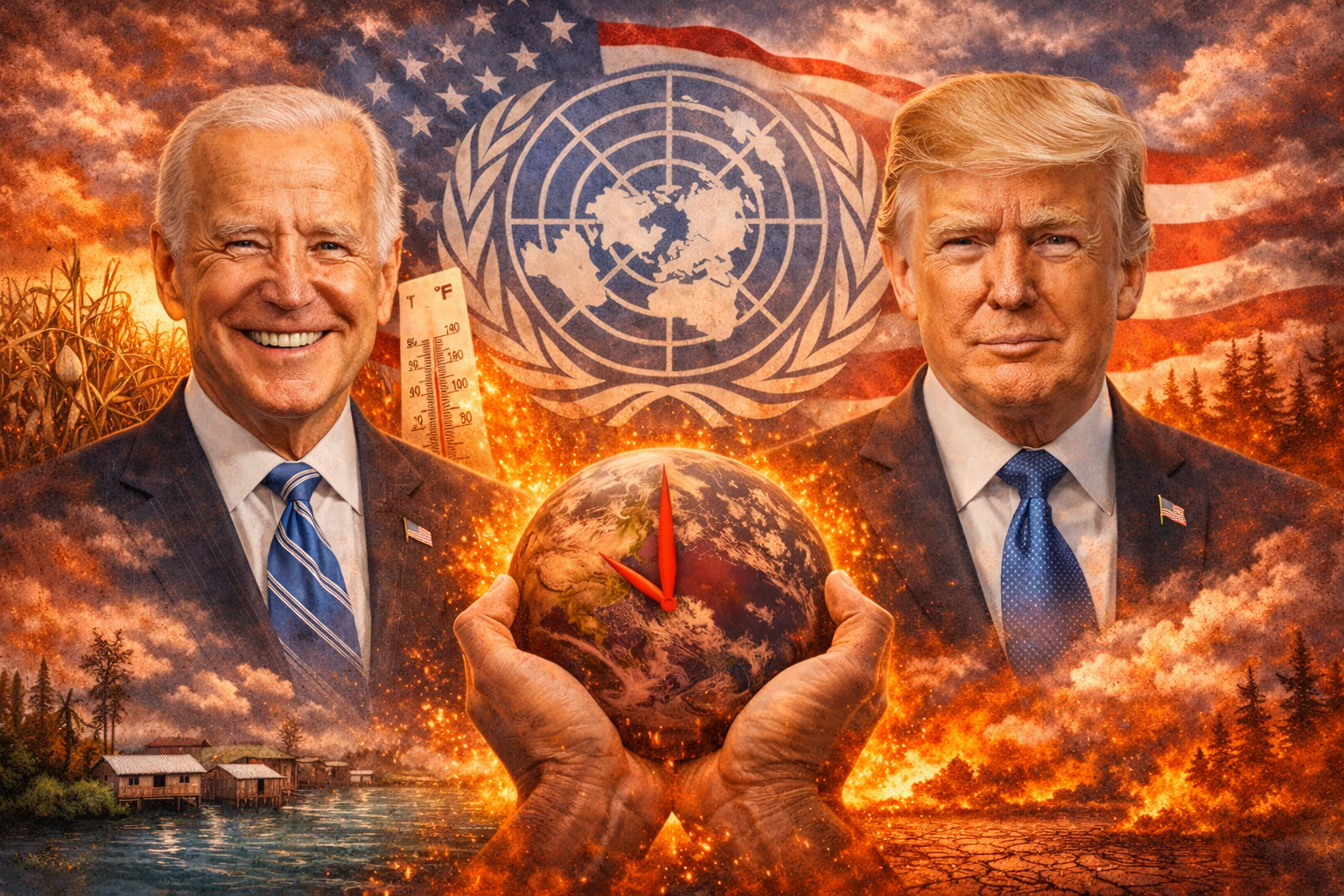
Illustration created with ChatGPT
Samuel Furfari
Date: 10 February 2026
On January 7, President Donald Trump signed an executive order to withdraw the United States from 66 international organizations deemed “redundant, poorly managed, unnecessary, costly, ineffective,” or instruments of America’s adversaries. Among them are various United Nations agencies and, most significantly, the Intergovernmental Panel on Climate Change (IPCC) and the1992 United Nations Framework Convention on Climate Change (UNFCCC), the backbone of global climate governance.
During his first term, President Trump removed the U.S. from the Paris Agreement, using its withdrawal clause. But a newly elected President Joe Biden promptly returned the nation to the agreement in 2021, making it a central gesture of his climate diplomacy. The episode exposed the fragility of international climate policy: A simple change in administration could send the U.S. in or out of the agreement, rendering global climate commitments mere extensions of domestic, partisan politics.
A Structural Break in U.S. Climate Policy
This time, however, there is a degree of permanence to the change. By targeting the UNFCCC itself, the Trump Administration has dismantled the legal framework that made possible reversal by a simple executive decree.
Adopted under the 1992 Convention, the Paris Agreement is built on the institutional architecture of the UNFCCC, whose bodies provide necessary support. These include the Conference of the Parties, the secretariat, and a system for financial contributions.
Paragraph 3 of Article 28 of the Paris Agreement reads as follows: “Any Party that withdraws from the Convention shall be considered as also having withdrawn from this Agreement.” By leaving the Framework Convention, Washington severs the link that allowed Biden’s reentry into the Paris Agreement. Trump’s withdrawal is structural, not tactical.
The Legal Framework Behind the Withdrawal
The key precedent insulating Trump from a Supreme Court challenge is Goldwater v. Carter, in which the high court in 1979 declined to review President Carter’s unilateral termination of a mutual defense treaty with Taiwan, effectively strengthening executive authority over withdrawals.
In practice, a president, therefore, can withdraw from a treaty without a clear judicial avenue to stop him. The Trump Administration sits in a legally comfortable position: Opponents have no leverage to undo the move, and seeking a new Supreme Court ruling risks establishing further executive power over treaty termination.
How the Paris Agreement Was Designed to Be Reversible
Democrats are paying the price for designing Paris to avoid Senate ratification. Knowing they lacked a two-thirds majority, the Obama administration insisted on voluntary, non-binding contributions and targets, which ensured Paris would rest on a reversible presidential signature rather than durable treaty law.
The Trump Administration has fully absorbed these lessons. During his first term, Trump withdrew only from the Paris Agreement, leaving the UNFCCC intact and allowing his successor to rejoin easily. This time, Trump’s action is far more radical: By targeting the Framework Convention itself, Trump deprives future presidents of convenient diplomatic back‑and‑forth. Politically, the message is clear: Washington increasingly views climate diplomacy as an instrument of external constraint, beneficial to America’s strategic competitors, a burden on U.S. industrial competitiveness and costly.
Formally, the U.S. could rejoin the UNFCCC, but politically it would now require a level of consensus that no longer exists. Approved in 1992 with faith in a painless energy transition, the Convention today confronts economic and geopolitical realities that expose prior illusions and make revival unlikely any time soon.
Implications for European Climate Strategy
What are climate true believers in the EU supposed to do now? One question rarely voiced publicly in Brussels, Strasbourg or Berlin: How long will the European Union persist in a climate strategy that no longer meaningfully binds either the United States or emerging nations beyond benevolent declarations?
The EU continues to lock itself into ever more ambitious targets (90% CO2 reduction by 2040 compared to 1990), while eroding its industrial base, deepening its dependence on China, and widening the gap between rhetoric and the reality of global emissions.
Instead of ritual denunciations of Trump, European leaders should ask this question: If the world’s leading economic and military power no longer wants to be trapped in a U.N.‑led climate architecture, isn’t it time for the EU to reassess its own commitments with clear eyes?
The wrong answer will leave Europe discovering too late that it has sacrificed its prosperity and strategic autonomy to a climate lunacy abandoned by its closest – and most consequential – allies.

This commentary was first published at National Review February 7.

Dr. Samuele Furfari
Dr. Samuele Furfari is a professor of energy geopolitics in Brussels and London, a former senior official with the European Commission’s Directorate-General for Energy and a member of the CO2 Coalition. He is author of the paper, “Energy Addition, Not Transition,” and 18 books, including “Energy Insecurity: The organised destruction of the EU’s competitiveness.”

more news
New York Times admits: global climate policy has failed
The World Comes to Its Senses The New York Times heralded the end of climate policy with a lengthy lament by David Wallace-Wells entitled “It's not just the US—the whole world has had enough of climate policy". The article seems like an unintended admission that the era of the Paris Agreement is [...]
Crisis or hoax?, a new book by former Dutch parliamentarian
Crisis or hoax?, a new book by former Dutch parliamentarian In Crisis or Hoax?, earth scientist and former Dutch parliamentarian Jules de Waart critically examines the IPCC's CO2-driven climate change narrative, arguing the science is unsettled and lacks robust evidence. Drawing on his expertise in climatology and political science, he challenges the [...]

The Tide is Turning Decisively Against Net Zero
The Tide is Turning Decisively Against Net Zero The cracks in the climate industrial complex are no longer hairline fractures; they are gaping holes, writes Tilak Doshi. Even some former apostles of the green faith, such as former UK Prime Minister Tony Blair, now admit that phasing out fossil fuels is “doomed to [...]

