
Australia wakes up to brown coal bonanza: 1,000 years of energy
Finally, we see a few key topics hitting the media in Australia, says Jo Nova. National Party leader Canavan even talks about the thousand-year supply of brown coal, and also about a method of turning coal to liquid fuel.

What a difference an oil war makes…
Five weeks after it started, suddenly Australians are noticing the bonanza under our feet all along.
That most hated thing, the unthinkable brown coal, could save the day if we would only stop beating it down with blunt sticks and Voodoo dolls.
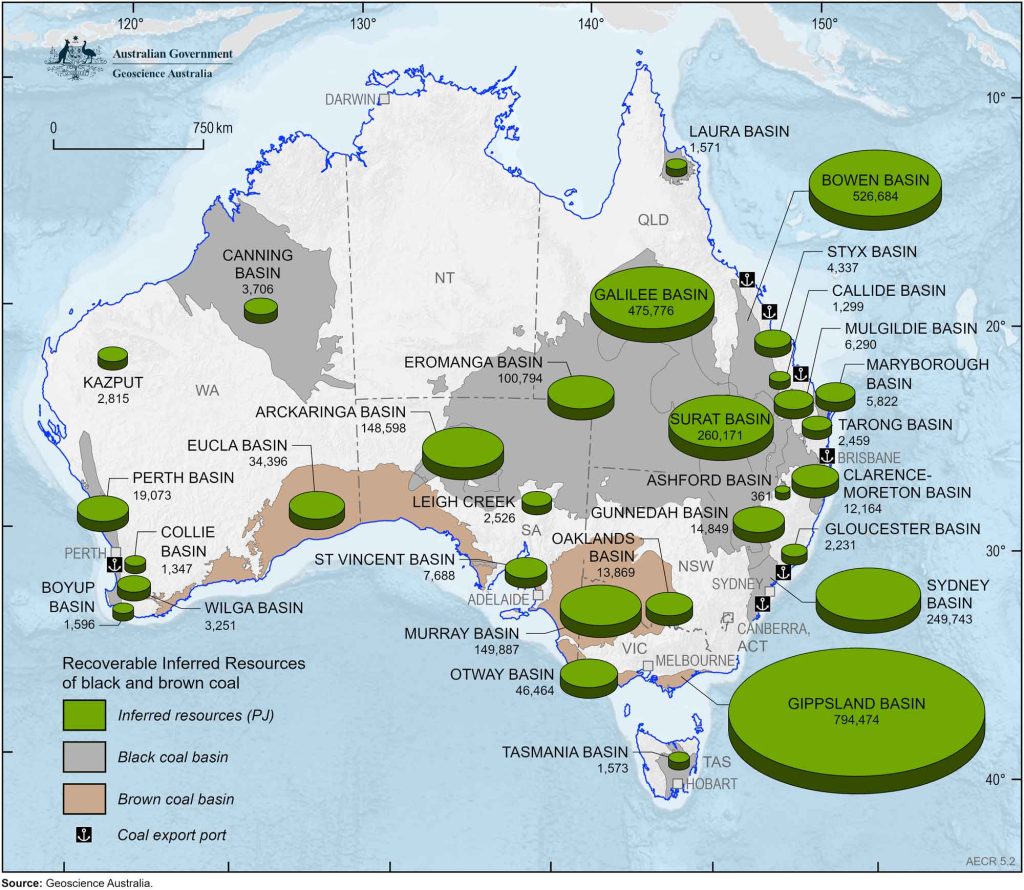
In 2016 Geoscience Australia estimated we have so much brown coal we could keep burning the deposits we already know about at the current rate for our whole lives, and our children’s lives, and their children’s lives too. We could keep going for 40 generations.
“Australia’s recoverable brown coal EDR did not change during 2016. The majority is located within the Latrobe Valley (Victoria). At 2016 production levels, Australia’s recoverable brown coal EDR is expected to last more than 1000 years.”
We burned it to make electricity all year in 2016 but the total amount was so insignificant no one counting national resources could even notice.
Look at the size of the Gippsland Basin deposit. It’s almost like God has a sense of humour putting all that in there so close to socialist HQ.
Brown coal is the cheapest fuel there is for reliable electricity, bar none, but even more importantly, it can be turned into liquid fuels, which Australia desperately needs for trucks, tractors, and mining gear. We need to be able to pour our energy into a tank at room temperature and pressure, and in five minutes flat.
It’s great to see National Party talking about the thousand-year supply, and also about a new method of turning coal to liquid fuel. Do the Liberals have enough gumption to even follow The Nats?
Australia’s coal and uranium reserves would power Australia “for over 1000 years”, Nationals leader Matt Canavan claims
— By Abisha Sapkota and Nathan Schmidt, The Australian
However, 95 per cent of that energy was “locked up in coal and uranium”, Senator Canavan said. “Two things the Labor Party doesn’t like to use,” he said. “In the short term, we need to use the coal and gas we export to these countries in North Asia as a bargaining chip to get liquid fuels.”
In the medium term, the Nationals are urging for the adoption of “coal to liquids” technology, Senator Canavan said, that would turn coal into liquid fuel.
The Nationals also want to get rid of the SafeGuard mechanism (Hallelujah!)
Introduced in July 2023 and reformed in 2023, the [Safeguard] policy requires facilities that emit more than 100,000 tonnes of carbon dioxide to keep net emissions below set limits. It’s a policy to assist Australia to reach net zero by 2050.
“Refineries are covered by the safeguard mechanism, which is designed to put refineries out of business,” [Matt Canavan] said. “OK, that’s what it’s there for, so get rid of that.”
David Archibald has been pointing out the benefits and ways to do coal-to-liquid programs for more than ten years.
There are two choices in coal liquefaction processes: Bergius and Fischer-Tropsch, both invented in Germany in the 1910s. In the Bergius process, hydrogen is forced into coal molecules at a temperature of 450˚C and a pressure of 170 kg/cm2. The Fischer-Tropsch process burns coal in pure oxygen to produce a synthesis gas that is catalysed to long chain hydrocarbons in an oil bath. Bergius is the better process. In WW2, German synthetic fuel production was dominantly via the Bergius process…
For self-sufficiency in liquid fuels, we need 33 Bergius plants producing 30,000 barrels per day at a cost of $4.6 billion per plant for a total outlay of $152 billion. Somehow we have run up a national debt of $1 trillion in the last 25 years and have nothing to show for it. Building the coal liquefaction plants we need will be an enormous benefit by comparison. We can do it.
Bergius plants are the near-term solution. Longer term it will always be nuclear…
Finally, we see a few key topics hitting the media. Things that should have been discussed 10 years ago.
Brown coal could fill an awesome gap in our national energy profile. Imagine we could make all the diesel, jet fuel and petrol we needed yet we were not doing it because we were afraid of 0.0001% more beach-weather a century from now?
China is already converting 400 million tons of coal each year and we’re afraid to copy that because some teenage girls will cry?

This article was published first on joannenova.com.au on 2 april 2026

Jo Nova
Jo Nova is science presenter, writer, speaker & former TV host; author of The Skeptic’s Handbook.

more news

New study finds low CO2-sensitivity again
A new paper by Frank Stefani compares solar variability and CO₂ emissions as drivers of global sea surface temperatures. Using the solar aa geomagnetic index alongside CO₂ data, the study estimates a transient climate response (TCR) of about 1.1–1.4 K, near the lower end of the IPCC range. The results align closely with other observation-based estimates and highlight the continuing scientific debate about the relative roles of solar activity and greenhouse gases in recent climate change.

Clintel Ambassador Ian Plimer on popular Triggernometry podcast: “Climate science is the biggest cult in scientific history”
Clintel-ambassador for Australia, prof. Ian Plimer, didn’t hold back in his recent interview on the popular Triggernometry podcast: “There’s a very large body of people out there who are actually using science to promote scams. It’s absolutely crippling Western countries. You can’t run an industrial society on sea breezes and sunbeams.”

Groundbreaking New Paper Challenges Foundation of Climate Change Assessments, Revealing Fatal Flaws in Ocean Heat Content Measurements
An international team of scientists has published groundbreaking research revealing that the primary measurement used to support claims of planetary “warming” is fundamentally flawed and scientifically invalid.

