
Beyond the Climate Change Consensus
Report from The International Conference of the Hungarian Academy of Sciences, Budapest by Demetris Koutsoyiannis

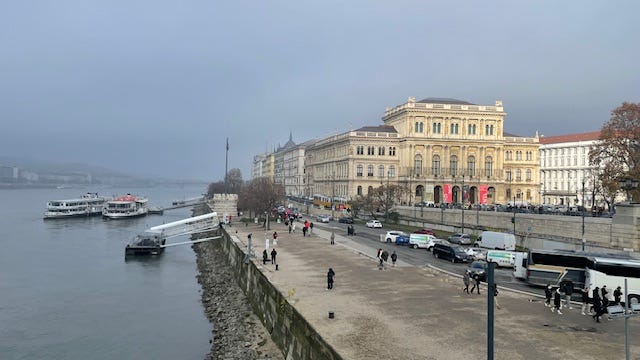
The building of the Hungarian Academy of Sciences, by the Danube River
(photo: courtesy of Wim Röst).
Demetris Koutsoyiannis
Date: 10 December 2025
The Hungarian Academy of Science is closely linked to climatology as it is the place where the greatest climatologist in history, Milutin Milanković, developed his theory. Nb., I use the traditional term climatology for the science of climate, as I dislike the postmodern term climate science, which in essence means climate sophistry.
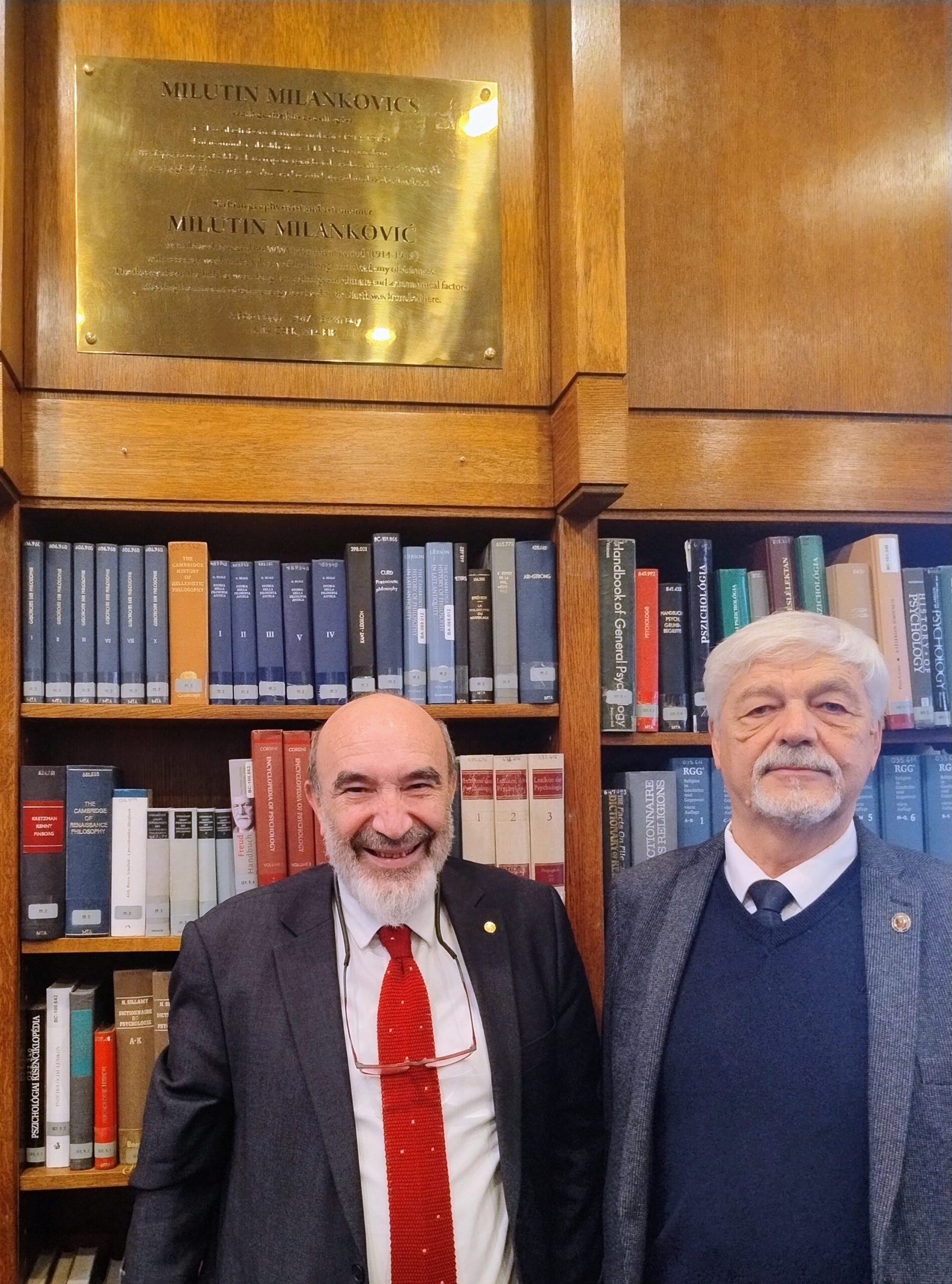
My humble self with the initiator of the event, Prof, László Szarka, below the plaque devoted to Milutin Milanković in the Library of the Hungarian Academy of Sciences. The inscription reads as follows: “Serbian geophysicist and astronomer Milutin Milanković was allowed to spend his WWI internment period (1914-1918) with research work in the Library of the Hungarian Academy of Sciences. The theory about the link between long-term changes in climate and astronomical factors affecting the amount of solar energy received at the Earth was founded here.”
It was the first time that I visited Hungary, even though I have great esteem for it and its people. I regard Hungarians as an exception within the decaying European Union. My visit not only confirmed my opinion, but also enhanced it. I was particularly impressed by Budapest, a city that has retained the grandeur it had before the war. They have repaired the buildings destructed in the WWII war in their original form. They keep the old European traditions, one sign of which (favouring my humble self) is that they respect the old men. For example, we oldies are allowed to use public transportation without a ticket…
The Chairman of the conference, Prof. Gábor Náray-Szabó, made it clear that the Academy is faithful to the “orthodox” climate dogma, except for one academician shown in the photo above. Nevertheless, the Academy embraced an event intended to present contrasting views on climate change. Initially, the plan was for an event with a debate between opposing sides (”blue-red”), but, as I was informed, the Earth Sciences Section did not accept the idea. Not a surprise for me, of course. Climate zealots are incapable of engaging in any kind of scientific dialogue — probably because it would expose their scientific nakedness.
My presentation in the conference can be downloaded from below or from the web site of the Itia research team.
The main points I presented are summarized in my climate decalogue, which comprises the main results of my recent research. Note that I use the term decalogue with the original Greek meaning, with δέκα meaning “ten” and λόγος meaning “rational considerations” (not to be misinterpreted as “ten commandments” which is the usual meaning in English).
- Climate change is real —and climate crisis too (but only in politics).
- Climate change has been real throughout Earth’s entire 4.5-billion-year history.
- Climate crisis is a purely political issue, with no relationship to the real world.
- There is no greenhouse effect (GHE), nor greenhouse gases (GHG), in the atmosphere.
- These are misleading terms, whose real meanings are “atmospheric radiation effect” (ARE) and “radiatively active gas” (RAG), respectively.
- The ARE mostly depends on the temperature gradient in the atmosphere.
- At the equilibrium (an isothermal atmosphere) the ARE is zero.
- In case of temperature inversion, the ARE results in cooling, not warming of the Earth.
- In the standard atmosphere (with gradient of 6.5 K/km) the ARE is dominated by H₂O (water vapour and clouds).
- CO₂ is playing a very minor role (quantified at 4-5%).
- The century-long observations of longwave (LW) radiation show no change in the ARE.
- The substantial increase of atmospheric [CO₂] did not give a discernible signal.
- There is no proof that the increase of atmospheric [CO₂] causes temperature increase.
- On the contrary, paleoclimatic and modern observational data support the reverse causality as the increase of temperature happens before that of [CO₂].
- Climate models suggest a causality direction opposite from that seen in the data.
- The carbon balance in the atmosphere is dominated by natural processes.
- Human CO₂ emissions (by burning fossil fuels etc.) are only 4% of the total.
- The increase of temperature resulted in substantial increase of natural CO₂ emissions.
- The isotopic carbon data (δ¹³C, Δ¹⁴C) show changes in the isotopic synthesis of atmospheric CO₂, but no sign of human influence.
- They show that the changes seen are driven by natural processes.
- The dynamics of atmospheric CO₂ can be recovered from natural processes only.
- Multiple evidence confirms a residence time of atmospheric CO₂ at 4 years, despite “climate science” longer estimates reaching thousands of years.
- Temperature increase in the 21st century is consistent with changes in the solar (shortwave—SW) radiation absorbed by the Earth.
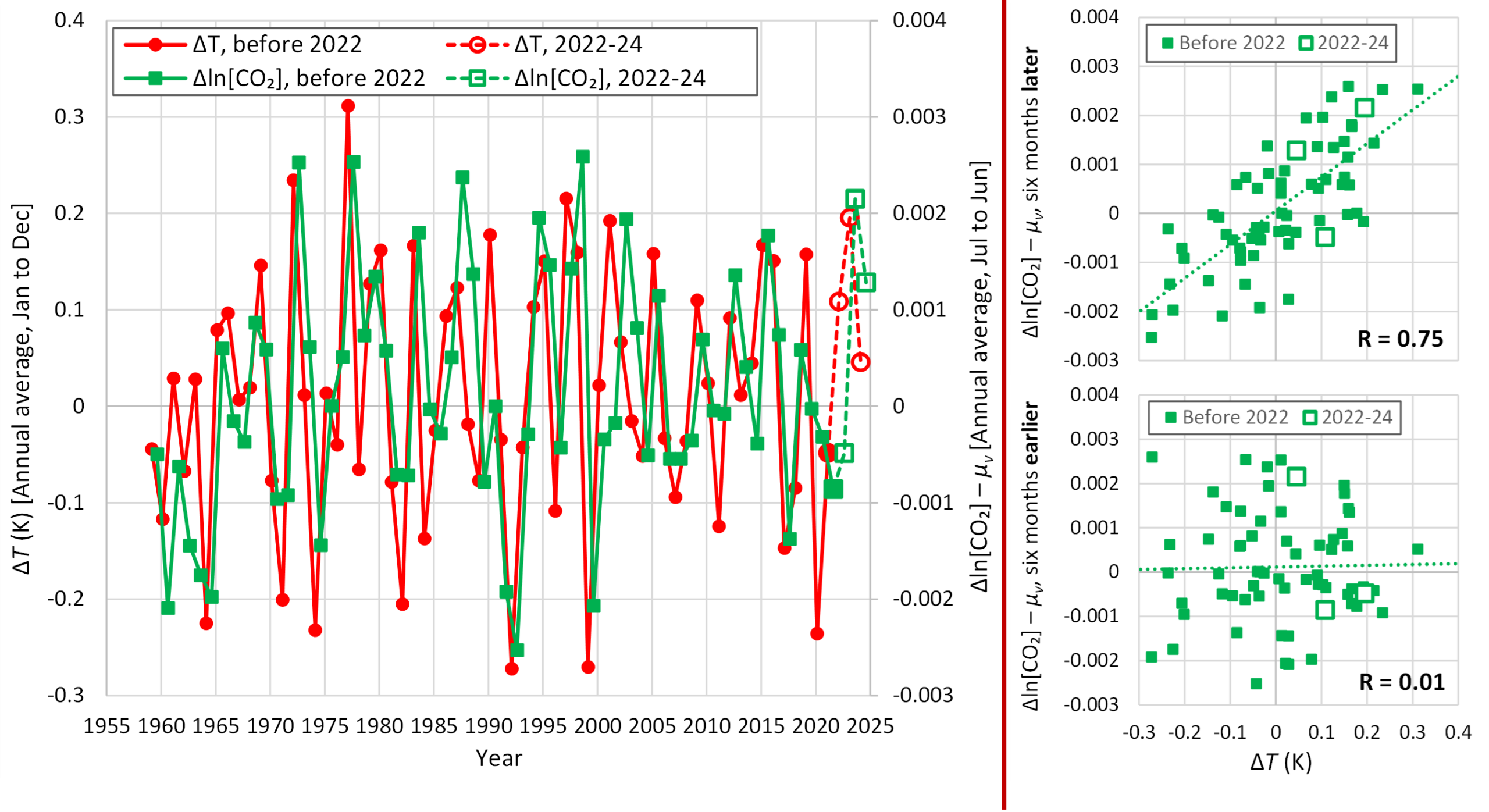
My presentation contains several original points, not found in my previous publications. One interesting addition is that shown in the graph below, where I have added the observations of the last three years to the graphical abstract of the 2023 paper:
D. Koutsoyiannis, C. Onof, Z. W. Kundzewicz, and A. Christofides, On hens, eggs, temperatures and CO₂: Causal links in Earth’s atmosphere, Sci, 5 (3), 35, doi:10.3390/sci5030035, 2023.
It can be seen that these newer observations are fully consistent with what we wrote almost three years earlier.
The concluding remarks of my presentation are the following:
Human CO₂ as the climate control knob is empirically untenable once we properly account for:
- natural CO₂ fluxes (∼25× larger);
- the effect of H₂O (vapour + clouds, ∼20× larger);
- the huge complexity of the climate system, including the biosphere’s role.
Climate models are in disagreement with observation while reversing cause and effect.
In complex systems, data are sovereign — and data have falsified the mainstream climate theory.
The emission-centric paradigm was a political project that conscripted science to provide authority.
“Climate science” is therefore not just corrupted science — it is purpose-built instrumentation wearing the lab coat of science while abandoning its method.
Scientists’ job is to kill bad theories and rip science back from politics — not posture as saviours of the planet.
PS. Dedicated to my beloved wife Annouska. Today is her name day, and it’s the first time after 42 years that we do not celebrate it as I don’t have her any more…

This report was previously published on Demetris Koutsoyiannis’ CLIMATH substack.

Demetris Koutsoyiannis
Professor emeritus of Hydrology and Analysis of Hydrosystems at the National Technical University of Athens. Rich experience in teaching, research, administration, and engineering. Good connection with reality thanks to the village where he was born.

more news
Clintel at Heartland Conference: new terminology in climate debate needed
At the Heartland Conference in Washington, D.C., Clintel highlighted new perspectives on climate science, including the benefits of CO₂-driven global greening and the need for a renewed vocabulary in the climate debate, as presented by Marcel Crok.

Coal, The Fuel We Ignore But Cannot Replace
If you think coal is a thing of the past…then you are missing the big picture, which is far more complex and far more relevant than most headlines suggest, says energy expert Lars Schernikau.
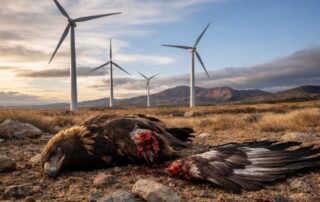
The ‘green’ transition is running red with the blood of animals
We must stop the reckless expansion of low-density energy projects (wind and solar) in valuable ecosystems, says Vijay Jayaray. The ‘green’ transition is running red with the blood of the creatures we are supposed to protect.

