
“Bringing youth into the climate realist fold”
At the recent Heartland Conference, there was a special session called Bringing youth into the climate realist fold. How are younger generations engaging with climate issues and shaping the future conversation? Two interesting speakers were Lucy Biggers, who used to hang out with Greta Thunberg, and Chris Martz, who has been called the ‘Anti Greta Thunberg’.

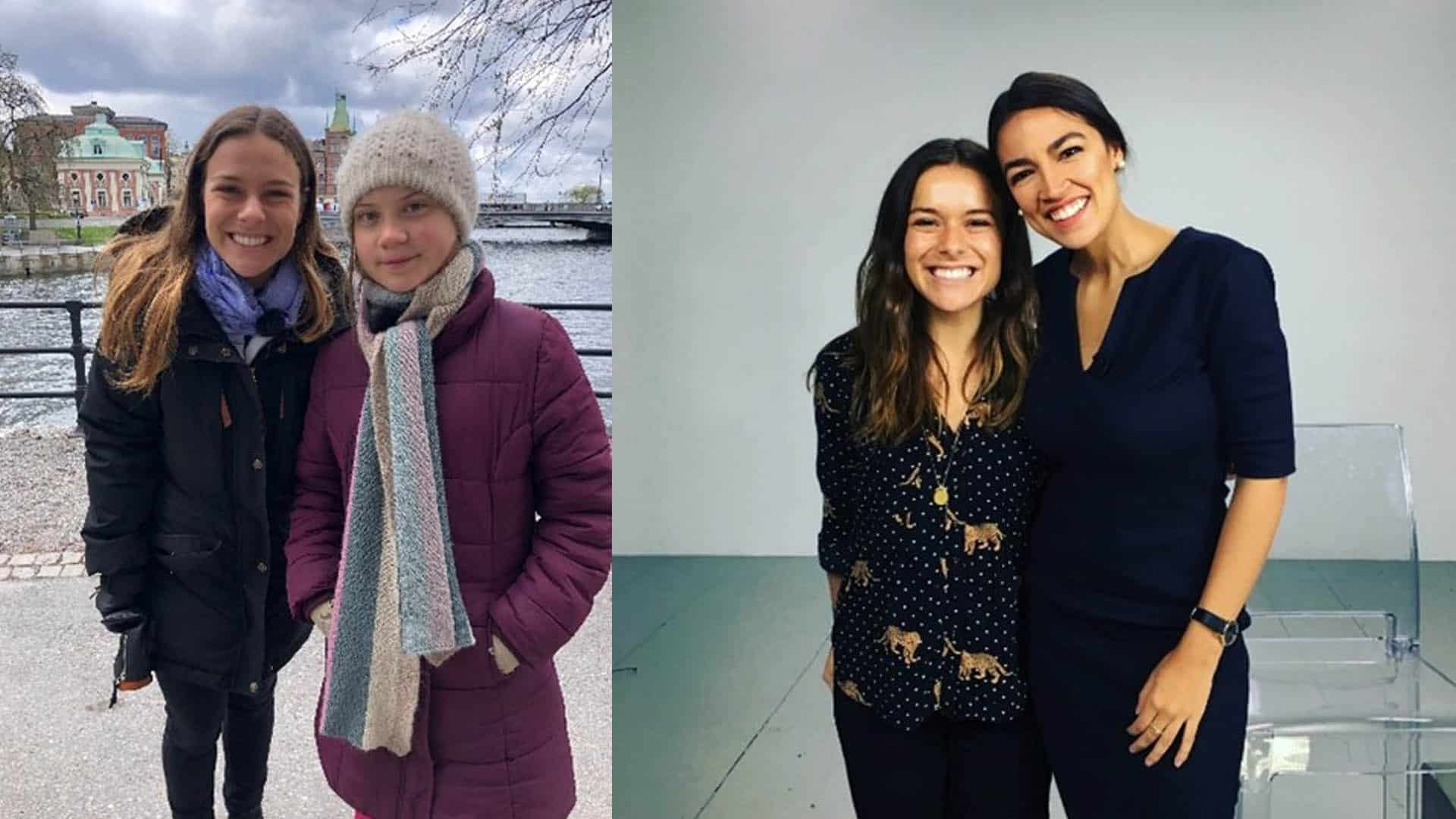
Lucy Biggers with Greta Thunberg and AOC. (Source: The Free Press)
Peter Baeten
Date: 21 April 2026
At the recent Heartland Conference, young climate realists Linnea Lueken, Chris Martz, Lucy Biggers, Emma Arns and Anika Sweetland discussed how younger generations are engaging with climate issues and shaping the future conversation. Interestingly, it was the only session of the Conference to be disturbed by climate protesters.
You can see the full presentations and discussions below. Two very interesting speakers were Lucy Biggers and Chris Martz. They gave the first two presentations.
Lucy Biggers
Until a few years ago, Lucy Biggers (35) was deeply involved in the climate movement. She even hung out with Greta Thunberg and worked with the pro climate Democratic congresswoman Alexandria Ocasio-Cortez (better known as AOC). Her ‘coming’ out took place in May 2024 with an extensive article in The Free Press, where she is head of social media now.
In her talk at the Heartland Conference, Lucy Biggers outlines her personal and ideological journey from climate activist to a critic of what she perceives as dominant climate narratives. She explains that she was initially fully aligned with mainstream portrayals of climate change, both in terms of urgency and framing. Within these environments, she says, there was little room for questioning the prevailing perspective. As she puts it: “I was completely immersed in that worldview.”
She further discusses the social dynamics within activist and media communities. According to Biggers, there is often implicit pressure to conform to dominant viewpoints, which can discourage open debate and critical inquiry. She frames this not necessarily as intentional suppression, but as a byproduct of groupthink and institutional culture. As she puts it: “There’s a lot of pressure to stay in line.”
Over time, however, she began to experience doubts. These doubts arose when she noticed that certain information was omitted or presented in overly simplified ways. More complex data or alternative viewpoints, she argues, were often excluded from the narratives she helped create. This led her to feel that the public conversation was not as complete or transparent as it could be. In her words: “I started noticing what wasn’t being said.”
A key turning point in her story came when she encountered alternative sources and experts who challenged mainstream climate models or policy approaches. She emphasizes that her shift in perspective was gradual rather than sudden. She began asking questions about underlying assumptions, data interpretation, and how uncertainty is communicated.
Emotion
Another central theme in her talk is the role of emotion and narrative. Biggers argues that fear has become a powerful driver in climate communication. While she acknowledges that urgency can be important, she suggests that reliance on fear-based messaging can lead to exaggerated or one-sided portrayals. As she states: “Fear is a very powerful tool.” She warns that this approach may ultimately undermine public trust, especially if predictions are perceived as overly absolute or fail to materialize as expected.
In the final part of her talk, Biggers reflects on her current stance. She does not present herself as someone who denies climate change, but rather as someone advocating for greater nuance, transparency, and open discussion. She stresses the importance of acknowledging scientific uncertainty and incorporating a broader range of perspectives in policymaking. She encourages both journalists and the public to engage in more critical thinking.
Chris Martz
Another speaker at this panel session was Chris Martz (23). Last year, Chris became the 2000th signatory of Clintel’s World Climate Declaration (WCD). He is a young meteorologist known for his outspoken views on climate science through his influential presence on the social media platform X. Martz built a substantial following on X with a viral post (a must read in which Martz explains his journey) garnering 30,000 likes and more than 2.5 million views. His candid posts challenging mainstream climate narratives have made him a polarizing figure (the New York Post called him the Anti Greta Thunberg), particularly among peers during his undergraduate years at Millersville University.
In his presentation at the Heartland Conference, Chris Martz, reveals that he, like Biggers, was on the other side of the climate fence when he was younger. Now, he positions himself as part of a younger generation challenging what he sees as exaggeration and misinformation in climate discourse.
Martz begins by emphasizing his background as a meteorologist and his early engagement with climate discussions online. He frames his role as someone who independently analyzed climate data and became skeptical of widely circulated claims. He stresses that his conclusions were not politically motivated but emerged from examining empirical evidence. As he puts it: “I started looking at the data for myself.”
Martz also addresses the role of media and social platforms in shaping climate narratives. A recurring theme throughout his talk is the idea that uncertainty is underrepresented in mainstream climate communication. Martz argues that scientific uncertainty is often downplayed in favor of more definitive statements, which can mislead the public about the level of consensus or confidence in specific claims. He emphasizes the importance of acknowledging limitations in data and models. As he puts it: “There’s a lot more uncertainty than people are told.”
Social dynamics
In addition to scientific arguments, Martz also touches on the social dynamics of the climate debate. He describes experiencing criticism and pushback for his views, particularly as a young voice challenging established narratives. But Martz also positions himself as part of a broader movement of younger individuals questioning dominant climate messaging. He frames this as a positive development, arguing that open debate and critical thinking are essential for scientific progress. He encourages the audience to examine data independently and to be cautious of claims that are presented with excessive certainty.

more news

The greenlash is here: Britain cannot afford Net Zero and democracy at the same time
The Net Zero revolution was supposed to save Britain. Instead, it’s breaking it. As the country plunges into an energy affordability crisis, even Westminster insiders are starting to question whether the grand green experiment has gone too far.
Dr. Michael Connolly (1949-2025)
Last month, on August 25th, 2025, CERES co-founder, Dr. Michael Connolly, unexpectedly passed away. He is survived by his wife, Dr. Imelda Connolly, their four children – Stephen, Ronan (also a CERES co-founder), Orla and Leona – and six grandchildren.
The Great UN Climate Con
The United Nations Framework Convention on Climate Change (UNFCCC), signed at the Rio Earth Summit on June 12, 1992, is not just another communiqué.

