
Climate Models Have Greatly Overstated Greenland Meltwater Runoff.
A new paper in Nature Communications exposes a major flaw in how climate models simulate Greenland’s runoff.

Cap Allon
Date: 2 October 2025
For decades, once seasonal snow melted, models assumed the exposed “bare ice” was impermeable—so every drop of meltwater was credited directly to the sea.
Field evidence now shows that assumption is wrong. Much of Greenland’s bare ice is porous, with a near-surface “weathering crust” that stores meltwater during the day and refreezes it at night. This overlooked process reduces actual runoff well below model output.
The study tested the idea in southwest Greenland—a sector that produces a large share of the ice sheet’s surface melt—using in-situ discharge measurements and two process models. One (“SkinModel”) emulated the standard impermeable-ice assumption. The other (“IceModel”) incorporated subsurface heating, porosity, and refreezing.
IceModel aligned with real-world discharge; SkinModel and existing regional models did not.
Multiple lines of evidence point to the same conclusion. Field discharge data show that supraglacial runoff has been overstated by 21–58% in peak summer. Satellite gravity (GRACE) indicates runoff-driven mass loss was exaggerated by 21–47%, while altimetry shows surface thinning overstated by 14–40%. Supraglacial lake infill rates near the snowline reveal even larger biases, in the range of 58–81%.
Gigatonnes
In southwest Greenland alone, between 11 and 17 gigatonnes per year of meltwater were retained and refrozen in bare ice between 2009–2018—around 9–15% of that sector’s modeled runoff. Extending the melt season raises the estimate to ~17 Gt. Since more than three-quarters of Greenland’s modeled runoff originates in bare-ice zones, this missing physics is not a minor detail—it is central.
The mechanism plays out like this: Daytime sunlight penetrates about a meter into impurity-laden bare ice, creating a water-saturated layer with measured density around 681 kg/m³—far below the 900 kg/m³ assumed by modern models. With horizontal water flow very limited, much of this liquid persists until evening, when surface air often drops to -5 to -6 C. At that point, refreezing rates approach 1 mm per hour, locking in meltwater that models had already counted as runoff.
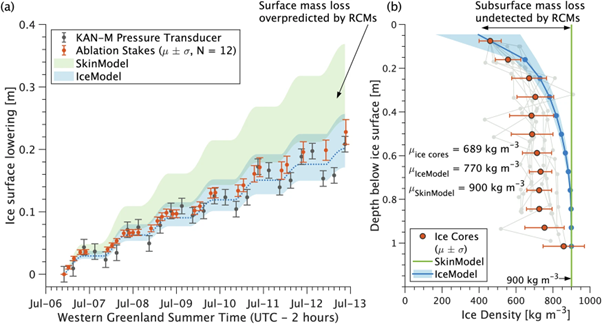
Figure: Field data versus models. Observations in southwest Greenland show porous bare ice retains water, aligning with IceModel. The standard impermeable-ice assumption (green) overpredicts surface loss and misses subsurface storage. Cooper et al., (2025).
Models have been consistently overshooting how much water actually leaves the ice sheet—often by more than half—because they fail to capture porous ice storage and nocturnal refreezing.
The authors stress that bare-ice refreezing is a buffer, not a brake. Greenland is still melting, but far less than models have assumed. Widely used climate models have been inflating runoff, particularly in peak summer, and projections built on those errors cannot be taken at face value.
For decades, Greenland has been cast as the ultimate climate “tipping point.” If its runoff has been overstated by such margins, then confidence in sea-level forecasts—and in the models that drive policy—demands re-examination.
Cap Allon is the owner of the website Electroverse.info which is now also available on Substack. It pays a lot of attention to cold anomalies around the world. This article was written for the Clintel website.

more news
AI accurately reconstructs temperatures across Antarctica
Artificial intelligence is increasingly being applied in climate science, with mixed results so far. A new study, however, suggests that deep learning can successfully reconstruct Antarctic surface temperatures despite limited observational data. By combining sparse measurements with reanalysis datasets, the researchers claim to achieve high accuracy—offering new insights into long-term temperature trends across the continent.

Clintel President Václav Klaus warns: “No radical change in Europe in the near future”
We must not be naïve optimists about climate policy and should not overestimate the recent positive signals, like those from President Trump. This is the view of Clintel President Václav Klaus: “Nothing has changed in the European Union. We, with a background in the social sciences, cannot imagine that any radical change will take place in Europe in the near future.” Klaus made these remarks in his speech at the annual meeting of the Norwegian Klimarealistene in Oslo on March 15.

New study finds low CO2-sensitivity again
A new paper by Frank Stefani compares solar variability and CO₂ emissions as drivers of global sea surface temperatures. Using the solar aa geomagnetic index alongside CO₂ data, the study estimates a transient climate response (TCR) of about 1.1–1.4 K, near the lower end of the IPCC range. The results align closely with other observation-based estimates and highlight the continuing scientific debate about the relative roles of solar activity and greenhouse gases in recent climate change.

