The Climate Policy Trap: Why Failure So Often Leads to More of the Same
Group identity, social status, and a credential-dominated policy establishment make the climate narrative increasingly immune to disappointing results, argues Evert Doornhof of Clintel. The result is a climate policy trap in which failure doesn’t lead to reconsideration, but to even more climate policy.
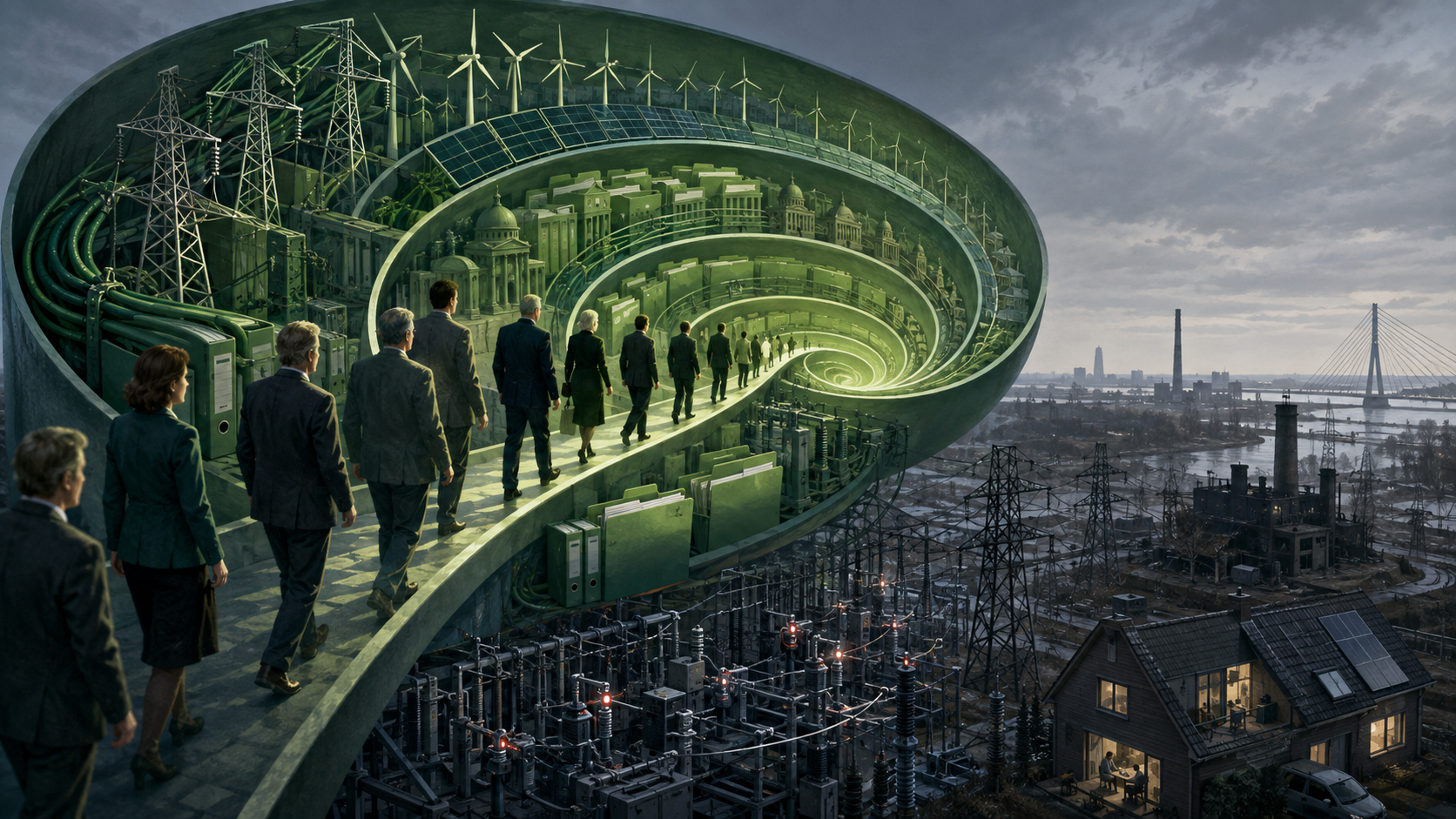
Illustration of the climate policy trap, in which policymakers descend into an increasingly complex and costly energy system. (AI-created)
Evert Doornhof
Date: 17 August 2026
The central question: Why do mounting social, economic, and energy-system costs so rarely trigger a fundamental reconsideration of climate policy?
The paradox of climate policy
Energy bills rise, electricity grids become congested, and new housing and industrial projects wait years for connections. Energy-intensive businesses postpone investment, shrink, or relocate. Wind and solar power require expanding networks, storage, balancing capacity, and dispatchable backup. At the same time, societies are being encouraged to electrify transport, heating, and industry, making reliable power more—not less—important.
One might expect these signals to trigger a fundamental review. Are the chosen instruments working? Are the costs proportionate to the benefits? Are there more reliable alternatives? Yet in much of the Western world, the usual response is the opposite. Grid congestion calls for more grid investment. High energy prices are cited as a reason to accelerate renewables. Disappointing emissions reductions call for stricter targets. Public resistance calls for better communication.
This produces a striking paradox: why does visible policy failure so often lead not to reconsideration, but to more of the same policy? The answer cannot be found in climate science alone, nor in any single political decision. Over several decades, climate policy has become embedded in the identity, status, institutions, and material interests of a highly educated governing class. The result is a self-reinforcing system that has difficulty treating disappointing outcomes as counterevidence.
A more resilient humanity
To understand that mechanism, begin with a fact that rarely occupies the centre of climate communication: humanity has become dramatically more resilient to natural hazards. Our World in Data, using the international EM-DAT database, reports that death rates from disasters have fallen by more than 90 percent over the last century. Even total deaths have declined substantially despite a world population roughly four times larger.
In the short English-language video ‘There is no climate emergency’, CLINTEL director Marcel Crok presents this resilience argument in accessible form. Its importance here is not that a brief video can settle every scientific dispute, but that it highlights the neglected denominator in climate risk: hazards matter, yet their human impact also depends on exposure, prosperity, infrastructure, preparedness, and adaptive capacity.
This is not evidence that hazards have disappeared. It is evidence that forecasting, early-warning systems, sturdier buildings, productive agriculture, trade, transport, public health, and coordinated emergency response save lives. Bangladesh offers a vivid example: cyclones that once killed hundreds of thousands now cause death tolls orders of magnitude lower when warnings, shelters, and evacuation systems work.
There are important caveats. Historical disaster records are incomplete, especially for smaller events, and deaths from heat are inconsistently recorded. Economic losses can also be severe and are shaped by the growing amount of property in harm’s way. None of this supports complacency. It supports a different conclusion: vulnerability is not fixed, and adaptation matters enormously.
That success story is politically awkward. If prosperity, reliable energy, technology, and adaptation are already reducing human vulnerability, it becomes harder to justify every policy choice through the language of permanent emergency. Within an emergency frame, good news is not merely neutral information; it can weaken the urgency on which the policy programme depends.
Climate as identity and status
The American sociologist Musa al-Gharbi offers a useful explanation. He writes about ‘symbolic capitalists’: highly educated professionals who make their living by producing and manipulating words, ideas, data, images, and symbols. They are concentrated in universities, media, government, law, consulting, finance, technology, the arts, and the nonprofit sector—the institutions that name social problems and determine which interpretations receive prestige.
Al-Gharbi’s uncomfortable point is that intelligence and education do not automatically protect people from tribalism. Cognitive sophistication can provide more knowledge and rhetorical skill with which to defend prior commitments. When evidence conflicts with political or moral preferences, highly capable people may be especially adept at finding flaws in unwelcome data, inventing exceptions, and assimilating counterevidence into the existing worldview.
The effect strengthens when an opinion conveys social status. In many professional-class settings, support for ambitious climate policy signals expertise, modernity, and moral responsibility. Expressing the approved concerns and endorsing the approved remedies marks a person as informed and decent. Fundamental doubt, by contrast, can be read as ignorance, selfishness, or hostility to science.
Climate knowledge therefore operates partly as cultural capital. This does not mean that concern about climate change is insincere, or that every policy advocate is engaged in status competition. It means that beliefs can perform two functions at once: describing the world and locating the believer within a social hierarchy. Once a policy position becomes a badge of group membership, changing one’s mind carries a social price that evidence alone may not overcome.
Credential democracy sets the agenda

Mark Bovens (left) and Anchrit Wille (right) discuss diploma democracy in an interview with De Nieuwe Wereld.
The psychological mechanism acquires political force through what political scientists Mark Bovens and Anchrit Wille call ‘diploma democracy’—the rise of political meritocracy. Their comparative study of Western Europe documents how university graduates have come to dominate political parties, parliaments, cabinets, organised interests, deliberative forums, and other channels of influence, even though citizens with low or medium educational qualifications form the majority of electorates.
The consequence is more than a shortage of recognisable representatives. A socially homogeneous governing class also helps determine which risks are urgent, which experts are credible, which research is funded, and which solutions fall within the boundaries of respectable debate. Its members often inhabit overlapping professional networks, consume similar media, and share cosmopolitan cultural preferences. This can narrow the range of assumptions that institutions test, even when every participant is intelligent and acting in good faith.
Climate policy fits particularly well with the priorities of green, progressive, and professional-class politics in Europe and North America, but the governing consensus extends beyond any one party family. Centre-left, centrist, and parts of the centre-right have all helped embed climate targets in legislation, regulation, financial policy, public administration, and supranational institutions. Elections may change governments while ministries, regulators, advisory councils, universities, NGOs, and climate-finance networks retain the same basic policy frame.
Those who experience the costs most directly often have less agenda-setting power. To a policymaker, a higher energy bill may be a distributional effect to be softened by a rebate. To a low-income household or an energy-intensive manufacturer, the same increase may be existential. The moral reward of ambitious policy tends to accrue to the class that designs and advocates it; the material burden is spread much more widely.
How a narrative protects itself
A dominant policy frame survives not only because many people sincerely believe it. It also develops filters that keep disconfirming information at a distance. The first is selection. A flood, heatwave, or wildfire is quickly presented as a warning about climate change. Falling disaster mortality, the role of exposure in rising losses, or successful adaptation receives less attention. One kind of information fits the prevailing story immediately; the other requires explanation and dilutes urgency.
The second filter is the mental label. Terms such as ‘climate denier’, ‘disinformation’, or ‘fossil-fuel mouthpiece’ are not themselves arguments. They position a speaker outside the moral and intellectual community. Once the label sticks, listeners feel licensed to ignore the claim without examining it.
Next comes guilt by association. A journalist, scientist, or politician who takes a stigmatised critic seriously may suffer reputational damage as well. That encourages self-censorship. Editors decline invitations, researchers avoid citations, and organisations distance themselves pre-emptively. No central coordination is required; participants understand the professional and social risks.
A fourth device is the dossier: a cumulative list of old remarks, disputed affiliations, funding insinuations, and prior accusations. No single item needs to be decisive. The length of the list creates an impression that there must be something wrong. Debate shifts from the quality of an argument to the character, network, or presumed motive of the person making it.
Clintel encounters this mechanism directly. It is repeatedly associated with the fossil-fuel industry, often through co-founder Guus Berkhout’s early career at Shell and his later geophysical research with an industry consortium. Those facts belong in a biography, but they do not determine whether a particular analysis is correct, how the organisation is currently funded, or whether the World Climate Declaration’s claims withstand scrutiny.
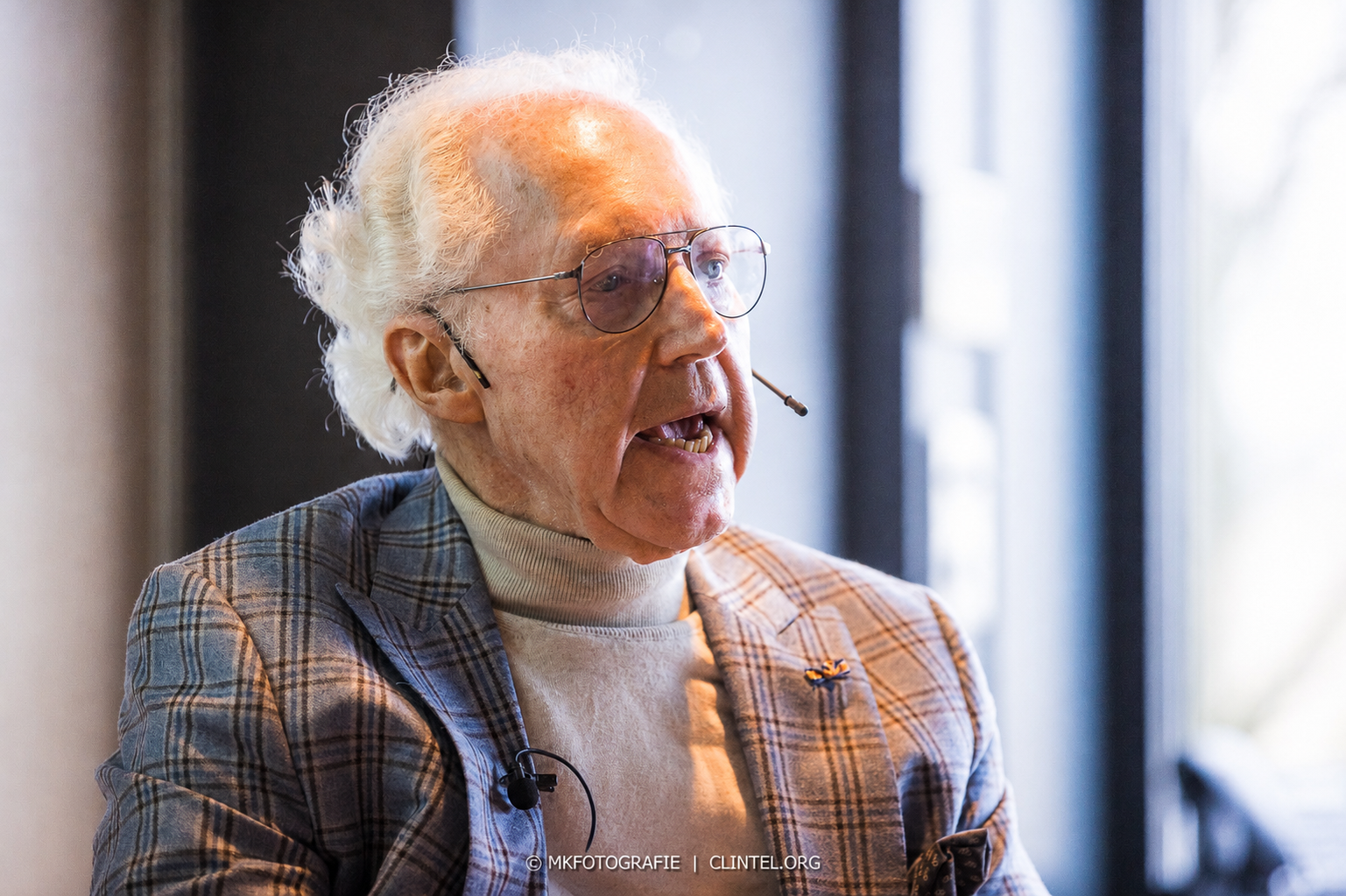
Professor Guus Berkhout, co-founder of Clintel.
Berkhout’s English-language Wikipedia page offers a revealing example of how selection and emphasis can create an interpretive frame. Its opening sentence identifies him as an engineer who worked for the oil and gas industry before mentioning his professorship in geophysics. A separate section on Clintel then foregrounds an anti-net-zero ‘campaign’, alleged industry ties, ‘misinformation’, and strongly negative fact-checks. His membership of the Royal Netherlands Academy of Arts and Sciences and appointment as an Officer of the Order of Orange-Nassau appear only later. The individual facts and criticisms may be relevant, but their sequence and vocabulary tell readers how to regard Berkhout and Clintel before they have considered a single substantive argument. Association thereby becomes a substitute for engagement.
Finally, institutions reinforce one another in a closed loop. Governments set climate objectives; agencies fund research organised around those objectives; advisory bodies assess implementation; media present the resulting work as the scientific or expert consensus; and governments cite science and public legitimacy in return. Each institution can sincerely claim to be performing its proper role, while the system as a whole leaves little room to question the original target or the chosen route.
Why every failure produces more policy
A robust proposition must in principle be vulnerable to reality. In climate policy, however, almost every adverse result can be explained in a way that preserves the underlying framework.
High energy prices are attributed not to the cost and complexity of the transition, but to the remaining dependence on fossil fuels. Grid congestion does not show that weather-dependent generation is poorly matched to demand and infrastructure; it proves that too little has been invested in grids. Industrial decline becomes evidence that incumbent firms failed to modernise. Variability will eventually be solved by batteries, hydrogen, interconnectors, demand management, or technologies still waiting to scale. Public resistance reflects misinformation or insufficient explanation.
In this way, every setback becomes an argument for acceleration. Policy cannot easily fail because failure is defined as a shortage of policy. That is how a programme becomes functionally resistant to falsification.
The costs are no longer abstract. The European Commission estimated in 2025 that EU electricity networks would require about €730 billion for distribution and €477 billion for transmission development by 2040. The International Energy Agency said in 2026 that annual global grid investment would need to rise by roughly 50 percent from around US$400 billion by 2030, while more than 2,500 gigawatts of renewable, storage, and large-load projects were waiting in grid queues. These figures do not prove that grid investment is unnecessary; modern economies plainly need strong grids. They do show why full-system comparisons—generation, backup, storage, transmission, distribution, curtailment, and financing—are indispensable before one technology is described as cheap.
Institutional interests matter as well. An extensive transition economy now includes utilities, network operators, consultants, NGOs, subsidy advisers, universities, government departments, ESG professionals, banks, and multinational funds. Budgets, careers, and reputations are tied to continuation of the agenda. This does not imply bad faith. Sincere conviction and institutional self-interest often reinforce each other more powerfully than either would alone.
There is also a rising political cost of return. After years of binding targets, vast expenditure, and moral condemnation of critics, admitting a wrong turn becomes increasingly painful. Officials would have to concede that warnings about cost, land use, industrial competitiveness, or reliability were dismissed too readily. Technical patches, fresh subsidies, and delayed deadlines are therefore more attractive than fundamental reconsideration.
The dangerous inversion
Here lies the deepest contradiction. The fall in vulnerability to extreme weather was achieved largely through prosperity, infrastructure, technology, and abundant energy. Heating and air conditioning protect people from cold and heat. Modern agriculture, water management, and transport reduce the impact of droughts and floods. Wealthier societies can build stronger homes, maintain sea defences, insure losses, and evacuate people in time.
If climate policy makes energy materially more expensive or less reliable, weakens industry, and slows economic growth, it may erode the very capabilities with which people protect themselves from climate risks. A policy intended to make society safer can reduce adaptive capacity—especially among poorer households and countries that have not yet achieved universal access to dependable energy.
This is not an argument for doing nothing, nor a denial that greenhouse gases affect climate. It is an argument for reversing the order of priorities. Rational climate and energy policy should begin with human welfare: affordability, availability, reliability, and resilience. It should invest in adaptation where risks are concrete, allow nuclear power to compete on equal terms, and judge wind, solar, storage, hydro, fossil fuels, and emerging technologies by their contribution to the whole energy system rather than by a single theoretical carbon score.
Escaping the climate policy trap
The persistence of climate policy does not require a central conspiracy. It can be understood as an emergent system in which moral conviction, group identity, status incentives, career structures, financial interests, and institutional self-confirmation all point in the same direction. Intelligent and well-intentioned people can thereby sustain a programme whose outcomes become increasingly difficult to reconcile with its promises.
The way out does not begin with still better communication from above. It begins with intellectual modesty and genuine pluralism. Let competing scientific interpretations and energy scenarios meet in public. Publish total system costs, benefits, trade-offs, and uncertainty. Give practical knowledge and the interests of non-graduate citizens real weight. Judge critics by their evidence and reasoning rather than labels and associations. Most importantly, specify in advance which outcomes would cause a policy to be revised or abandoned.
Energy policy should again be treated as the provision of a basic necessity. That requires calculation across the entire chain—from extraction and generation to conversion, transmission, storage, backup, and final use. ‘Renewable’ is not automatically synonymous with sustainable; hydrogen is an energy carrier, not a primary source; and installed capacity is not the same as dependable output. Only full accounting reveals which combinations can deliver reliable, affordable power at scale.
The decisive question is not whether leaders care enough about the climate. It is whether they are willing to let reality correct their policy. As long as bad news justifies more intervention, good news is discounted, and policy-created problems are treated as proof of insufficient ambition, the climate policy trap remains closed.
Sound energy policy requires not less science, but science that tolerates dissent; not less responsibility, but responsibility for every consequence of policy. Reconsideration must again be understood as evidence of governing maturity rather than moral betrayal. Only then can climate debate return to where it belongs: an open comparison of risks, costs, benefits, and alternatives.
Sources and further reading
Musa al-Gharbi, Smart People Are Especially Prone to Tribalism, Dogmatism and Virtue Signaling
Rob Henderson, Do the Most Educated People Look Down on Everyone Else?
Mark Bovens and Anchrit Wille, Diploma Democracy: The Rise of Political Meritocracy
Hannah Ritchie, Pablo Rosado and Max Roser, Natural Disasters
Marcel Crok, There is no climate emergency (video)
European Commission, EU guidance on ensuring electricity grids are fit for the future
International Energy Agency, Electricity 2026: Grids
Clintel, World Climate Declaration
Wikipedia, Guus Berkhout
Evert Doornhof
Evert Doornhof has long been active in the financial world in commercial and management roles. After the COVID pandemic, he changed course when he observed how quickly personal freedoms can be restricted. He is now committed to shedding light on crises that appear to be manufactured or exaggerated. Among other things, he is active with the Clintel Foundation, where he manages social media and has written several articles.
The article you have just read was made possible by our donors.
Every day, Clintel publishes articles on climate, energy and science. We also translate and share international analyses in multiple languages, produce videos, publish reports and organize conferences and events around the world.
We receive no government funding and rely entirely on the support of our donors. Your support helps us promote independent research and contribute to a more open and balanced debate on climate and energy issues.
Would you like to support our work? Choose the option that suits you best:
• Become a Friend of Clintel – support us with an annual contribution
• Make a recurring donation – provide ongoing support and help us plan ahead
• Make a one-time donation – every contribution helps
Thank you for your support.
more news
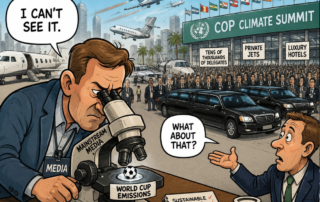
The World Cup Is About Soccer Not Climate Guilt
The attempt to transform the World Cup into a climate morality tale ignores context, comparative scale and common sense, says Anthony Watts. It’s a perfect example of modern climate journalism’s tendency to shoehorn climate change into virtually every subject imaginable.

Global Warning, a genuine attempt to be objective about climate
Canadian filmmaker Mathew Embry (Painkiller: Inside the Opioid Crisis) has released a remastered edition of his 2019 climate documentary Global Warning. It is more relevant than ever and is one of the few genuine attempts by the media to take a truly objective look at the climate debate.

Do Los Niños cause climatic cooling?
The upcoming El Niño will affect our weather for a year or two, but what is the climatic effect of this weather feature, if any?