
Climath 2025: A Complete Collection of All Climath Posts by Demetris Koutsoyiannis
Climath 2025 is a comprehensive collection of all Climath posts published by Demetris Koutsoyiannis during 2024 and 2025. This volume preserves critical reflections on climate science, academic discourse, censorship, and intellectual freedom in a durable, archivable format.

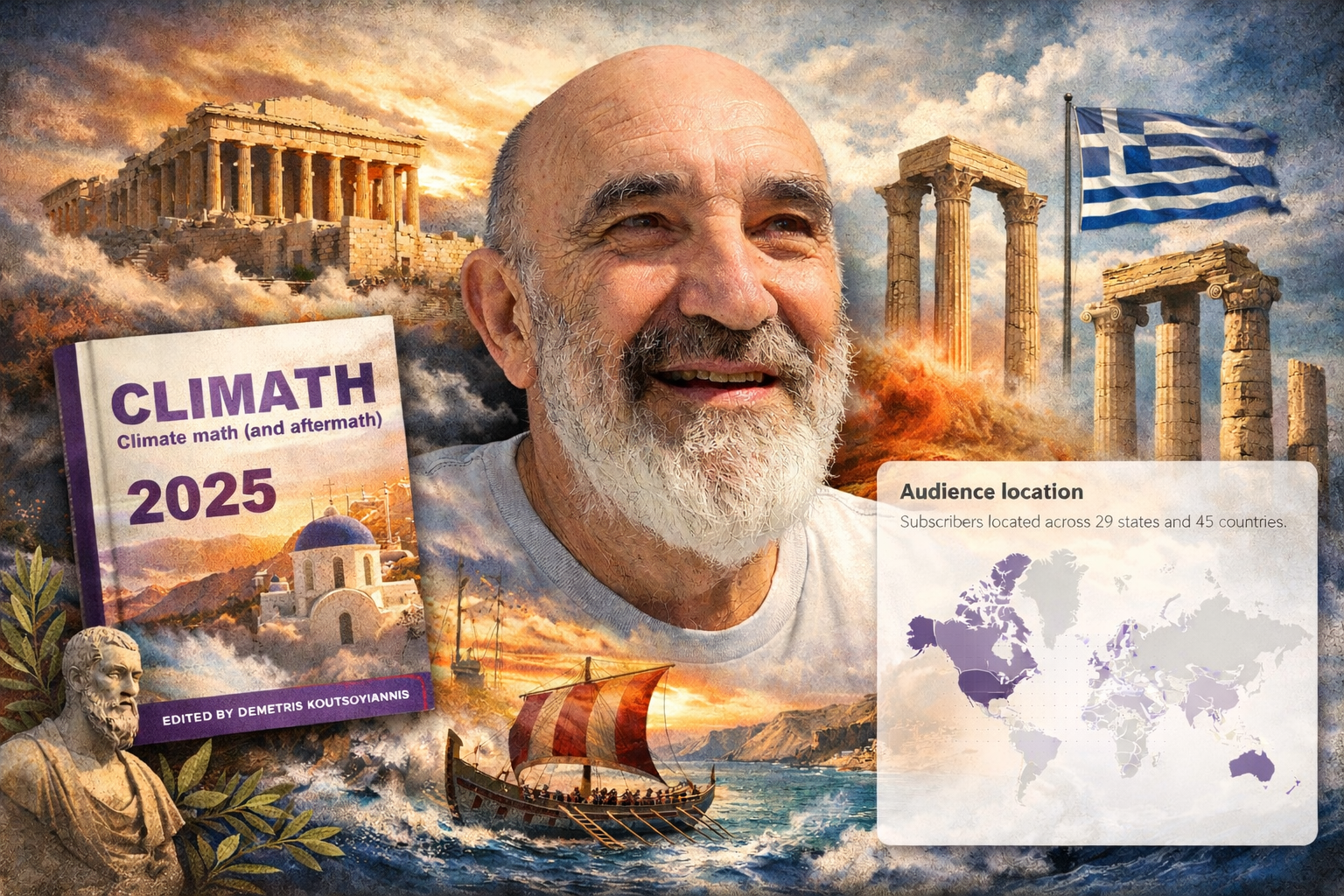
Demetris Koutsoyiannis / ChatGPT
Demetris Koutsoyiannis
Date: 19 January 2026
Introduction to the Climath 2025 Collection
I have compiled all Climath posts and comments from the last year (2025) into this book-sized volume of more than 300 pages. As Climath began on 21 November 2024, the volume also contains the initial posts, those from late 2024.
Why This Volume Was Created
I undertook this endeavour for several reasons, including my perception that:
- Compiling past information helps us to recall the past and reevaluate the correctness or incorrectness of the thoughts we presented.
- Gathering the fragmented information from websites in a traditional book volume offers some advantages, at least for traditional readers.
- A book can be much more resilient to future censorship or silencing attacks, which are quite probable. It can easily be converted into a print form and, even in electronic form, it can be saved in multiple places. Hence, I am archiving this volume on multiple sites, including Climath and Itia.
Censorship, Platforms and the Need for Archiving
To clarify the latter threat, I am offering the following example: In one of my Climath posts (here reproduced as the section “Twelve replies to comments on my last climate paper”), I praised the ResearchGate platform for enabling the archiving of research items or discussions about them, and for not censoring these items or the comments on them. Soon after my post (as I detail in an update of it), ResearchGate not only discontinued the commenting feature, but also erased all existing comments, without notification. And it is hard to lose intellectual property, even if it is published informally.
I am grateful to Substack for offering me the opportunity to share my ideas and thoughts on its platform, and to discuss them with colleagues, while assigning me the copyright ownership. But I will refrain from further praise, given the experience from other platforms as above, and the global tendency towards authoritarianism, as articulated in several of the posts contained in this volume. Substack seems to align with this tendency as it clearly states this: “Substack is free to terminate (or suspend access to) your use of Substack, or your account, for any reason at our discretion.”
The Making of the Climath 2025 Volume
Initially I thought it would be easy to create this compilation. I consulted an AI bot that promised to help me automate the procedure. However, after wasting several hours chatting with the bot, I found that the programs it suggested and the software components it prompted me to install resulted in total failure. In the end, I did everything manually. I believe I have been faithful to the original posts, here represented as sections, including the structure, the spelling and the hyperlinks. However, to avoid confusion among the sections, I renumbered the footnotes with a uniform numbering system for the entire volume.
Acknowledgements and Future Plans
I am indebted to all contributors, listed on the previous page, and the readers who visited Climath giving it the rather satisfactory statistical performance shown on the following pages.
My plan for 2026 is to continue posting on Climath and, hopefully, to produce another volume with the entries of 2026.
Athens 2026-01-12
Demetris Koutsoyiannis
This article was previously published on climath.substack.com by Demetris Koutsoyiannis. There you can download the uncompressed version of ‘Climath 2025’.

more news
AI accurately reconstructs temperatures across Antarctica
Artificial intelligence is increasingly being applied in climate science, with mixed results so far. A new study, however, suggests that deep learning can successfully reconstruct Antarctic surface temperatures despite limited observational data. By combining sparse measurements with reanalysis datasets, the researchers claim to achieve high accuracy—offering new insights into long-term temperature trends across the continent.

Clintel President Václav Klaus warns: “No radical change in Europe in the near future”
We must not be naïve optimists about climate policy and should not overestimate the recent positive signals, like those from President Trump. This is the view of Clintel President Václav Klaus: “Nothing has changed in the European Union. We, with a background in the social sciences, cannot imagine that any radical change will take place in Europe in the near future.” Klaus made these remarks in his speech at the annual meeting of the Norwegian Klimarealistene in Oslo on March 15.

New study finds low CO2-sensitivity again
A new paper by Frank Stefani compares solar variability and CO₂ emissions as drivers of global sea surface temperatures. Using the solar aa geomagnetic index alongside CO₂ data, the study estimates a transient climate response (TCR) of about 1.1–1.4 K, near the lower end of the IPCC range. The results align closely with other observation-based estimates and highlight the continuing scientific debate about the relative roles of solar activity and greenhouse gases in recent climate change.

