
Trump tells US power plants to emit as much CO2 as they want
The EPA (Environmental Protection Agency) has announced that they will scrap the limits set for ‘climate pollution’ from US power plants. Jo Nova thinks that the mission creep of bureaucrats may finally be coming to an end: Slaying the Bureaucratic Blob.


Trump’s EPA administrator, Lee Zeldin, is expected to announce today that they will scrap the limits set for ‘climate pollution’ from US power plants. Naturally, the Blob Bureaucrats will oppose this in the courts in every way possible. But there is something much bigger at stake here than just American electricity prices. Somehow desk clerks you didn’t vote have graduated from checking smokestacks to choosing America’s power stations and redesigning its car fleet and perhaps one day, even banning your burgers. (You know they want to.).”
What the Blob is most afraid of here, is that if Trump can repeal these EPA rules, and the courts agree the Clean Air Act never authorized them in the first place, future Presidents won’t be able to bring back the glory days of the EPA (or any of the other jumped-up bureaucratic agencies). Which all sounds unlikely, you would think, in a democracy, but the real problem is that legal case could expose that the EPA never had the right to hold such vast sweeping powers anyway.
Arsenic
The agency created to stop arsenic leaking into rivers gradually promoted itself to national electricity planner, vehicle designer, wetlands referee and atmospheric thermostat. Lately the EPA used the Clean Water Act to try to force farmers to ask for permits, in case every soggy paddock might count as a federally protected wetland. The Supreme Court pegged that back.
Factors that affect US competitiveness or national security, obviously, are so big they not supposed to be meted out to jumped-up little agencies with delusions of grandeur (especially ones that voters can’t vote out).
The central question is whether the EPA was never given authority by congress to transform the US economy and kill industries in order to control the Earth’s climate. (Or in this case, to pretend to). So faced with a challenge the Supreme Court may find that Congress is responsible for writing the country’s rules, not the EPA.
But what a crushing loss to the Kleptocrats — they might not be able to find trillion-dollar powers hidden between the commas of 50-year-old legislation.
From the New York Times: E.P.A. Expected to Erase Limits on Climate Pollution From Power Plants
By Maxine Joselow and Lisa Friedman, New York Times
The Trump administration plans to announce Monday that the United States will no longer limit the planet-warming pollution that power plants pump into the air while burning coal and gas, according to two people familiar with the proposal.
The shift by the Environmental Protection Agency would complete the administration’s erasure of the most consequential climate policies of Presidents Joseph R. Biden Jr. and Barack Obama. If the move survives expected legal challenges, it could also prevent future administrations from regulating greenhouse gas emissions from power plants.
Earlier this year, the E.P.A. eliminated greenhouse gas standards for car tailpipes and eased restrictions on planet-warming chemicals used in air-conditioners and refrigerators. Most consequentially, the agency repealed the scientific determination that gave it the legal authority to create climate regulations in the first place.
The agency plans to argue Monday that greenhouse gases from power plants do not endanger human health or the environment, and therefore it lacks the legal authority to regulate these emissions under the Clean Air Act, according to the people familiar with the matter. If courts uphold this argument, it could prevent future administrations from restoring the restrictions.
Biden
The Biden administration brought in “climate rules” for power plants in 2024. The new carbon dioxide limits would have meant that coal and gas plants would have had to install 90% “carbon capture” or something equivalent to that. These options are obscenely expensive and would have effectively driven them out of business, and for what gain? One less beachy weekend in 2102?
The coal industry had complained that Biden-era restrictions on emissions were costly and unworkable. It had predicted that many coal plants would have closed instead of spending billions of dollars on new pollution controls.
It is taking Trump’s team years to unwind the bureaucratic revolution that has been marching through the institutions.
The mess has taken decades to build, so unraveling it is slow. The process to disassemble the EPA overreach started in 2017 when Trump began appointing three Supreme Court justices. By 2022 when West Virginia took on the EPA there were enough conservative views in the Supreme Court to invoke and crystallize what became known as the Major Questions Doctrine which is key to pegging back the bureaucrats. It’s a philosophy that puts the onus back on the agencies to show exactly where Congress gave them power over big things like the type of cars Americans can drive, or which power plants they can use.
Vague
These small agencies were assuming they had those powers, but were relying on interpreting broad and vague legislation to imply with a hop, step and a jump, that because they control air pollution — they can force you to pay 20,000 dollars more on a car, 5,000 more for electricity and drive industries out of business. And this applied even if China was making the “environmental” cars with coal power and the IPCC maths showed that it made no measurable difference to the temperature. The costs are absurd, and even the Democrats admit Americans would never have voted for it.
The Major Questions Doctrine says, in effect, that if Congress wanted the EPA to be in charge of transportation policy, it would have said so, not hidden that elephant in a mousehole. It means that Congress will still be free to give away its power about these things to the Environmental Protection Agency, but it will take an Act of Congress with explicit legislation to do so. That’s so much more difficult than just assuming power through creative statutory interpretation.
The EPA had merely decided it could regulate almost anything connected by six degrees of separation to carbon dioxide.
This article was published first on joannenova.com.au on 15 September 2026.

Jo Nova
Jo Nova is science presenter, writer, speaker & former TV host; author of The Skeptic’s Handbook.
The article you have just read was made possible by our donors.
Every day, Clintel publishes articles on climate, energy and science. We also translate and share international analyses in multiple languages, produce videos, publish reports and organize conferences and events around the world.
We receive no government funding and rely entirely on the support of our donors. Your support helps us promote independent research and contribute to a more open and balanced debate on climate and energy issues.
Would you like to support our work? Choose the option that suits you best:
• Become a Friend of Clintel – support us with an annual contribution
• Make a recurring donation – provide ongoing support and help us plan ahead
• Make a one-time donation – every contribution helps
Thank you for your support.

more news
Judge Rejects Climate Dogma, Begins to Restore Integrity
In a significant move for scientific accountability, a U.S. federal judge has removed a controversial climate change chapter from a key judicial reference manual. The decision challenges the dominance of model-based climate narratives in the courts and signals a renewed emphasis on empirical evidence and institutional integrity.
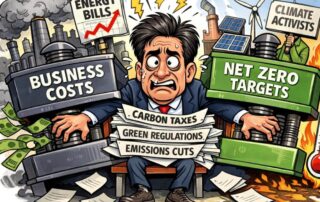
Ed Miliband is the last fool standing on Net Zero
As the United States moves to reconsider key climate regulations, Britain’s aggressive push toward Net Zero is drawing increasing scrutiny. In this commentary, Matt Ridley argues that unilateral decarbonisation risks leaving the UK economically isolated while much of the world shifts course.

Climate change computer projections are manifestly false and dangerously misleading
The alleged threat to the planet from human caused climate change has been at the forefront of Australian politics over the recent half century. Every year, just before meetings of the UN Conference of the Parties (COP) to the Climate Change Convention, slight increases in atmospheric carbon dioxide and global temperature are portrayed in the media as harbingers of future doom. Every extreme weather event is made out to be an ill omen of what is to come unless fossil fuels are eliminated.

