
No Evidence Weather Extremes Are Becoming More Frequent or Intense: (3) Floods
In a series of articles on extreme weather attribution, physicist Ralph B. Alexander examines whether observational evidence supports claims that weather extremes are becoming more frequent or intense. Following his previous article on droughts, this installment focuses on floods.

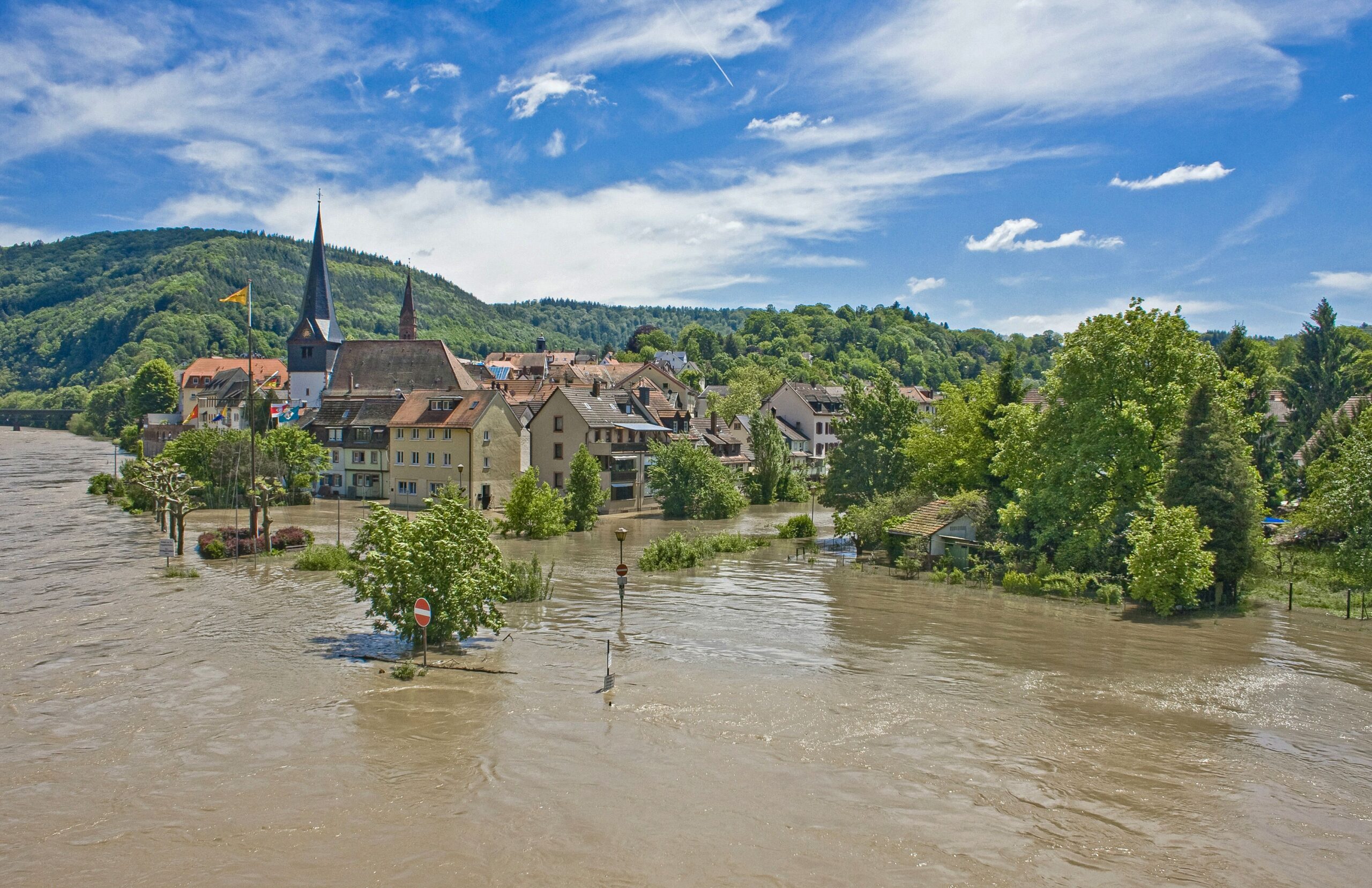
Flooding of the Neckar in Germany in 2021. (Source: Shutterstock)
Ralph Alexander
Date: 20 August 2026
You’d think that floods would proliferate in a warming world, since precipitation increases due to enhanced evaporation from tropical oceans. Yet there is no evidence that flooding is becoming more prevalent.
A 2017 study found that, despite average rainfall getting heavier as the planet warms, excessive precipitation is not the only cause of flooding. What is less obvious is that alterations to the catchment area – such as land-use changes, deforestation and the building of dams – also play a major role. This had even been recognized by the IPCC (Intergovernmental Panel on Climate Change) in its Sixth Assessment Report, which stated that:
In addition to precipitation, flooding also depends on basin and river characteristics such as permeability, antecedent soil moisture, and antecedent flow levels for river flooding, so projections of extreme precipitation and flooding are not always closely linked.
Size
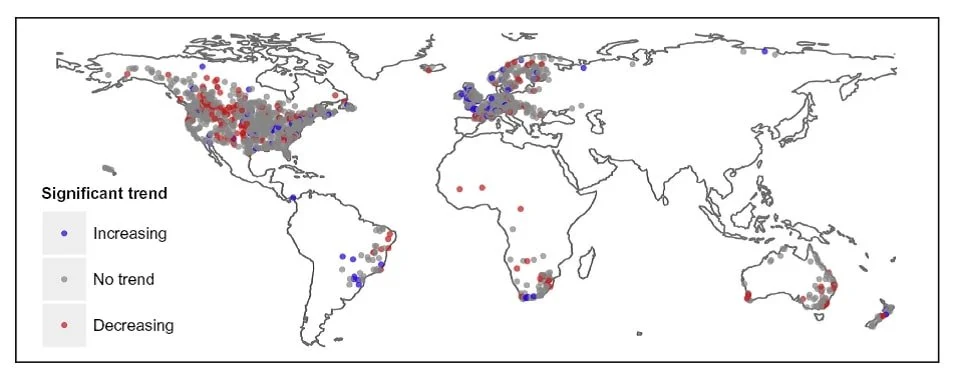
Even so, the 2017 study concluded that the biggest influence on flood trends is none of these factors, but rather the size of the catchment area. While smaller catchments do show a trend in flood risk that’s increasing over time, larger catchments exhibit a decreasing trend.
Globally, larger catchments dominate, so the trend in flood risk is actually decreasing rather than increasing in most parts of the world. This is illustrated in the figure below, the data coming from 1,907 different locations over the 40 years from 1966 to 2005.
Another 2017 study, this time restricted to North America and Europe, found “no compelling evidence for consistent changes over time” in the occurrence of major floods from 1930 to 2010. Like the first study described above, this research included both small and large catchment areas. But the only catchments studied were those with minimal alterations, so as to focus on any trends driven by climate change.
The next figure shows the likelihood of a 100-year flood occurring in North America or Europe in any given year, during two slightly different periods toward the end of the 20th century. Blue dots represent observed values, lines a logistic regression fit to the data. A 100-year flood is a massive flood that occurs on average only once a century and has a 1 in 100 or 1% chance of occurring or being exceeded in any given year – although the actual interval between 100-year floods is often less than 100 years.
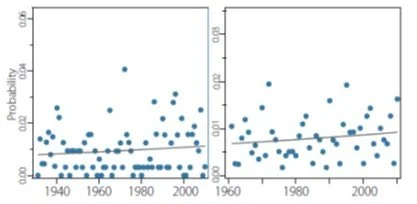
You can see that for both periods studied, the probability of a 100-year flood in North America or Europe hovers around the 1% (0.01) level or below, implying that 100-year floods were no more or less likely to occur during those intervals than at any time. The straight lines drawn through the data points show no significant trend. Similar results were obtained for 50-year floods.
Although the study authors concluded that major floods in the Northern Hemisphere between 1931 and 2010 weren’t caused by global warming and were no more likely than expected from chance alone, they did find that floods were influenced by the climate. The strongest influence is the naturally occurring Atlantic Multidecadal Oscillation, an ocean cycle that causes heavier than normal rainfall in Europe and lighter rainfall in North America during its positive phase – leading to an increase in major European floods and a decrease in North American ones.
Danube
Floods in the modern era are no more common nor deadly or disruptive than any of the thousands of floods in the past. The figure below shows flood levels of Germany’s Danube River recorded in the town of Passau over more than 500 years. As the caption states, the highest flood level over this period was back in 1501, and only two of the nine severe floods occurred during the last 70 years.
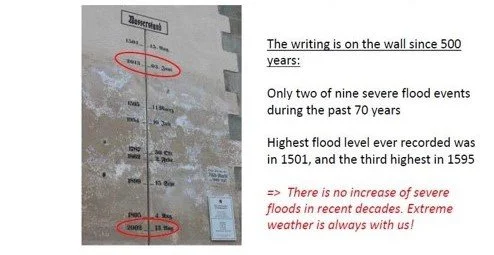
Germany in fact has been battered by devastating floods many times during the last few centuries, including a 1717 Christmas Eve flood that killed 13,700 people. More recently, the Ahr valley in Germany, which was struck in July 2021, experienced major floods in the same locations on 12 June 1910, when at least 52 people were killed.
These numbers pale in comparison with the number of fatalities caused by historical floods in Asia, notably in China, India, Pakistan and Japan. The death toll from past flooding in these countries has often been in the millions, either by drowning or from subsequent famine or disease.
In the more developed world, the illusion that major floods are becoming more frequent is due in part to the growing population and the appeal of living near water. This has led to people building their dream homes in harm’s way, on river or coastal floodplains, where rainfall-swollen rivers or storm surges result in intermittent flooding and subsequent devastation. It is changing human wants rather than climate change that are responsible for disastrous floods.
This article was published first on Science under Attack on 17 August 2026.

Ralph B. Alexander
Ralph B. Alexander, a science writer who puts science above political correctness, is the author of several recent reports on weather extremes and global warming; he has also authored “Science Under Attack: The Age of Unreason” and “Global Warming False Alarm”. With a PhD in physics from the University of Oxford, he has written numerous scientific research papers and reports on complex technical issues. Dr. Alexander has been a researcher at laboratories in Europe and Australia, a professor at Wayne State University in Detroit, the co-founder of an entrepreneurial materials company, and a market analyst in environmentally friendly materials for a small consulting firm. He grew up in Perth, Western Australia and currently lives in California.
The article you have just read was made possible by our donors.
Every day, Clintel publishes articles on climate, energy and science. We also translate and share international analyses in multiple languages, produce videos, publish reports and organize conferences and events around the world.
We receive no government funding and rely entirely on the support of our donors. Your support helps us promote independent research and contribute to a more open and balanced debate on climate and energy issues.
Would you like to support our work? Choose the option that suits you best:
• Become a Friend of Clintel – support us with an annual contribution
• Make a recurring donation – provide ongoing support and help us plan ahead
• Make a one-time donation – every contribution helps
Thank you for your support.

more news

Professor Seok Soon Park: Climate Models Are Fear-Mongering Machines
During a lecture in Oslo on June 30, 2026, Professor Seok Soon Park, a leading South Korean environmental scientist and Clintel Ambassador for South Korea, presented a comprehensive critique of the climate models used by the IPCC. Drawing on decades of experience in environmental modeling, he argued that these models have fundamental scientific limitations and function more as "fear-mongering machines" than reliable tools for predicting future climate.

Henrik Svensmark fired by his university
Danish scientist Henrik Svensmark, known for his controversial research on cosmic rays and cloud formation, has been dismissed by his university in Copenhagen after years of internal conflict. In an interview with the Danish newspaper Berlingske, he described the decision as “a death blow” to his research.

Steven Koonin: “There Is a Significant Gap Between What Climate Science Says and What You’ve Been Told It Says”
During the ARC Conference 2026, American physicist Steven Koonin argued that there is "a very significant gap" between what climate science actually says and what the public has been told it says. The former science adviser to President Barack Obama calls for a more honest debate about climate science, scientific uncertainty and climate policy.

