
In the run-up to Belém: the climate circus COP has had its day
This book review looks at The Truth About the COPs, in which Samuel Furfari dissects the history, failures, and political theatre of the UN’s climate conferences.

Peter Baeten
Date: 5 November 2025
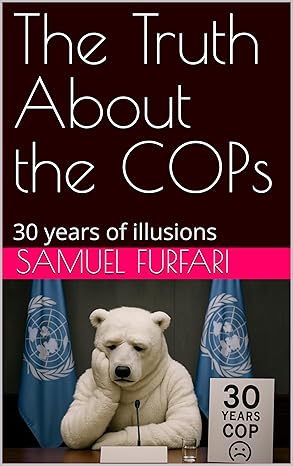
In The Truth About the COPs, 30 years of illusions, Samuel Furfari gives a detailed account of the history and madness of the annual UN climate conferences.
This month, the annual climate conference of the UN countries will take place again: COP30, this time in Belém, Brazil. The aim of these COPs (Conference of the Parties) is to reduce greenhouse gas emissions, especially CO2.
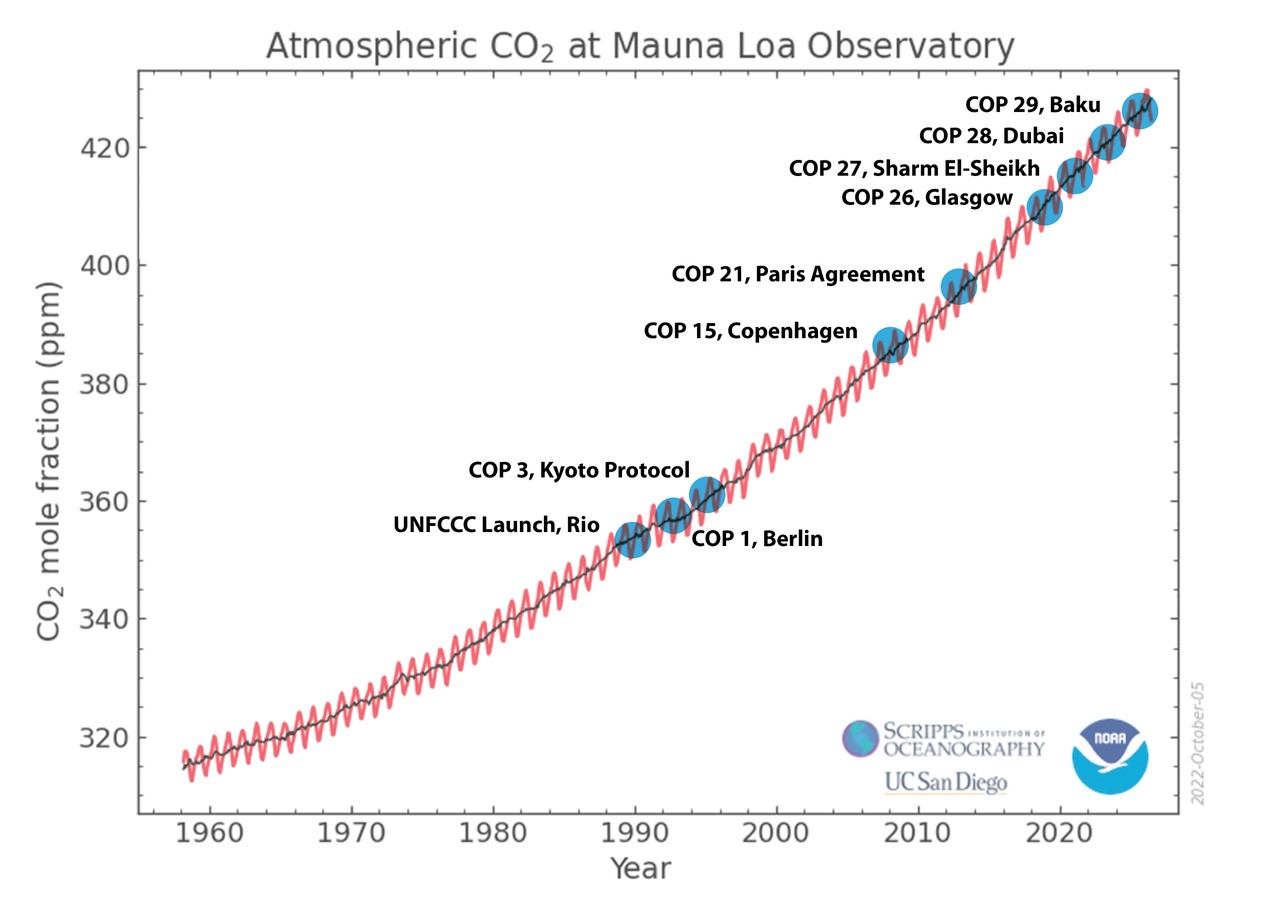
The problem is: it’s not working. Since these conferences began in 1995, global CO2 emissions have risen by about 65 percent, and our dependence on fossil fuels is still above 80 percent. As Senior Official in the field of energy for the European Commission (1982-2018), Samuel Furfari witnessed many of the conferences up close. In The Truth About the COPs, 30 years of illusions, he provides a detailed account of the history and background of the COPs: from the work of the Club of Rome to the Earth Summit in Rio de Janeiro in 1992, to the first COP in Berlin with (then) Minister Angela Merkel playing a crucial role. Furfari also discusses the public failure in Copenhagen in 2009 and the apparent success of Paris 2015 (COP21), which, however, quickly turned out to be a flimsy agreement.
Furfari viewed and continues to view the climate hysteria with regret and will undoubtedly have attempted to counterbalance it internally. He does not even speak out against the reduction of greenhouse gases on principle, but rather points out the unfeasibility of rapid decarbonization and its drastic consequences. We are now seeing these consequences mainly in Europe, because the rest of the world, logically, has no interest in strict climate measures. From the outset, climate policy has been a Western, mainly European, Alleingang, supported by the media and NGOs. Europe is therefore the only continent where CO2 emissions have fallen since 1990 (this also happened in the US, but that has less to do with policy than with their transition from coal to shale gas).
And now we in Europe are left with the dire consequences. Fortunately, this is becoming clear to more and more people. The general public also increasingly realizes that a COP is one big circus, not least because of the tens of thousands of participants who arrive there by plane… So, the tide has been turning over the last three conferences, Furfari notes. Realism is returning, the economy is back at the forefront, and nuclear energy is back on the agenda.
Furfari shows a lot of compassion for developing countries. They should not be forced to go along with Western climate thinking. Their first priority must be poverty alleviation, and fossil fuels are simply indispensable for that. At the COPs, this always leads to tension between the West and the Global South. The latter countries also invariably want large sums of money from the West as compensation for alleged historical and future climate damage and for climate adaptation. This will be no different in Belém. At the last minute, a vague compromise will once again be reached that limits the loss of face for all parties. And then we move on to the next COP. Furfari is a strong advocate of abolishing the COPs, but also notes that there are still too many parties with a (political) interest in the continuation of the circus.


more news

Professor Seok Soon Park: Climate Models Are Fear-Mongering Machines
During a lecture in Oslo on June 30, 2026, Professor Seok Soon Park, a leading South Korean environmental scientist and Clintel Ambassador for South Korea, presented a comprehensive critique of the climate models used by the IPCC. Drawing on decades of experience in environmental modeling, he argued that these models have fundamental scientific limitations and function more as "fear-mongering machines" than reliable tools for predicting future climate.

Henrik Svensmark fired by his university
Danish scientist Henrik Svensmark, known for his controversial research on cosmic rays and cloud formation, has been dismissed by his university in Copenhagen after years of internal conflict. In an interview with the Danish newspaper Berlingske, he described the decision as “a death blow” to his research.

Steven Koonin: “There Is a Significant Gap Between What Climate Science Says and What You’ve Been Told It Says”
During the ARC Conference 2026, American physicist Steven Koonin argued that there is "a very significant gap" between what climate science actually says and what the public has been told it says. The former science adviser to President Barack Obama calls for a more honest debate about climate science, scientific uncertainty and climate policy.

