
ICSF/Clintel lecture by Roger Pielke Jr.: RCP8.5 is Retired – What Now?
In his recent ICSF/Clintel Lecture, Roger Pielke Jr. acknowledges that the scientific community is now correcting a long-standing problem regarding extreme climate scenarios like RCP8.5. But he warns that the consequences of past reliance on these scenarios will continue for many years.
Clintel Foundation
Date: 27 June 2026
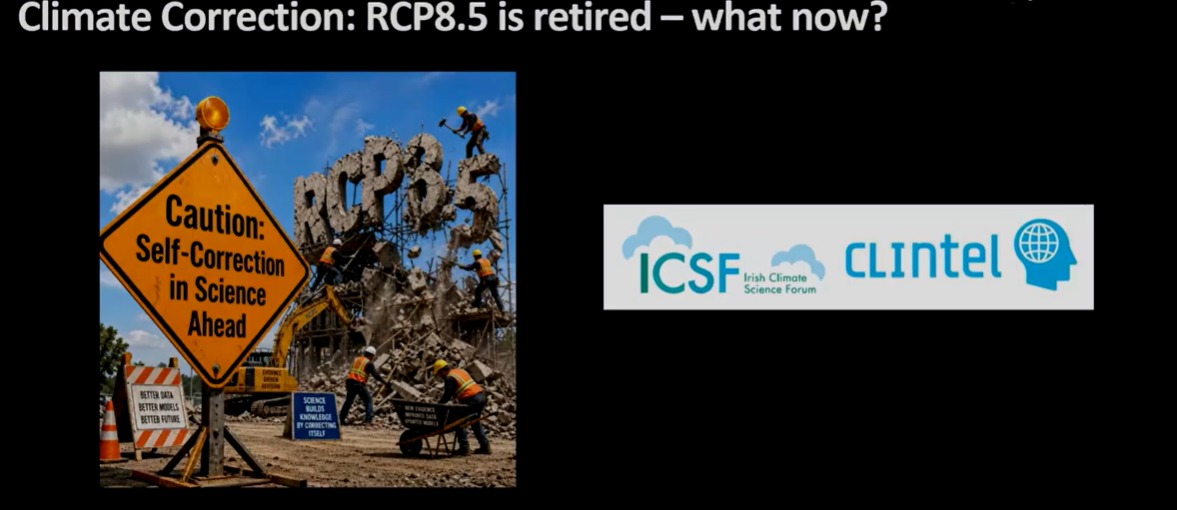
Roger Pielke Jr.’s ICSF/Clintel lecture of June 24th focused on what he regards as one of the most significant recent developments in climate science: the retirement of the high-end climate scenarios RCP8.5, SSP5-8.5 and SSP3-7.0 as official baseline scenarios by the committee responsible for developing future IPCC scenarios.
You can see the entire lecture below:
According to Pielke, these scenarios have profoundly shaped climate research, policy analysis, media reporting and public debate for nearly two decades, despite being increasingly inconsistent with observed global developments. The scientific community is now correcting a long-standing methodological problem, although the consequences of past reliance on these scenarios will continue for many years.
This development received surprisingly little international media attention despite its importance. While a few European newspapers highlighted the change—one referring to it as the IPCC abandoning its ‘doomsday scenario’ —most international reporting remained limited.
Pielke describes this shift as the culmination of years of work by himself, Justin Ritchie and other researchers who questioned whether the highest emissions scenarios ever represented plausible futures.
Climate is a problem
Pielke begins by emphasizing that he accepts the reality of human influence on climate and supports both mitigation and adaptation policies. He distances himself from arguments that deny climate change, instead explaining that his concern lies with the proper use of scientific scenarios. He also observes that climate policy has increasingly become part of broader energy policy, where considerations such as affordability, energy security and reliable energy access must be balanced alongside emissions reductions.
The central argument of the lecture concerns the role of scenarios in climate science. Scenarios are not forecasts or predictions but structured hypothetical futures designed to explore the consequences of different assumptions. As Pielke explains: “Scenarios are not forecasts. They’re not predictions… scenarios are tools for the intellect.” Their purpose is to help decision-makers understand possible futures rather than predict what will actually happen.
Extreme scenarios
Pielke argues that an important distinction gradually disappeared during the development of the Representative Concentration Pathways (RCPs). Climate modelers often require extreme scenarios because they help separate long-term climate signals from natural variability in complex Earth-system models. Such scenarios are scientifically useful for experimentation. Policymakers, however, require plausible scenarios that represent realistic future developments. According to Pielke, these two purposes became conflated.
Originally, socioeconomic assumptions determined future emissions, which were then translated into radiative forcing and climate projections. During the development of the RCP framework around 2005, this sequence was effectively reversed. Climate modelers first selected radiative forcing targets that suited modeling exercises, after which economists and social scientists attempted to construct socioeconomic pathways capable of producing those forcing levels. Pielke says that nobody was assigned responsibility for asking the most basic question: were these scenarios actually plausible?
He refers to this institutional oversight as a “plausibility vacuum.” In his view, scientific convenience gradually displaced realistic socioeconomic analysis.
Baseline
RCP8.5 became especially influential because it was designated as the primary reference or baseline scenario. Yet Pielke argues that this designation was fundamentally mistaken. The scenario originated from a single integrated assessment model that generated exceptionally high emissions through assumptions that were already questionable when the scenario was introduced.
Among its assumptions were an eightfold increase in global coal consumption during the twenty-first century, extensive production of liquid fuels from coal, declining shares of nuclear and renewable energy, and fossil fuel use far beyond proven coal reserves. Observed global energy trends have instead shown coal’s share beginning to decline while renewable energy has expanded rapidly.
Pielke therefore concludes that “RCP 8.5 was never plausible… It’s a fantasy world.” He argues that even if one could return to 2005, the scenario would already fail a plausibility assessment based on known demographic, technological and energy trends.
Nevertheless, RCP8.5 became extraordinarily influential. Thousands of scientific papers adopted it as “business as usual.” National climate assessments, financial stress tests, insurance risk analyses, banking regulations and estimates of the social cost of carbon all relied heavily upon it. Pielke notes that despite repeated warnings—including by some of the architects of the scenario framework itself—more than 100,000 peer-reviewed studies eventually used RCP8.5 as a baseline.
He argues that this widespread adoption resulted not from individual scientific misconduct but from institutional incentives. Standardizing research around a small number of scenarios made international climate model comparisons easier and simplified future IPCC assessments. However, this standardization also created what he describes as a “single point of failure”: once one implausible scenario became the dominant reference, the entire research literature inherited that assumption.
Self-correction
Pielke draws an analogy with biomedical research, where scientists unknowingly used mislabelled cancer cell lines for thousands of published studies. Although the mistake was eventually recognized, correcting the accumulated literature proved slow and difficult. He suggests that climate science is experiencing a similar process of scientific self-correction.
Much of the lecture reviews the historical evolution of climate scenarios. Earlier IPCC scenario frameworks contained multiple plausible futures without designating a single baseline. The 2000 Special Report on Emissions Scenarios (SRES) explicitly stated that none of its forty-two scenarios represented a reference future. According to Pielke, this approach better reflected genuine uncertainty.
He argues, however, that the SRES scenarios quickly became politicized because some low-emissions futures suggested emissions might decline without strong climate policy interventions. This, he believes, contributed to the decision to redesign the scenario framework, eventually leading to the RCP system.
The lecture then turns to recent developments. The committee preparing scenarios for the next generation of climate model intercomparison projects (CMIP7) has now officially retired the three most extreme baseline scenarios, including RCP8.5 and SSP5-8.5. Instead, new scenarios distinguish more clearly between plausible reference pathways and exploratory high-emissions experiments.
Problems remain
Pielke welcomes this change while noting that some problems remain. The new exploratory high scenario still assumes unusually large increases in coal use and projects world population reaching approximately 14.5 billion by 2100—an assumption he believes is inconsistent with current demographic research suggesting population growth may peak before the end of the century.
He nevertheless gives considerable credit to the scenario committee for recognizing the problem. “They have eliminated the three most extreme scenarios,” he says, describing the decision as a major scientific correction.
Using updated emissions data and revised climate emulators, Pielke argues that projected warming under plausible scenarios now clusters largely between approximately 2 and 3°C by 2100, with his own research suggesting a median estimate near 2.2°C. He emphasizes that these values remain well above the Paris Agreement targets but substantially below the 4–6°C warming often associated with RCP8.5.
Influence
The retirement of the old scenarios, however, does not immediately remove their influence. Tens of thousands of published papers remain in the scientific literature. Government reports, banking regulations, adaptation plans, insurance models and international financial institutions still incorporate analyses based upon scenarios now officially regarded as implausible. Pielke expects that updating these applications will require many years.
Finally, he argues for substantial reform of the scenario-development process itself. Rather than relying on a handful of fixed reference scenarios that remain in use for fifteen or twenty years, he advocates continuously updating socioeconomic assumptions as new evidence becomes available. Decision-makers should have access to multiple plausible futures instead of being anchored to one dominant baseline.
He concludes by emphasizing that the purpose of scenarios is to broaden thinking rather than narrow it. As he puts it: “Scenarios should open up our policy discussions and not collapse them.”
The article you have just read was made possible by our donors.
Every day, Clintel publishes articles on climate, energy and science. We also translate and share international analyses in multiple languages, produce videos, publish reports and organize conferences and events around the world.
We receive no government funding and rely entirely on the support of our donors. Your support helps us promote independent research and contribute to a more open and balanced debate on climate and energy issues.
Would you like to support our work? Choose the option that suits you best:
• Become a Friend of Clintel – support us with an annual contribution
• Make a recurring donation – provide ongoing support and help us plan ahead
• Make a one-time donation – every contribution helps
Thank you for your support.
more news
Continuing Slump in Global Media Climate Agitprop
Last year saw a 14% global slump in climate-related stories compared to 2024, which was already 38% down on peak Greta hysteria in 2021.
CERES Team at Heartland Institute’s ICCC16: Bold Voices for Climate Realism
The CERES team presented new analyses at the Heartland Conference challenging key assumptions in climate science. Their talks questioned the Earth’s energy imbalance, criticized IPCC methodologies, and emphasized the need for independent, data-driven research.
John Clauser at Heartland Conference: where is the proof?
Nobel Prize winner John Clauser was one of the speakers at last week’s International Conference on Climate Change. Clauser states that there is no proven climate crisis. He is a prominent signatory of Clintel’s World Climate Declaration.

