
Marc Morano: the best time for climate realism in the last 50 years
At the 16th ICCC in Washington, D.C., Marc Morano argues that the global climate agenda is weakening, calling this the most promising moment for climate realism in the past 50 years.

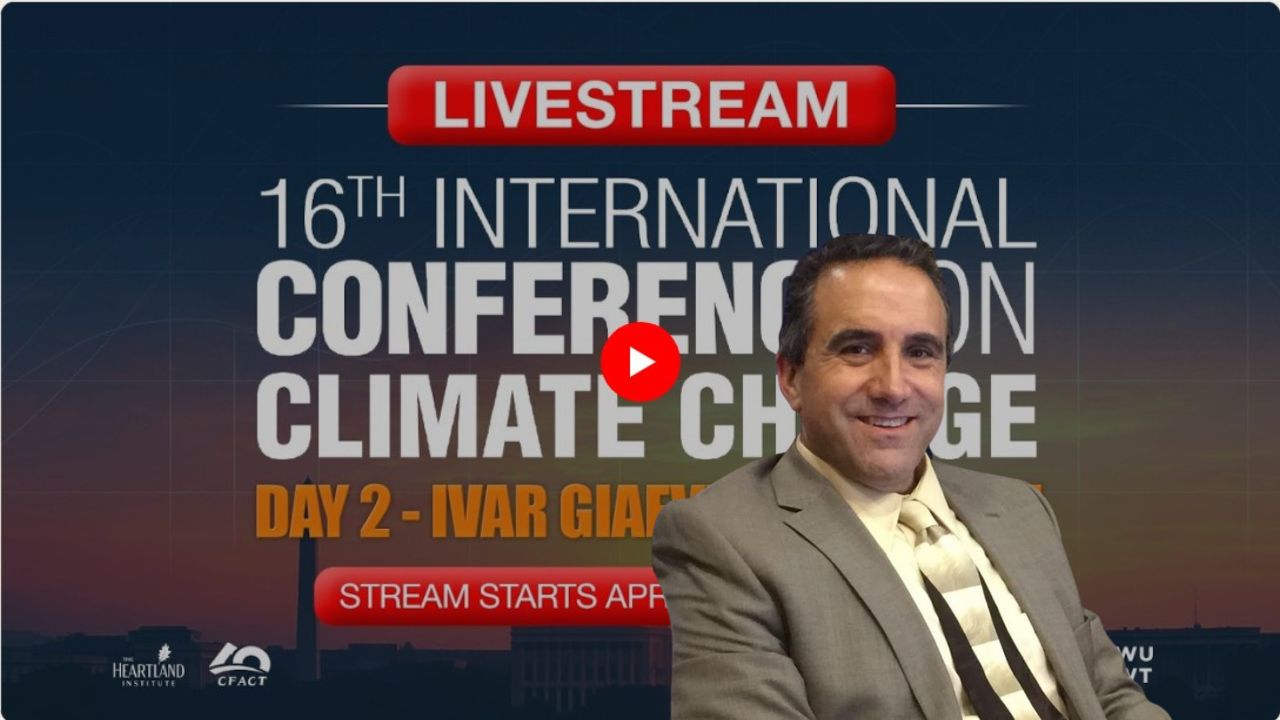
Marc Morano
Marcel Crok
Date: 12 April 2026
The final talk of the 16th International Conference on Climate Conference in Washington DC (8 and 9 April) was given by Marc Morano of the website climatedepot.com. Morano is a longtime follower of the climate agenda (he visited close to all the yearly Conference of the Parties, COP’s). He gave a fascinating overview of how the climate agenda has been crumbling down in the past year or so, not only in the US but around the globe (although Europeans maybe notice this less). He concluded with the remark that we live in the best times for climate realism in the last 50 years.
That’s all good news, but Morano also warned that we aren’t there yet and that the forces behind the climate agenda can or will pop up again, for example these days in the form of energy lockdowns because of the crisis in the Strait of Hormuz. So we have to be very vigilant. But the fact of the matter is that Trump, Chris Wright and administrator Lee Zeldin (who spoke at the Conference) are punching big holes in the climate agenda currently and that the other side is not fighting back at all. They seem to have given up, maybe because of a lack of funding (Bill Gates, Jeff Bezos, Larry Fink all moved away from the climate agenda, partly or mainly because of their interests in AI for which you need dispatchable energy).
The Conference in Washington is organised every year by the Heartland Institute. Clintel and The Heartland Institute (and maybe other organisations) have serious plans to organise next year’s conference in The Netherlands.
The complete recordings of both days (in both rooms) are available on the conference website. You can see the presentation by Clintel Director Marcel Crok: here.
Watch Marc Morano’s lecture below:


more news
AI accurately reconstructs temperatures across Antarctica
Artificial intelligence is increasingly being applied in climate science, with mixed results so far. A new study, however, suggests that deep learning can successfully reconstruct Antarctic surface temperatures despite limited observational data. By combining sparse measurements with reanalysis datasets, the researchers claim to achieve high accuracy—offering new insights into long-term temperature trends across the continent.
Clintel President Václav Klaus warns: “No radical change in Europe in the near future”
We must not be naïve optimists about climate policy and should not overestimate the recent positive signals, like those from President Trump. This is the view of Clintel President Václav Klaus: “Nothing has changed in the European Union. We, with a background in the social sciences, cannot imagine that any radical change will take place in Europe in the near future.” Klaus made these remarks in his speech at the annual meeting of the Norwegian Klimarealistene in Oslo on March 15.

New study finds low CO2-sensitivity again
A new paper by Frank Stefani compares solar variability and CO₂ emissions as drivers of global sea surface temperatures. Using the solar aa geomagnetic index alongside CO₂ data, the study estimates a transient climate response (TCR) of about 1.1–1.4 K, near the lower end of the IPCC range. The results align closely with other observation-based estimates and highlight the continuing scientific debate about the relative roles of solar activity and greenhouse gases in recent climate change.

