
Press release Clintel Foundation
Pope Francis’ Climate Crusade or the erosion of faith in God, a tale of two encyclicals
By uncritically embracing climate catastrophism, Pope Francis, perhaps unwittingly and most certainly unwillingly, rejects the God he clearly tries to serve wholeheartedly. That is the main conclusion of the essay Pope Francis’ Climate Crusade or the erosion of faith in God, a tale of two encyclicals, written by Jaap C. Hanekamp and William M. Briggs and published by Clintel.

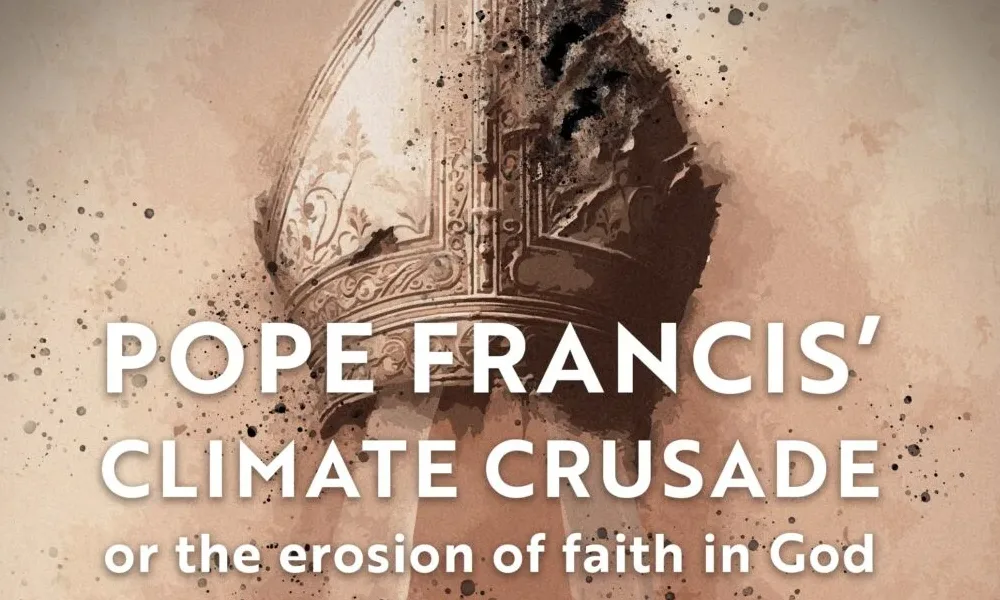
Pope Francis outlined his views on climate change in two encyclicals, Laudato Si’ (2015) and Laudate Deum (2023). Concisely, the Pope fears that the world in which we live is collapsing and may be nearing the breaking point because of climate change. In fact, the Pope announced in his encyclicals that there is a “global climate crisis.”
In the essay Pope Francis’ Climate Crusade or the erosion of faith in God chemist and theologian Jaap C. Hanekamp and statistician and meteorologist William M. Briggs reflect on both encyclicals, though they do not assess the scientific information on climate change as such. Instead, they examine the Pope’s use and understanding of models, and delve deeper into the overarching philosophy that sustains both encyclicals. They conclude that the Pope, carelessly in their view, embraces scientism, and not science, which inadvertently weakens his position, and those that follow his scientistic prescriptions.
Scientism is the ideology that science alone is deemed capable of elucidating and resolving all genuine human problems, and that all human affairs can be reduced to science. Accordingly, scientism is the effort to expand science to all other fields of human affairs, even theology, and to usurp them in a reductionist fashion.
Hanekamp and Briggs conclude that the climate scientism Pope Francis peddles stands diametrically opposed to the Christian worldview. “Scientism of any stripe is incommensurable with not only the Christian faith but also with science.”
About the authors
Jaap C. Hanekamp is a chemist by trade and received his first PhD in 1992. In 2015, he defended his second dissertation: Utopia and Gospel: Unearthing the Good News in Precautionary Culture. He blogs at https://jaaphanekamp.com/. William M. Briggs holds a PhD in Mathematical Sciences and an MS in Atmospheric Physics, and has served in various roles including professor, consultant, and statistician. He blogs at https://www.wmbriggs.com/.
The essay can be downloaded here.
ABOUT CLINTEL
The Climate Intelligence foundation (Clintel) was founded in 2019 by emeritus professor of geophysics Guus Berkhout and science journalist Marcel Crok. Clintel’s main objective is to generate knowledge and understanding of the causes and effects of climate change, as well as the effects of climate policy. Clintel published the World Climate Declaration, which has now been signed by more than 1900 scientists and experts. Its central message is “there is no climate emergency”. In 2023 Clintel published the book The Frozen Climate Views of the IPCC, in which it documented serious errors and biases in the latest IPCC report.
For more information, interview requests with the authors and other reactions, please contact Marcel Crok, director of Clintel, marcel.crok@clintel.org.


more news

In a Warming World, Rising Cold Deaths Outnumber Heat Deaths 12 to 1
A new paper shows that in the USA, cold weather is a much larger contributor to mortality than heat, and that social vulnerability plays a major role in determining outcomes.

“It’s the sun, stupid!” gets new relevance
A new report from the World Meteorological Organization once again led to apocalyptic headlines in the newspapers last week. Unintentionally, writes Marcel Crok, the report opens the door to the most important factor in our climate: the sun.
Yet Another Reason Why Wind And Solar Will Never Work
The idea that wind and solar power can easily replace fossil fuels sounds appealing. But behind this optimistic narrative lie complex technical challenges, such as intermittency, grid stability, and the crucial roles of synchronization and inertia in maintaining a reliable electricity system, concludes Francis Menton after a powerful presentation by Kathryn Porter.

