
Rethinking the Mediterranean Climate Hotspot: New Evidence Reveals a More Complex Reality
Is the Mediterranean really a climate hotspot? Drawing on long-term hydroclimatic observations, Demetris Koutsoyiannis and Theano Iliopoulou revisit the evidence and highlight the region’s striking climatic complexity.

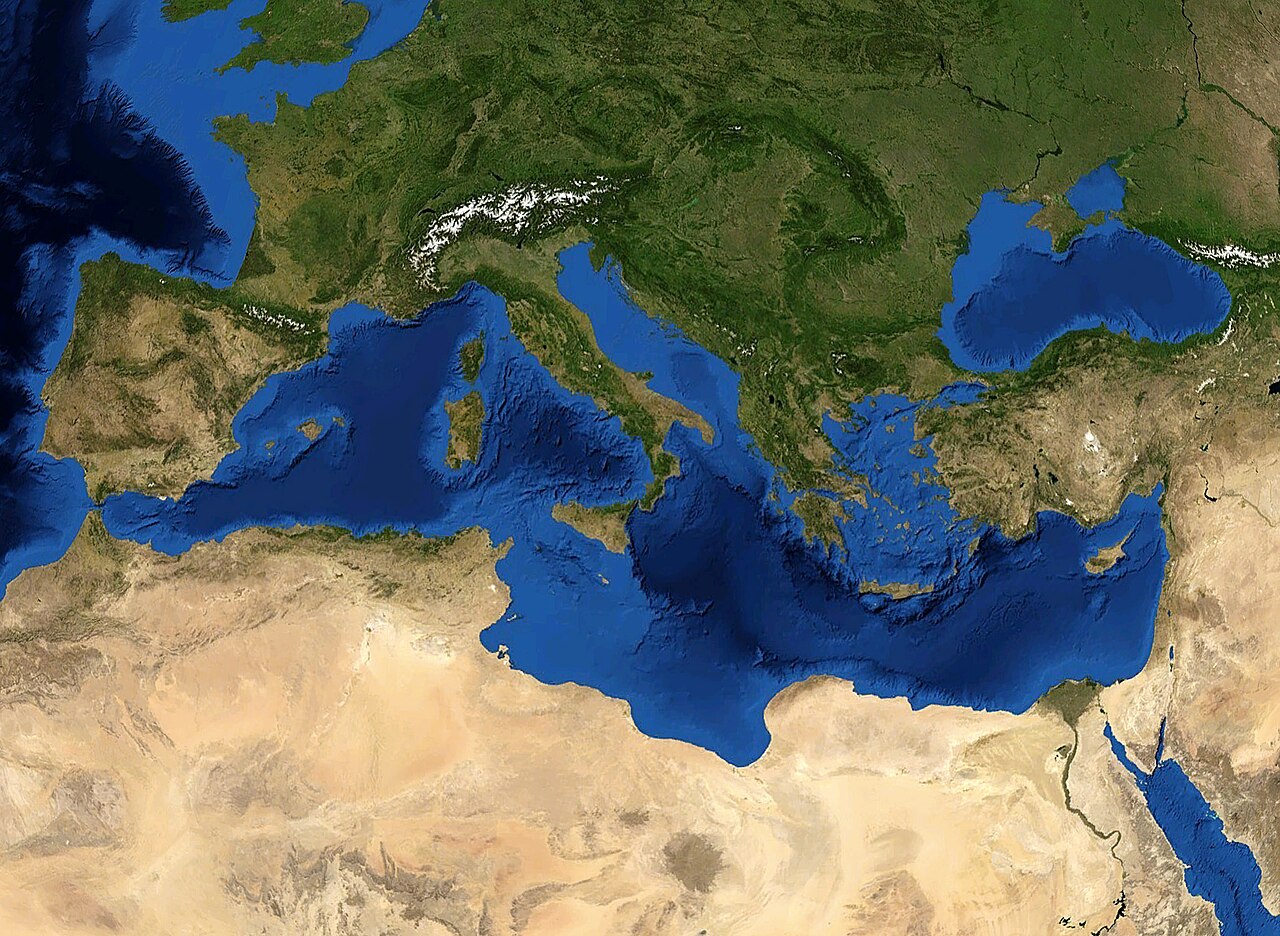
There is very high confidence (to use its own language) that the IPCC designates the Mediterranean as a “climate change hotspot”. In section “10.6.4.6
Future Climate Information From Global Simulations”, IPCC AR6 states (our emphasis):
The Mediterranean is expected to be one of the most prominent and vulnerable climate change hotspots (…). CMIP5, CMIP6, HighResMIP and CORDEX (…) simulations all project a future warming for the 21st century that ranges between 3.5°C and 8.75°C (…). The enhanced summer warming also increases the amplitude of the seasonal cycle (…). Climate models project a reduction in precipitation in all seasons, and a northward and eastward expansion of the Mediterranean climate, with the affected areas becoming more arid with an increased summer drying (…).
The report is full of terrifying predictions for the Mediterranean. Thus, Tables 11.5 and 11.7 suggest (our emphasis):
CMIP6 models project a robust increase in the intensity and frequency of heavy precipitation (…). Additional evidence [sic] from CMIP5 and RCM simulations for an increase in the intensity of heavy precipitation
About wind, section “12.4.1.3 Wind” states (our emphasis):
There is high confidence in climate change-induced future decreasing mean wind, wind energy potential and strong winds in North Africa and Mediterranean regions as a consequence of the poleward shift of the Hadley cell (…) The frequency of Mediterranean wind storms reaching North Africa, including Medicanes, is projected to decrease, but their intensities are projected to increase.
Furthermore, section “12.4.5.2 Wet and Dry” informs us that (our emphasis):
There is high confidence that aridity will increase (…), and high confidence that agricultural, ecological and hydrological droughts will increase in the Mediterranean region (…). There is high confidence in fire weather increase in the Mediterranean region.
Finally, “Box TS.6 | Water Cycle” states (our emphasis):
Projected increases in evapotranspiration due to growing atmospheric water demand will decrease soil moisture over the Mediterranean region,
In earlier studies for parts of the Mediterranean, we showed that the gloomy predictions do not come true — and sometimes the disagreement is entertaining:
D. Koutsoyiannis, and A. Montanari, Climate extrapolations in hydrology: The expanded Bluecat methodology, Hydrology, 9, 86, doi:10.3390/hydrology9050086, 2022.
D. Koutsoyiannis, T. Iliopoulou, A. Koukouvinos, N. Malamos, N. Mamassis, P. Dimitriadis, N. Tepetidis, and D. Markantonis, In search of climate crisis in Greece using hydrological data: 404 Not Found, Water, 15 (9), 1711, doi:10.3390/w15091711, 2023.
We have now a new paper, published last week: 1 This research began as a research project of the undergraduate NTUA students Marianna Lada, Christina-Ioanna Stavropoulou, and Dimitra-Myrto Tourlaki, coauthors of the paper, who were supervised by the other coauthors, in the framework of the course “Stochastic Methods” of the School of Civil Engineering at NTUA (9th semester). The students presented a preliminary version at the EGU 2025 conference:
M. Lada, C.I. Stavropoulou, D.M. Tourlaki, N. Tepetidis, P. Dimitriadis, T. Iliopoulou, and D. Koutsoyiannis, Stochastic analysis of the hydrological cycle in the Mediterranean and its recent climatic variations, European Geosciences Union General Assembly 2025, EGU25-7024, doi:10.5194/egusphere-egu25-7024, European Geosciences Union, 2025.
T. Iliopoulou, M. Lada, C.I. Stavropoulou, D.M. Tourlaki, N. Tepetidis, P. Dimitriadis, and D. Koutsoyiannis, Complexity of hydroclimatic changes in the Mediterranean: Exploring climate drivers using ERA5 reanalysis, Water, 18 (3), 331, doi:10.3390/w18030331, 2026.
In this, we explore the ERA5 reanalysis dataset for 1950–2024 to systematically examine the co-variability of temperature, precipitation, evaporation, sensible heat, column water, and wind across the Mediterranean.
Rather than focusing on a single indicator, in this work we address three central questions:
- Q1: How have key hydroclimatic variables evolved over land, sea, and the integrated Mediterranean domain during 1950–2024, and to what extent do their patterns of change exhibit synchronization or divergence across the region?
- Q2: How has the vertical temperature structure of the Mediterranean atmosphere evolved during 1950–2024, and what does the resulting change in the lapse rate reveal about the distribution of warming across atmospheric layers?
- Q3: To what extent do Mediterranean hydroclimatic processes exhibit long-term persistence, and how does the Hurst–Kolmogorov framework characterize their temporal variability beyond deterministic trends?
Our analysis confirms a strong warming signal across the region, particularly over land. Temperatures near the surface show a strong warming trend, while warming aloft is weaker, producing a gradual steepening of the atmospheric lapse rate.2 About the importance of the lapse rate, see:
D. Koutsoyiannis, and G. Tsakalias, Unsettling the settled: Simple musings on the complex climatic system, Frontiers in Complex Systems, 3, 1617092, doi:10.3389/fcpxs.2025.1617092, 2025.
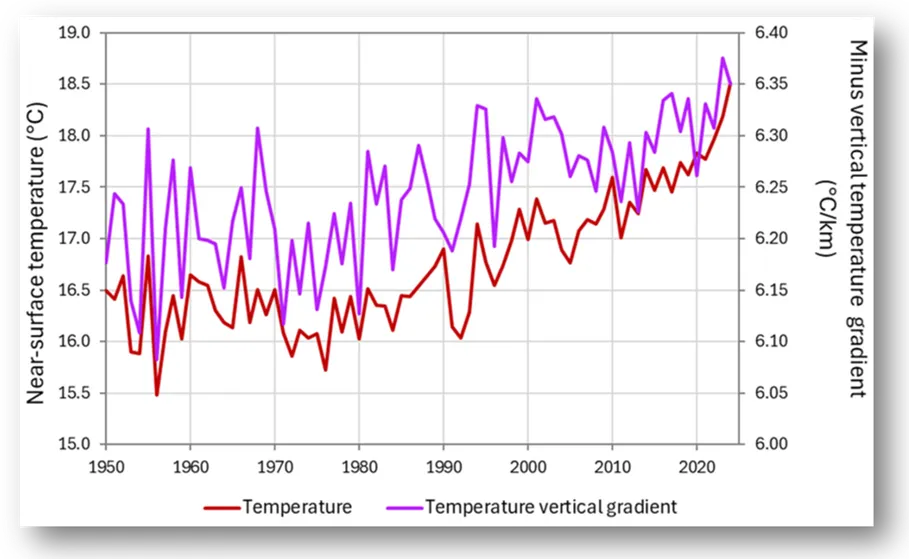
Yet this thermodynamic signal does not translate into systematic changes in rainfall or evaporation.
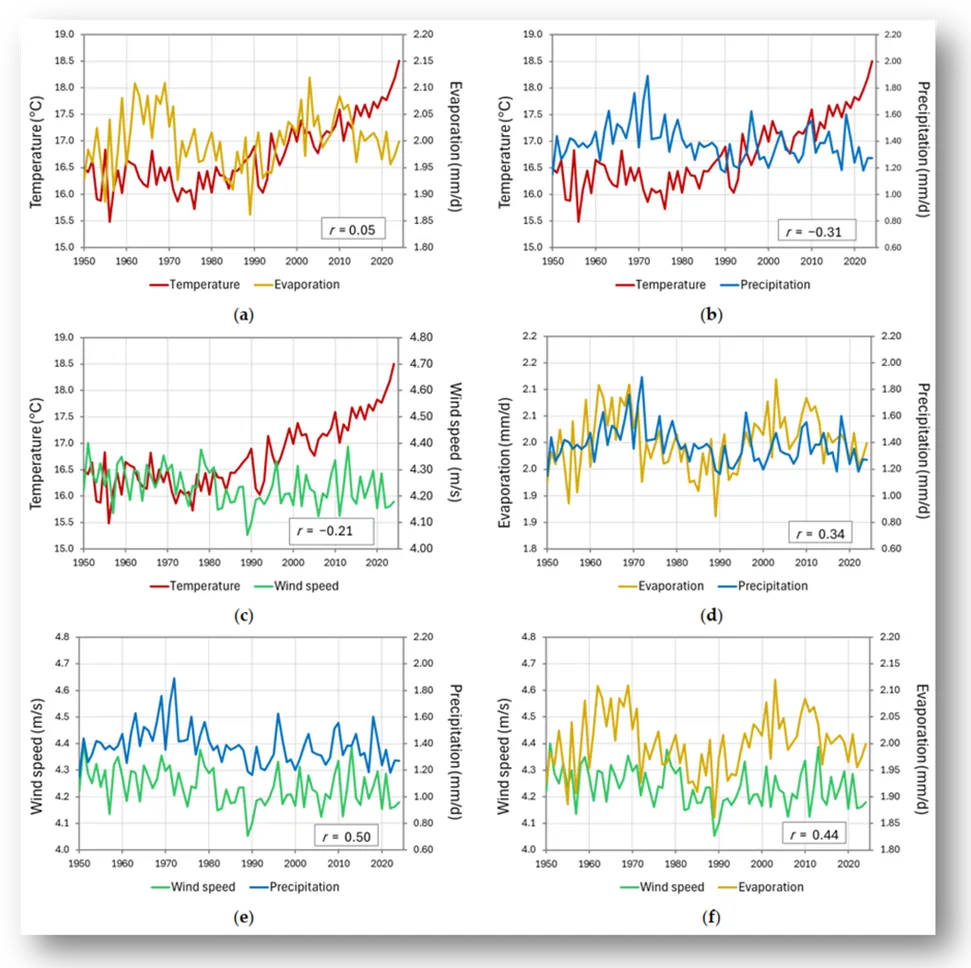
Instead, the complexity of Mediterranean climate dynamics is manifest, as evidenced by in the divergence between land and sea, the lack of synchronized changes among variables, and the departure of observed patterns from those expected based solely on simplified thermodynamics or temperature trends.
Apart from temperature, the other climatic variable do not show a noteworthy monotonic trend. One particularly useful result is that precipitation and evaporation are positively correlated, and both are also positively correlated with wind speed. The latter is slightly decreasing, as is zonal wind, thus negatively affecting evaporation, which, despite IPCC expectations, has not increased.
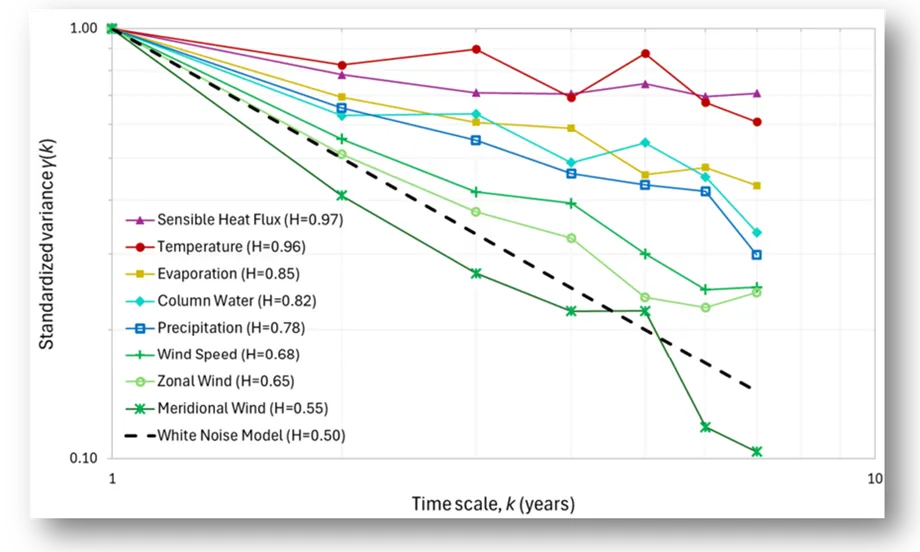
Using a Hurst–Kolmogorov perspective, the study further shows that Mediterranean hydroclimatic processes exhibit long-term persistence, revealing a climate system whose variability extends well beyond deterministic trends.
Our general conclusion is the following:
The complex and non-linear coupling among atmospheric circulation, surface conditions, and atmospheric moisture availability challenges simplified expectations that link warming directly to hydrological-cycle intensification, including those arising from constant relative-humidity interpretations of the Clausius–Clapeyron relationship. Rather than a uniform “hotspot” of climate change, the Mediterranean appears as a region where warming, circulation patterns, and surface–atmosphere feedbacks interact with substantial spatial and temporal complexity.
Footnotes:
- 1This research began as a research project of the undergraduate NTUA students Marianna Lada, Christina-Ioanna Stavropoulou, and Dimitra-Myrto Tourlaki, coauthors of the paper, who were supervised by the other coauthors, in the framework of the course “Stochastic Methods” of the School of Civil Engineering at NTUA (9th semester). The students presented a preliminary version at the EGU 2025 conference:
M. Lada, C.I. Stavropoulou, D.M. Tourlaki, N. Tepetidis, P. Dimitriadis, T. Iliopoulou, and D. Koutsoyiannis, Stochastic analysis of the hydrological cycle in the Mediterranean and its recent climatic variations, European Geosciences Union General Assembly 2025, EGU25-7024, doi:10.5194/egusphere-egu25-7024, European Geosciences Union, 2025. - 2

This article was published under the title ‘Mediterranean: climate change hotspot or notspot?’ on 5 February 2026 on climath.substack.com.

more news
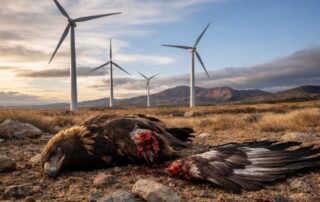
The ‘green’ transition is running red with the blood of animals
We must stop the reckless expansion of low-density energy projects (wind and solar) in valuable ecosystems, says Vijay Jayaray. The ‘green’ transition is running red with the blood of the creatures we are supposed to protect.

Europe’s Energy Armageddon
The haughty European ruling class that alienated hydrocarbon suppliers while betting the continent’s future on intermittent wind and solar, is discovering the limits of its own propaganda. Europe’s Hormuz Armageddon is not merely an energy crisis. It is the moment the post-war geopolitical illusion ends — and the real multipolar world, cold, hard and unforgiving, begins, says Tilak Doshi.

Matt Ridley thinks the Climate Parrot is almost dead
In his recent ICSF/Clintel lecture, Matt Ridley argued that public and political momentum behind the “climate emergency” narrative is weakening, and he explored the reasons for this shift as well as its implications.
- 1This research began as a research project of the undergraduate NTUA students Marianna Lada, Christina-Ioanna Stavropoulou, and Dimitra-Myrto Tourlaki, coauthors of the paper, who were supervised by the other coauthors, in the framework of the course “Stochastic Methods” of the School of Civil Engineering at NTUA (9th semester). The students presented a preliminary version at the EGU 2025 conference:
M. Lada, C.I. Stavropoulou, D.M. Tourlaki, N. Tepetidis, P. Dimitriadis, T. Iliopoulou, and D. Koutsoyiannis, Stochastic analysis of the hydrological cycle in the Mediterranean and its recent climatic variations, European Geosciences Union General Assembly 2025, EGU25-7024, doi:10.5194/egusphere-egu25-7024, European Geosciences Union, 2025. - 2

