Roger Pielke Jr.: “The correction came far too slowly”
Now that the extreme climate scenario RCP 8.5 has finally been abandoned, the debate has shifted significantly, says Roger Pielke Jr. The American researcher recently gave an interview to the Global Warming Policy Foundation.
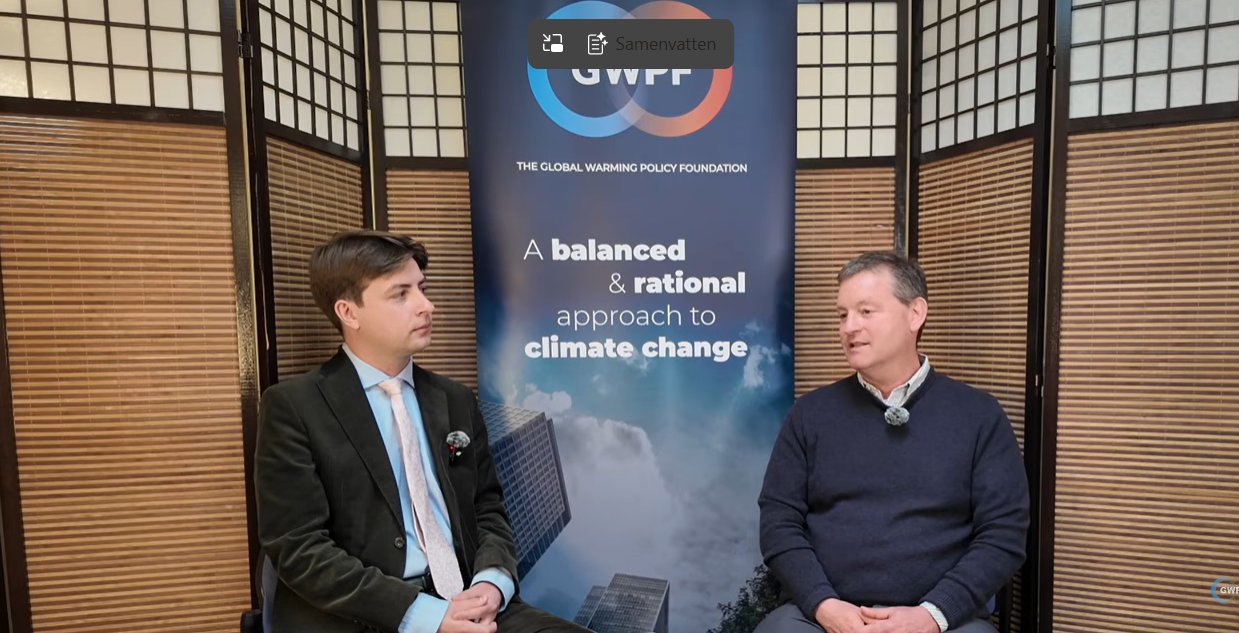
Roger Pielke Jr. in conversation with the GWPF
Clintel Foundation
Date: 16 May 2026
Roger Pielke Jr.’s recent conversation with the Global Warming Policy Foundation begins off course with what he describes as one of the most important developments in climate science and policy in recent years: the effective “death” of the emission scenario known as RCP 8.5.
You can see the full interview here:
For more than a decade, this scenario formed the backbone of many of the world’s most alarming climate projections. It shaped scientific research, government policy, financial regulation, infrastructure planning, media coverage, and public understanding of climate change. According to Pielke, the gradual abandonment of RCP 8.5 represents not merely a technical adjustment within climate modeling, but a profound correction to the assumptions that have dominated climate discourse for years.
Assumptions
Pielke begins by explaining the central role that socioeconomic scenarios play in climate science. Climate models do not simply project future temperatures on their own; they require assumptions about how human societies will evolve over decades. “Climate models run first and foremost on inputs from socioeconomic scenarios.” These scenarios attempt to estimate future population growth, economic development, technological innovation, energy systems, and patterns of fuel use. Because none of these variables can be predicted with certainty, climate scientists rely on multiple scenarios representing different possible futures.
The Representative Concentration Pathways, or RCPs, were developed more than twenty years ago as standardized emissions trajectories for climate modeling. Four main pathways were created: RCP 2.6, 4.5, 6.0, and 8.5, with the numbers corresponding to different levels of radiative forcing by the year 2100. RCP 2.6 roughly aligned with ambitious climate mitigation goals and lower warming outcomes, while RCP 8.5 represented the highest-emissions future, associated with approximately 5°C of warming by the end of the century.
Over time, however, RCP 8.5 evolved far beyond its original role as a stress-test scenario. It increasingly became treated as the default “business-as-usual” future — the world that would emerge if governments failed to take aggressive climate action. Pielke argues that this transformation had enormous consequences. “If you see a headline about how climate change is going to affect society… odds are it’s going to be based on RCP 8.5,” he observes. Even people unfamiliar with the technical terminology were constantly exposed to conclusions generated from this extreme scenario.
Never plausible
According to Pielke, the influence of RCP 8.5 spread well beyond academic climate science. Governments incorporated it into adaptation planning, financial regulators embedded it into banking stress tests, and engineers used it to inform decisions about infrastructure, flood defences, airports, and urban planning. The scenario became deeply institutionalized across the developed world. Its assumptions shaped not only scientific papers but also political rhetoric and public fear about climate change.
The central problem, Pielke argues, is that RCP 8.5 was never a plausible representation of likely future emissions. The scenario relied on assumptions that increasingly diverged from real-world energy trends. In particular, it assumed a massive expansion of coal use throughout the twenty-first century, including the replacement of cleaner energy sources with coal-derived fuels. The scenario effectively envisioned a world that abandoned trends already underway toward natural gas, nuclear energy, and renewables.
Pielke explains that research led by his colleague Justin Ritchie demonstrated years ago that these assumptions were unrealistic. “That theory is wrong,” Pielke says bluntly. The world was not moving toward a coal-dominated future and likely never had been. Yet despite growing evidence against the scenario, RCP 8.5 remained deeply embedded in climate research and public communication for nearly a decade after the first major critiques appeared.
Slow correction
One of the interview’s most important themes is the tension between the self-correcting nature of science and the slowness of institutional change. Pielke emphasizes that science does eventually correct errors. “One of the most valuable aspects of science is that it’s self-correcting,” he says. However, he also argues that in this case the correction came far too slowly given the immense policy significance of the issue. Tens of thousands of studies continued to use RCP 8.5 even after its assumptions had become increasingly detached from observable trends.
Pielke believes that the persistence of RCP 8.5 was not simply an innocent scientific oversight. He suggests that the scenario’s dramatic projections made it politically and rhetorically useful. Worst-case outcomes generated alarming headlines, strengthened arguments for rapid policy intervention, and reinforced narratives of climate emergency. The scenario therefore acquired institutional momentum even as doubts about its plausibility grew stronger.
Policy was not the reason
A major part of the discussion addresses the argument now advanced by some climate advocates that the world avoided the RCP 8.5 pathway because climate policy succeeded. According to this interpretation, international agreements, renewable subsidies, carbon taxes, and other interventions “bent the curve” away from catastrophic emissions trajectories. Pielke strongly disputes this claim. “There’s no good evidence that the reason was policy,” he states.
Instead, he argues that the divergence from RCP 8.5 occurred because the original scenario was fundamentally flawed. Empirical evidence shows that rates of decarbonization and changes in energy intensity did not suddenly accelerate after major climate agreements. Rather, the assumptions behind RCP 8.5 were inconsistent with the way energy systems were already evolving. In his view, the narrative that aggressive climate policy “saved the world” from RCP 8.5 serves partly as a face-saving explanation for why the scenario turned out to be unrealistic.
Pielke also reflects on the political consequences of challenging dominant assumptions within climate science. For years, critics of RCP 8.5 and other worst-case projections were often marginalized or attacked. Pielke himself became a prominent target. He recalls being investigated by members of the U.S. Congress and publicly denounced for questioning mainstream climate narratives. He describes how even sympathetic colleagues often hesitated to defend him publicly out of fear for their own careers.
Significant shift
Despite this, Pielke now believes that the debate has shifted significantly. The retirement of RCP 8.5 by mainstream scientific bodies represents, in his view, a delayed vindication of critiques that were once dismissed as politically suspect. Looking back, he remarks that “the work that I and my colleagues did has stood the test of time.”
Beyond the RCP 8.5 controversy, the interview touches on several related topics in climate science and policy. Pielke discusses the evidence surrounding extreme weather events, emphasizing that scientific confidence varies greatly depending on the phenomenon. Heat waves and heavy precipitation show detectable trends linked to greenhouse gases, but for many other events — including hurricanes, tornadoes, floods, and droughts — the evidence remains far more uncertain. “For most metrics of extreme weather, there has not been detection or attribution,” he explains, stressing that this reflects the conclusions of the IPCC itself rather than a fringe position.
He is particularly critical of the rise of “attribution science,” a field that attempts to quantify how much climate change contributed to individual disasters. Pielke argues that these studies often blur the distinction between long-term climate trends and the complex causes of specific weather events. In his view, they frequently generate misleading certainty and serve media and legal agendas more than scientific understanding.
Climate litigation
The interview also explores climate litigation, especially lawsuits against governments and fossil fuel companies. Pielke argues that litigation is unlikely to significantly affect the pace of decarbonization, which depends primarily on technological innovation and energy systems rather than courtroom decisions.
On economic policy, Pielke discusses recent research questioning the reliability of models linking global temperature changes to GDP impacts. He argues that many economic damage estimates rely on fragile assumptions and statistical methods that cannot robustly predict future outcomes. While he accepts that climate change may have economic consequences, he is skeptical of claims that precise global damage functions can be scientifically established.
Despite his criticisms of climate alarmism, Pielke is not opposed to decarbonization itself. He argues that economies have been gradually decarbonizing for decades as a natural consequence of technological progress, efficiency gains, and transitions toward cleaner energy sources. He supports pragmatic energy policies that balance affordability, security, growth, and emissions reductions. He also supports carbon pricing in principle, though he argues that politically realistic measures matter more than theoretically perfect solutions.
In the final part of the conversation, Pielke reflects on the broader evolution of climate discourse over the past twenty years. He acknowledges frustration at how slowly scientific and political systems respond to criticism and evidence. Yet he also expresses cautious optimism that the debate is becoming more rational and empirically grounded. The retreat from RCP 8.5, he suggests, may represent the beginning of a more balanced approach to climate science — one less dominated by worst-case scenarios and exaggerated certainty, and more attentive to realism, evidence, and the complexity of energy transitions.

more news

“Complete elimination of all ruminants would reduce temperature by only 0.05°C”
In a recent lecture prof. William Happer showed that even the complete elimination of all ruminants would reduce global temperatures by only about 0.05°C. The effect is so small that it calls into question the justification for aggressive mitigation policies targeting these methane producing animals, like cows.
We are nowhere near a Climate Tipping Point
A recent paper predicts an irreversible disaster beyond which the planet would become unbearably hot. But a careful look at the evidence reveals this claim to be absurd, with no sign that we are currently anywhere close to such a climate tipping point.
Understanding the Psychology of Climate Doom
The persistence of ‘climate doom’ narratives isn’t mysterious—it follows recognizable psychological and social patterns, says Anthony Watts.