
The Strait of Hormuz’s Bitter Lesson for the European Union
Strait of Hormuz Europe energy vulnerability, In May 2023, Ursula von der Leyen, President of the European Commission, declared that the fossil-fuel-based growth model is “simply obsolete.” The partial blockade of the Strait of Hormuz starkly exposes the irony of that statement, says Samuel Furfari.

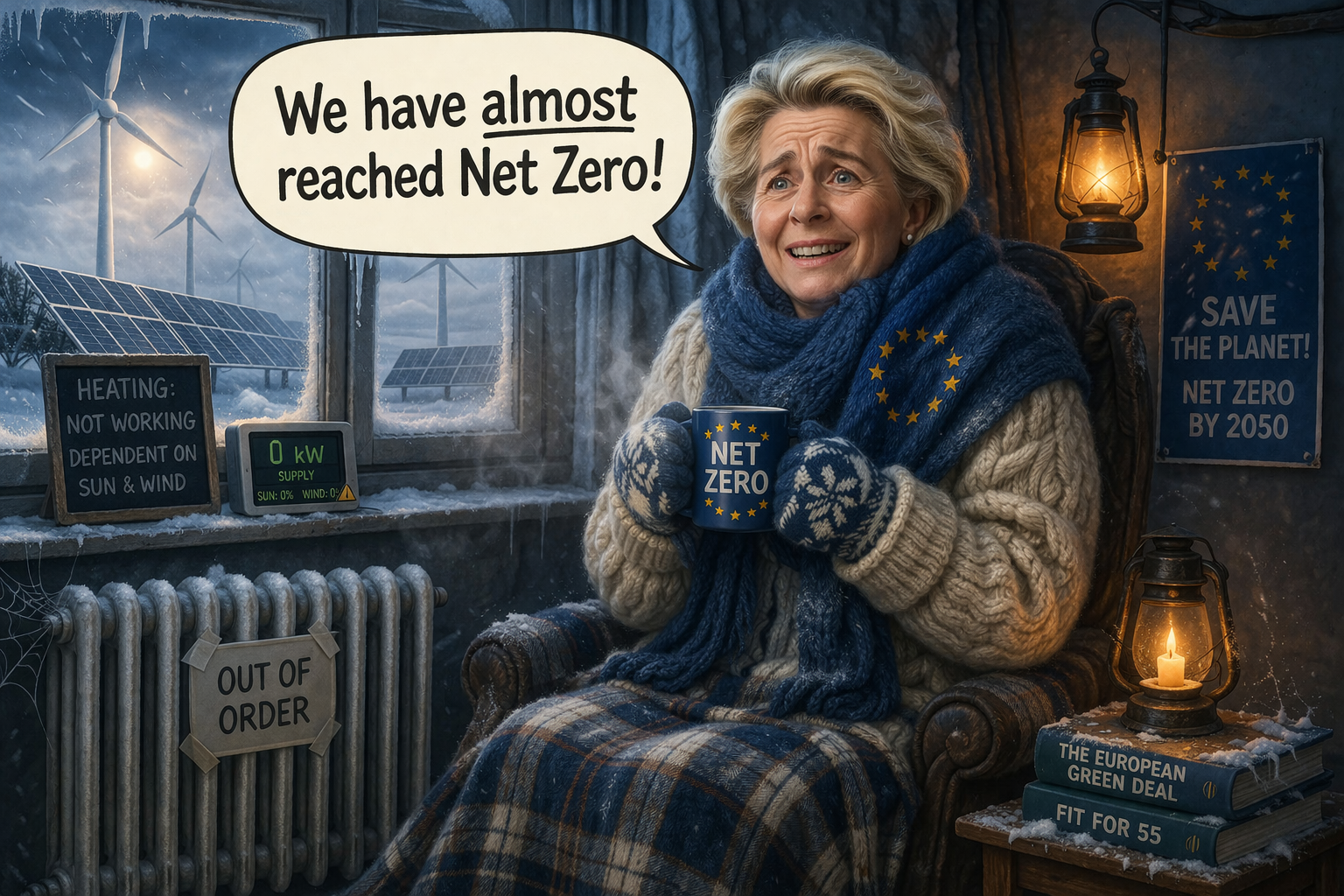
Ursula von der Leyen almost enjoying Net Zero (image created with ChatGPT)
Samuel Furfari
Date: 3 April 2026
The crisis in the Strait of Hormuz reveals a truth that many European policymakers have ignored: Humanity remains structurally dependent on oil. This reality, first highlighted during the 1973 oil shortage and reinforced by the 1979 version – triggered by Iran – continues to be neglected, even openly dismissed, by certain political elites.
A half century later, energy insecurity persists with undiminished intensity. Yet as early as 2000, the European Commission emphasized the imperative for the European Union to ensure the security of energy supplies. Those warnings, however, were not heeded, as priority was given instead to reducing CO₂ emissions and promoting “renewable” energy.
Disastrous
As a former official in the European Commission’s Directorate-General for Energy for 36 years, I have witnessed relentless efforts to promote so-called alternatives to hydrocarbons and their disastrous results. Yet, in the face of the current crisis, the EU refuses to recognize its desperate need for fossil fuels.
In May 2023, Ursula von der Leyen, President of the European Commission, declared that the fossil-fuel-based growth model is “simply obsolete.” The partial blockade of the Strait of Hormuz starkly exposes the irony of that statement.
Nevertheless, most political leaders continue to claim simplistically that expansion of wind and solar power will free us from dependence on the Strait.
This view is not only naïve but also mistaken, as it stems from a fundamental confusion between electricity and energy. Wind turbines and solar panels produce electricity, but they do not generate heat – the essential driver of industrial processes, transportation and heating. Today, roughly 75% of the primary energy consumed in the European Union comes from fossil fuels, while the global share remains about 87%. It is illusory to believe that “renewable” electricity can meet basic needs.
Exorbitant costs
Beyond being unable to fill overall energy demand, wind and solar also impose exorbitant – and well-documented – costs on consumers and businesses. Instead of pursuing inadequate alternatives, the EU should acknowledge that oil will remain indispensable for a very long time and abandon its delusional “green” credo.
The EU must produce the hydrocarbons it needs rather than continue relying on imports. For now, such production is constrained by legislative bans and political choices that are disconnected from geopolitical realities. In France, for example, the Hulot law prohibits the exploitation of hydrocarbons, despite the country’s significant potential in this area.
The Equatorial Margin of South America, stretching from northern Brazil to Venezuela, is rich in hydrocarbons. Guyana, located east of Venezuela, is establishing itself – thanks to U.S. companies – as an oil Eldorado of impressive proportions.
Aware of this windfall, Brazilian President Lula da Silva decided to begin exploration of the Equatorial Margin in open contradiction to Brazil’s own climate-governance rhetoric.
Meanwhile, French Guiana, although in the heart of this highly promising zone, remains paralyzed by legislative prohibitions. A French minister recently attempted to reopen the question, but President Emmanuel Macron rebuked him.
French intransigence to reality contrasts with Asian pragmatism that pursues domestic energy development in a variety of forms and displays geopolitical savvy. China, India, and Japan have already secured assurances from the Iranian Revolutionary Guards to protect their navigation in the Persian Gulf.
New era
The EU must recognize that the world has entered a new era of energy geopolitics, shaped by the abundance of fossil fuels, the determination of new players asserting themselves in this evolving landscape, and, above all, the resolve of emerging countries to secure their future through abundant and affordable energy. This is the true lesson of the Strait of Hormuz.
In this context, the so‑called energy transition to wind and solar power is exposed as a political illusion specific to an EU under pressure on all fronts. At the March European Council, several member states called for abandoning the carbon tax – disguised under the label of the Emissions Trading System – and obtained a revision of this mechanism in the hope of ending economic self‑sabotage.
Domestic oil and gas production could, at the very least, substantially replace hydrocarbons that the EU imports from the Persian Gulf. It is time to move beyond simplistic rhetoric and adopt a realistic, balanced approach. If the European Union is to meet the challenges of the 21st century, it must make judicious use of its own hydrocarbons and abandon its futile quest for decarbonization.

This commentary was first published at Washington Examiner on 30 March 2026.
Dr. Samuel Furfari
Dr. Samuel Furfari is a professor of energy geopolitics in Brussels and London, a former senior official with the European Commission’s Directorate-General for Energy and a member of the CO2 Coalition. He is author of the paper, “Energy Addition, Not Transition,” and 18 books, including “The Truth About the COPs: 30 years of illusions.”

more news

Trump Admin Hires Sceptic Matthew Wielicki to Run National Climate Assessment
The U.S. Global Change Research Program has a new boss: Dr. Matthew Wielicki. He is a former University of Alabama geochemist, a self-described professor in exile, who spends a fair amount of time questioning mainstream climate science online. He will now oversee the program’s flagship product, the congressionally mandated National Climate Assessment.

The dark green lobby that nobody talks about
There is a highly influential lobbying group in Europe, founded and based in The Hague, which you have never heard of: the European Climate Foundation. With an annual budget of hundreds of millions of euros, funded by American billionaires, it successfully lobbies for climate neutrality in Europe. Yet the media remains deafeningly silent on this group

Nicola Scafetta on Tom Nelson’s podcast: the limitations of global climate models
Nicola Scafetta recently talked about his new book Frontiers of Climate Science: Solar Variability, Cycles and Model Uncertainty on Tom Nelson’s podcast. The book is an attempt to encourage a broader discussion about the uncertainties that remain in climate science and the limitations of contemporary global climate models.

