
We are nowhere near a Climate Tipping Point
A recent paper predicts an irreversible disaster beyond which the planet would become unbearably hot. But a careful look at the evidence reveals this claim to be absurd, with no sign that we are currently anywhere close to such a climate tipping point.
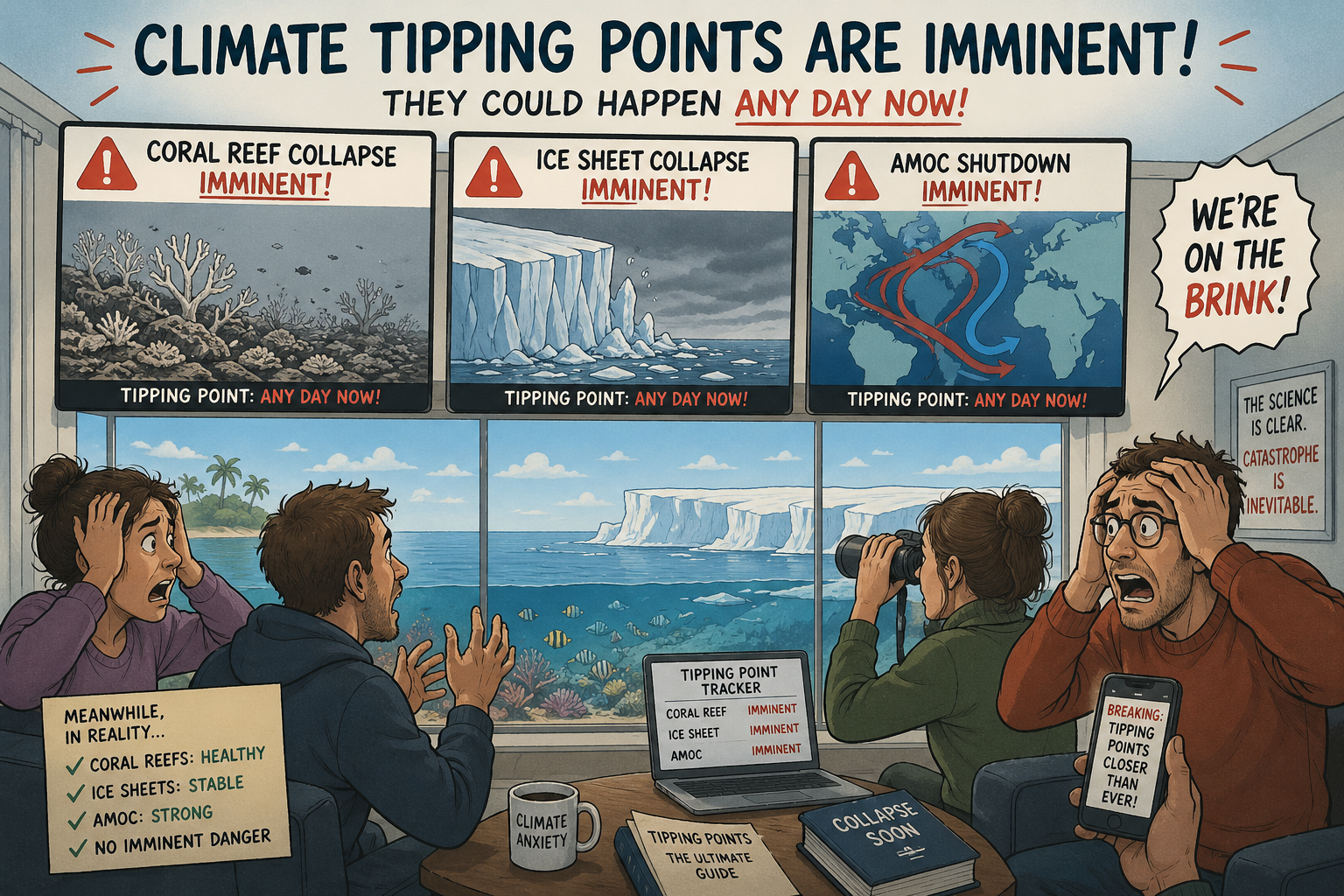
Image created with ChatGPT
Ralph Alexander
Date: 29 April 2026
A recent paper raises the specter of the earth’s climate being on a “hothouse trajectory” – a pathway in which self-reinforcing feedbacks push the climate system past a point of no return, an irreversible disaster beyond which the planet would become unbearably hot. But a careful look at the evidence reveals this claim to be absurd, with no sign that we are currently anywhere close to such a tipping point.
This is not a new form of alarmism. In fact, the paper’s lead author published another paper over six years ago titled “World Scientists’ Warning of a Climate Emergency,” perhaps the beginning of the recent obsession with the erroneous notion of a climate crisis caused by global warming. And a new NGO (non-governmental organization), Global Tipping Points, has in 2023 and 2025 produced fearmongering reports on tipping points.
Extreme weather
That we are approaching a tipping point, insists the new paper, is evident from an imagined surge in extreme weather that the paper claims is becoming “more frequent, intense, and costly.” However, the observational evidence shows that most forms of extreme weather are becoming neither more frequent nor more intense, as I’ve demonstrated numerous times in these pages (see Category “Weather extremes”). The increasing costs of natural disasters are simply a result of population gain and the ever-escalating value of property in harm’s way.
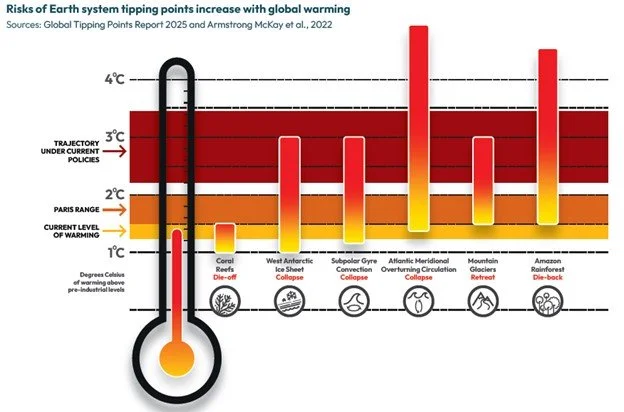
The NGO’s 2025 report features the following summary of supposed global-warming-enhanced tipping points faced by our earth. The vertical bars represent the range of anticipated temperature increases that would trigger various tipping points. The report’s purported nearness of tipping points is reflected in the lower limits of all the bars being in the current level of warming band.
Nevertheless, it’s not difficult to show that none of these tipping points – nor several others cited in the report – are imminent. I’ll discuss just three here: coral reefs, ice sheets, and the AMOC (Atlantic Meridional Overturning Circulation).
Coral reefs
According to the figure above, die-off of low-latitude coral reefs has already begun, with an estimated tipping point of 1.2 degrees Celsius above preindustrial temperatures. This shortsighted claim, probably based on temporary losses in global coral cover during the recent period of elevated sea surface temperatures, is irrational.
Australian physicist and leading coral reef authority, Professor Peter Ridd has explained in a 2023 report that most corals that bleach due to higher temperatures do not die, but are capable of rapid recovery in a decade or less. This is exemplified by studies of Australia’s Great Barrier Reef, which has the most reliable long-term record of large-area coral cover. Despite four supposedly catastrophic bleaching events in the six years prior to 2022, the reef’s coral cover reached a record high in 2024, as depicted in the image on the left below.
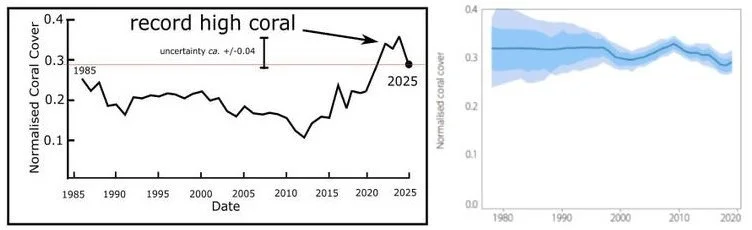
The image on the right shows the estimated global average cover of hard coral (solid line) and its associated uncertainty (shaded areas) since the late 1970s. Note that data before the late 1990s is of little value, says Ridd, because of small sample sizes; but the data since then reveals little overall variation – certainly nothing suggestive of a tipping point, either already passed or impending.
Antarctica
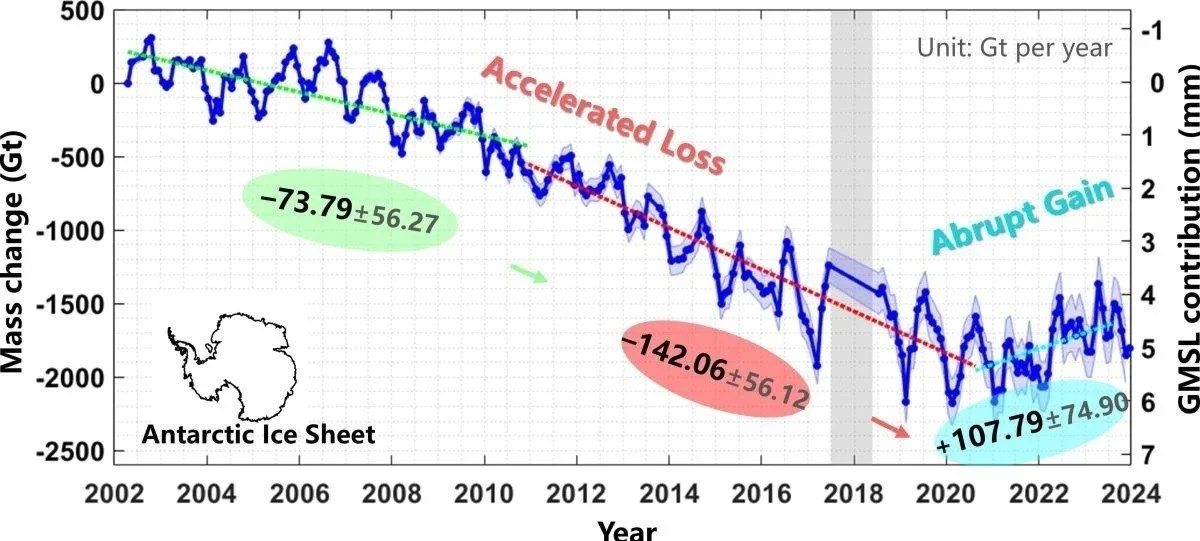
As for likely collapse of the West Antarctic ice sheet, there’s no evidence that such a catastrophic event is just around the corner either. As I discussed in a 2025 post, the Antarctic ice sheet overall is growing, and no longer melting, for the first time in decades. This is illustrated in the figure below, which shows changes in Antarctic ice sheet mass from April 2002 to December 2023, measured in billions of tonnes.
AMOC
Finally, I also discussed the very unlikely slowing down, let alone collapse, of the AMOC in a very recent blog post. All claims of impending doom rely on computer climate models, which have a generally poor history of making predictions. Although some models do indeed support the existence of a weakened AMOC, such cherry picking is highly unscientific and many of the ignored models in fact simulate a strengthened AMOC.
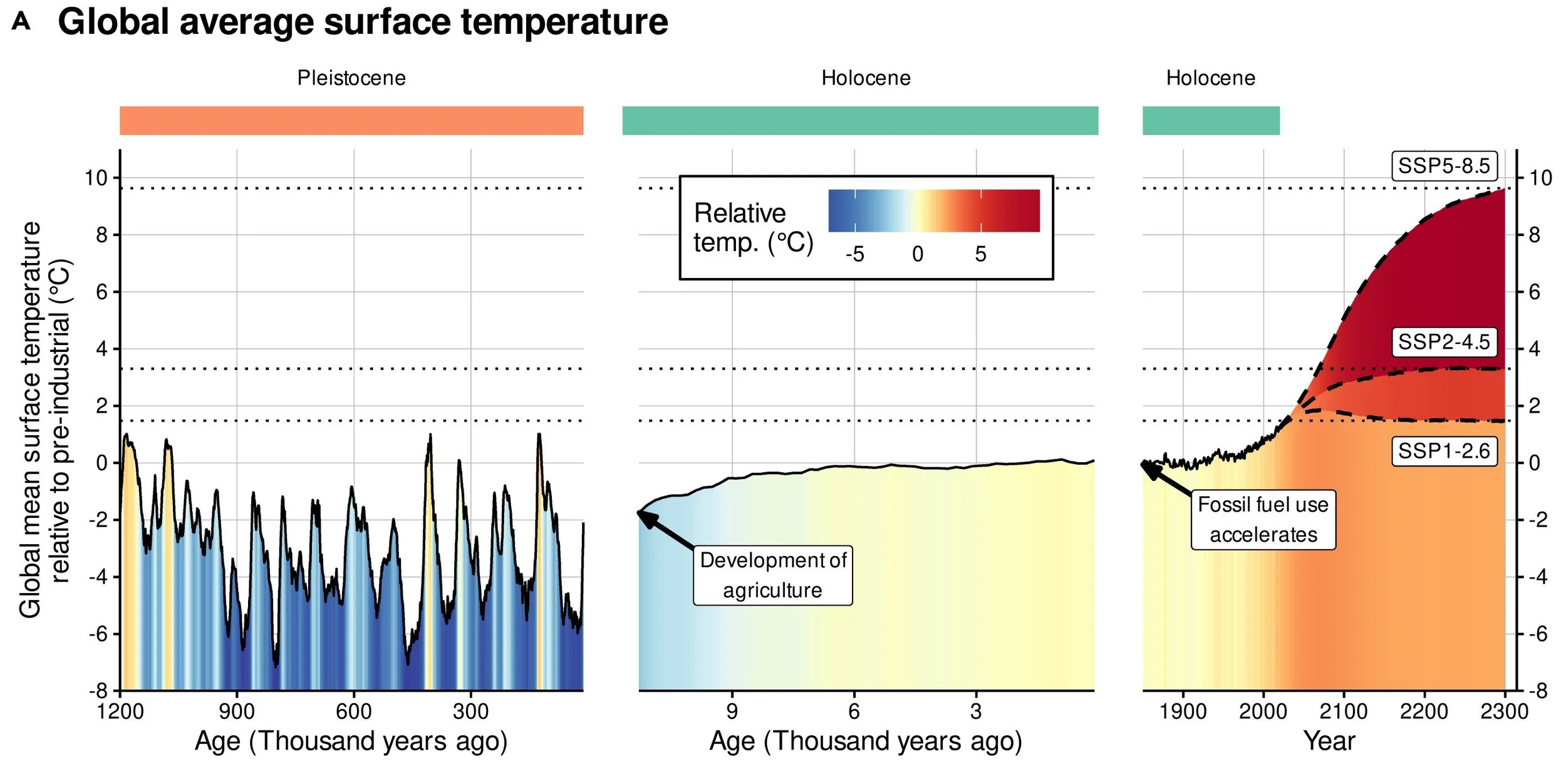
The next figure, from the new paper, graphs the mean global temperature over past millennia, with future projections based on so-called SSPs (Shared Socioeconomic Pathways) that range from low- to high-emission scenarios. As climate writer Roger Pielke Jr. has emphasized on many occasions (see here, for example), high-emission scenarios such as SSP5-8.5 are implausibly extreme. More realistic scenarios such as SSP1-2.6 or even SSP2-4.5 will produce only modest warming in the near future, with no likelihood of triggering tipping points.
This article was published first on Science under Attack on 27 April 2026.

Ralph B. Alexander
Ralph B. Alexander, a science writer who puts science above political correctness, is the author of several recent reports on weather extremes and global warming; he has also authored “Science Under Attack: The Age of Unreason” and “Global Warming False Alarm”. With a PhD in physics from the University of Oxford, he has written numerous scientific research papers and reports on complex technical issues. Dr. Alexander has been a researcher at laboratories in Europe and Australia, a professor at Wayne State University in Detroit, the co-founder of an entrepreneurial materials company, and a market analyst in environmentally friendly materials for a small consulting firm. He grew up in Perth, Western Australia and currently lives in California.

more news

Henrik Svensmark fired by his university
Danish scientist Henrik Svensmark, known for his controversial research on cosmic rays and cloud formation, has been dismissed by his university in Copenhagen after years of internal conflict. In an interview with the Danish newspaper Berlingske, he described the decision as “a death blow” to his research.

Steven Koonin: “There Is a Significant Gap Between What Climate Science Says and What You’ve Been Told It Says”
During the ARC Conference 2026, American physicist Steven Koonin argued that there is "a very significant gap" between what climate science actually says and what the public has been told it says. The former science adviser to President Barack Obama calls for a more honest debate about climate science, scientific uncertainty and climate policy.

The Desperate Attempt to Save the Climate Alarm Narrative
In this commentary, energy analyst Tilak Doshi examines the growing debate over climate messaging within the Democratic Party. He argues that political leaders are quietly retreating from climate alarmism as voters become increasingly concerned about the costs of decarbonisation.

