
China cooks the carbon accounting books by 400 million tons
China treats us like mugs and we cheer it on, says Jo Nova. Almost no one cares that the largest emitter on Earth has gaping holes in its CO2-numbers.

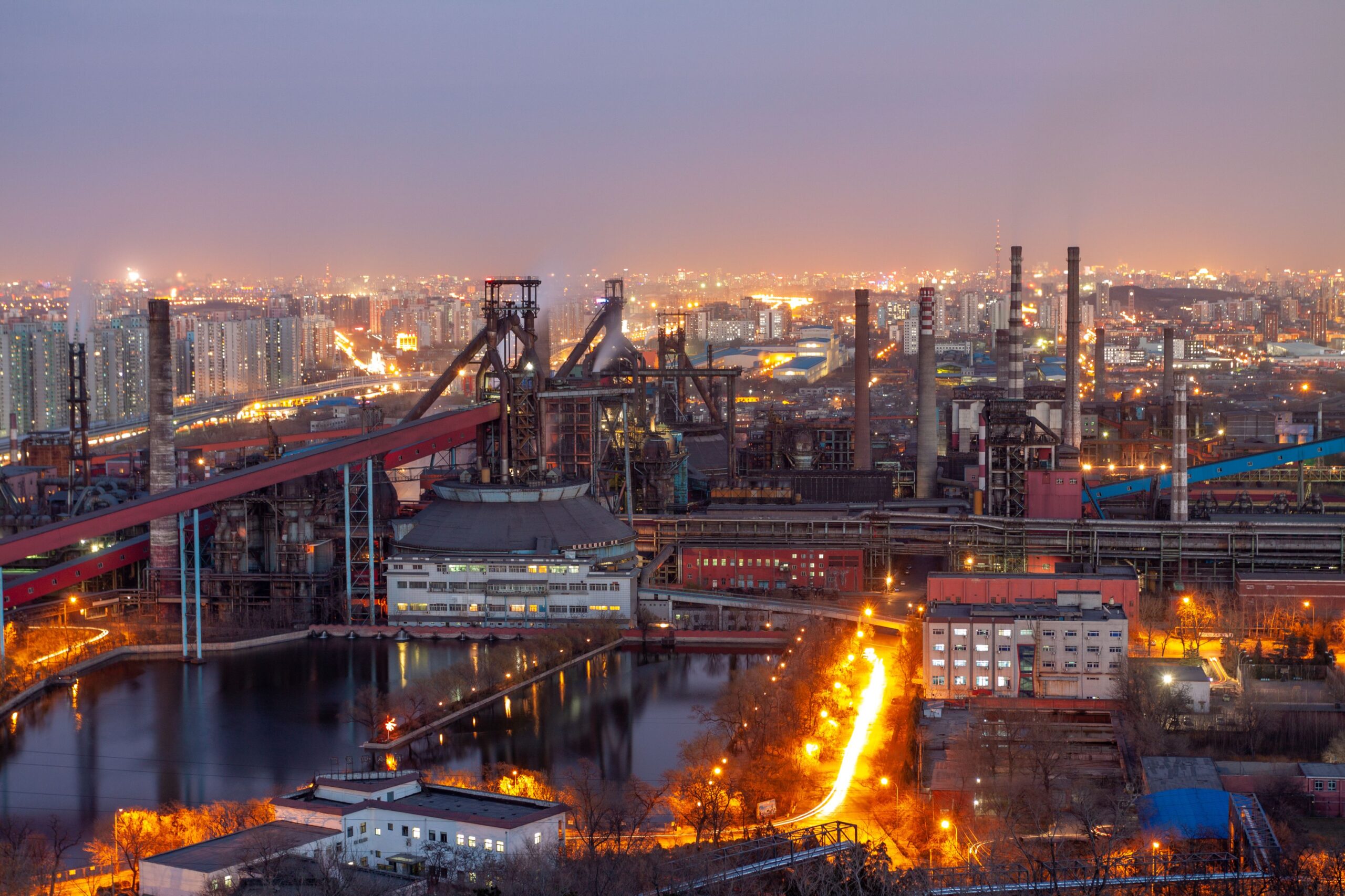
Overlooking Beijing Shougang Industrial Zone. (Source: Shutterstock)
Jo Nova
Date: 6 June 2026
One reader in The Wall Street Journal, pointed out that The Onion saw it coming years ago:
“China Vows to Begin Aggressively Falsifying Air Pollution Numbers.” (2014)
We live in an era where satire became the news.
The Paris Agreement allows everyone to set their own targets, and to define their own terms (and retrospectively as well). So China decided it would count ‘carbon intensity’, rather than carbon output. But it didn’t define carbon intensity. Normally it means the amount of CO2 emitted per unit GDP — which would work well for China with its rapidly growing economy. But something else is going on.
In the last five years China had promised to cut emissions by 18%, but all the official statistics suggested it was only getting 12% of the way there. Then a miracle happened and suddenly China leapt to a 17.7% reduction, just in the nick of time.
The Ecoworriers team at Carbon Brief are probably the only ones who do care and they drilled through all the detail. But being as generous as they can, even they can’t explain where 380 megatons went.
To put that in perspective, Australia’s entire annual emissions was 459 megatons. It’s like someone just said Oopsie to 80% of our national emissions.
So the rules are loose, and China is taking advantage of every loophole. The CCP knows that the UN isn’t going to turn up with guns to say ‘pay up’. But there is a price. The whole renewables project that China profits from looks just that much more dodgy, and so does the CCP. Who can trust anything they say?
China Cooks the Carbon Emissions Books
The Editorial Board, Wall Street Journal
Unlike the West’s green radicals, China isn’t willing to sacrifice its economy to meet its climate pledges. But Beijing isn’t above cooking its carbon books to gull Western activists into thinking it is.
At United Nations climate conferences in Copenhagen in 2009 and Paris in 2015, Beijing vowed sizeable reductions in the amount of carbon China emits per dollar of gross domestic product, or carbon intensity. Subsequent national planning documents reiterated this goal.
Old-style accounting implies China’s emission grew by a huge 1,430 megatons in the last five years. But the new carbon-intensity figures imply only 690 megatons of CO₂ growth, creating a 730 megatons from CO₂ gap.
China’s new carbon metric leaves Germany-sized gap in its emissions
By Lauri Myllyvirta, Carbon Brief
A major change in the way that China measures its core climate goal has effectively halved the growth in the country’s carbon dioxide (CO2) emissions over the past five years.
Here’s one slight of hand — only coal burnt in pursuit of energy counts. Not coal converted to plastics, asphalt, rubber, chemicals or fertilizer.
A footnote in China’s latest statistical communique offers a brief description of carbon intensity as relating to the CO2 emissions from “energy activities and industrial production”.
This indicates that the carbon-intensity calculation now includes industrial process emissions and excludes non-energy uses of fossil fuels.
Remember China’s huge coal-to-liquids program that I wrote about two months ago? Every year nearly 400 million tons of coal are converted to fertilizer, chemicals, plastics, jet fuel and diesel.
And some of these accounting tricks make sense. The Tupperware containers for example, are legitimately holding their CO2 (for now). But even that trick doesn’t account for the missing CO2.
So China treats us like mugs and we cheer it on. Why?
This article was published first on https://www.joannenova.com.au on 4 June 2026.

Jo Nova
Jo Nova is science presenter, writer, speaker & former TV host; author of The Skeptic’s Handbook.

more news
Understanding the Psychology of Climate Doom
The persistence of ‘climate doom’ narratives isn’t mysterious—it follows recognizable psychological and social patterns, says Anthony Watts.

Andy May on ‘The Sun versus CO2’
The relative contributions of solar radiation and greenhouse gases to ocean warming are not as well understood as often portrayed. Significant uncertainties remain, says Andy May in a recent podcast with Tom Nelson.

The European Union and the UK increasingly resemble the late Soviet Union
Western Europe’s ancien régime will not endure very much longer. Populist-conservative parties have been gaining ground across the continent over the past several years precisely because the lived reality of the majority contradicts elite doctrine. Yet until voters enforce a return to economic literacy, rational energy policy and national sovereignty, Western Europe and Britain will continue its Soviet-style trajectory.

