
COP30 Is Lying To Justify Its Existence
COP30 is building its case on climate misinformation that rewrites the past to claim a victory it never earned.

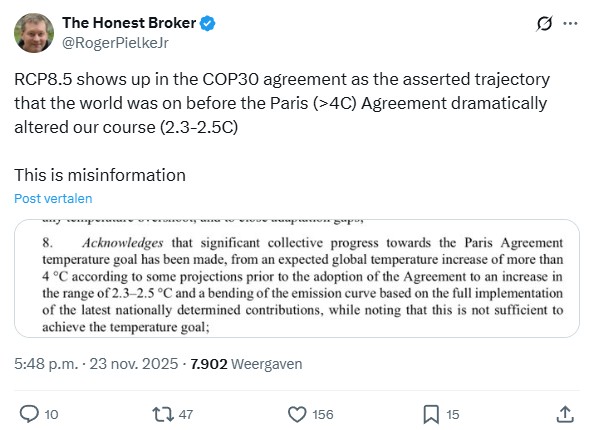
The COP30 agreement claims the world was previously on track for more than 4C of warming until the Paris Agreement heroically “bent” that trajectory down to 2.3–2.5C:

However, “this is misinformation,” says Roger Pielke Jr., Professor of Environmental Studies at the University of Colorado Boulder. It is a fiction built on the carcass of RCP8.5 — the extreme scenario that scientists quietly abandoned years ago because it required impossible coal use, implausible demographics and an economic collapse that never happened.
COP30 is resurrecting an unrealistic, disowned scenario in order to claim that Paris saved the world. The problem is the data. Real-world emissions show no curve bending, no slowdown and no “Paris effect”.
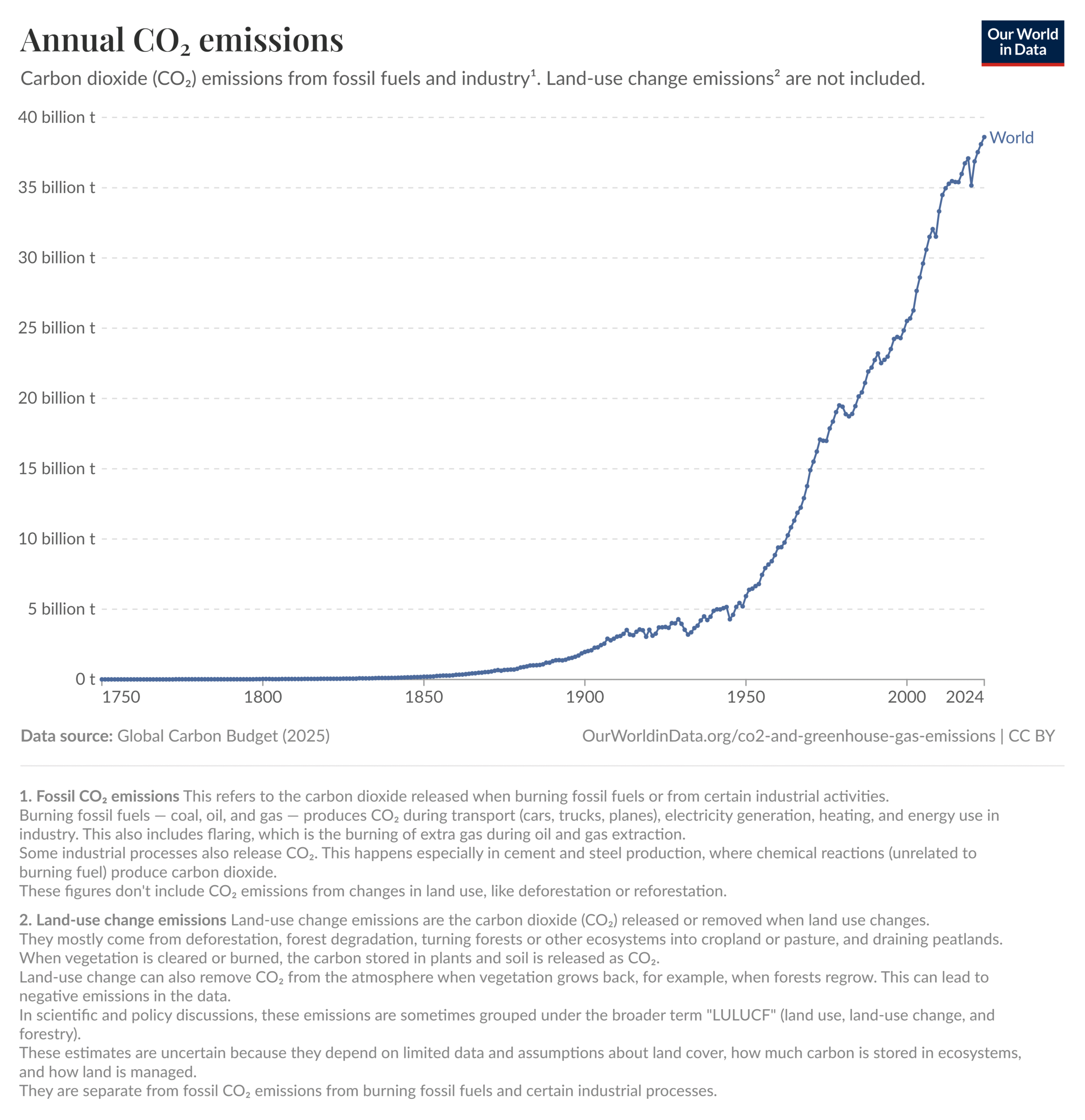
Paris didn’t change emissions, but it did unlock a permanent justification for climate taxation, energy rationing and the dismantling of cheap, reliable power — the foundation of economic prosperity.
COP30 needs a victory to justify its existence. So it has rewritten history: invent a 4C trajectory, pretend Paris knocked it down, and congratulate itself for saving humanity.
The world was never heading for RCP8.5. Paris didn’t change emissions.
Lies.

more news

Why the modern CO₂ spike looks scarier than it is
Modern CO₂ levels often appear dramatic when recent instrumental measurements are directly compared with long-term ice core records. However, paleo-CO₂ proxies smooth atmospheric signals over centuries, which dampens rapid changes. When modern CO₂ data are smoothed to match proxy resolution, today’s levels still exceed past interglacial peaks but appear far less extreme than the raw measurements suggest.
‘Green’ Ideology is a force for African Oppression
After 2030, the number of people in extreme poverty is expected to start rising again, driven largely by Africa. While the rest of the world marches toward prosperity, Africa is being forced into a trajectory of destitution. The data is an indictment of the modern ‘green’ agenda.

Women are speaking out against the climate agenda
In the climate debate, it is mainly older, often retired male scientists who are challenging the prevailing paradigm. Female skeptics are few and far between. However, this has been changing recently. Both in science and the media, women are increasingly speaking out against what they see as a frightening and socially disruptive agenda. This is a positive development.

