
COP30 Is Lying To Justify Its Existence
COP30 is building its case on climate misinformation that rewrites the past to claim a victory it never earned.

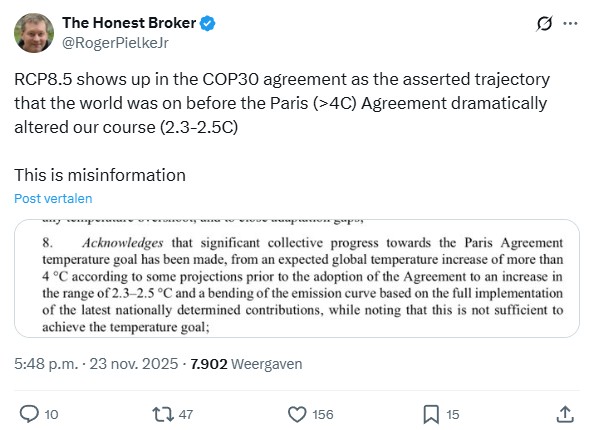
The COP30 agreement claims the world was previously on track for more than 4C of warming until the Paris Agreement heroically “bent” that trajectory down to 2.3–2.5C:

However, “this is misinformation,” says Roger Pielke Jr., Professor of Environmental Studies at the University of Colorado Boulder. It is a fiction built on the carcass of RCP8.5 — the extreme scenario that scientists quietly abandoned years ago because it required impossible coal use, implausible demographics and an economic collapse that never happened.
COP30 is resurrecting an unrealistic, disowned scenario in order to claim that Paris saved the world. The problem is the data. Real-world emissions show no curve bending, no slowdown and no “Paris effect”.
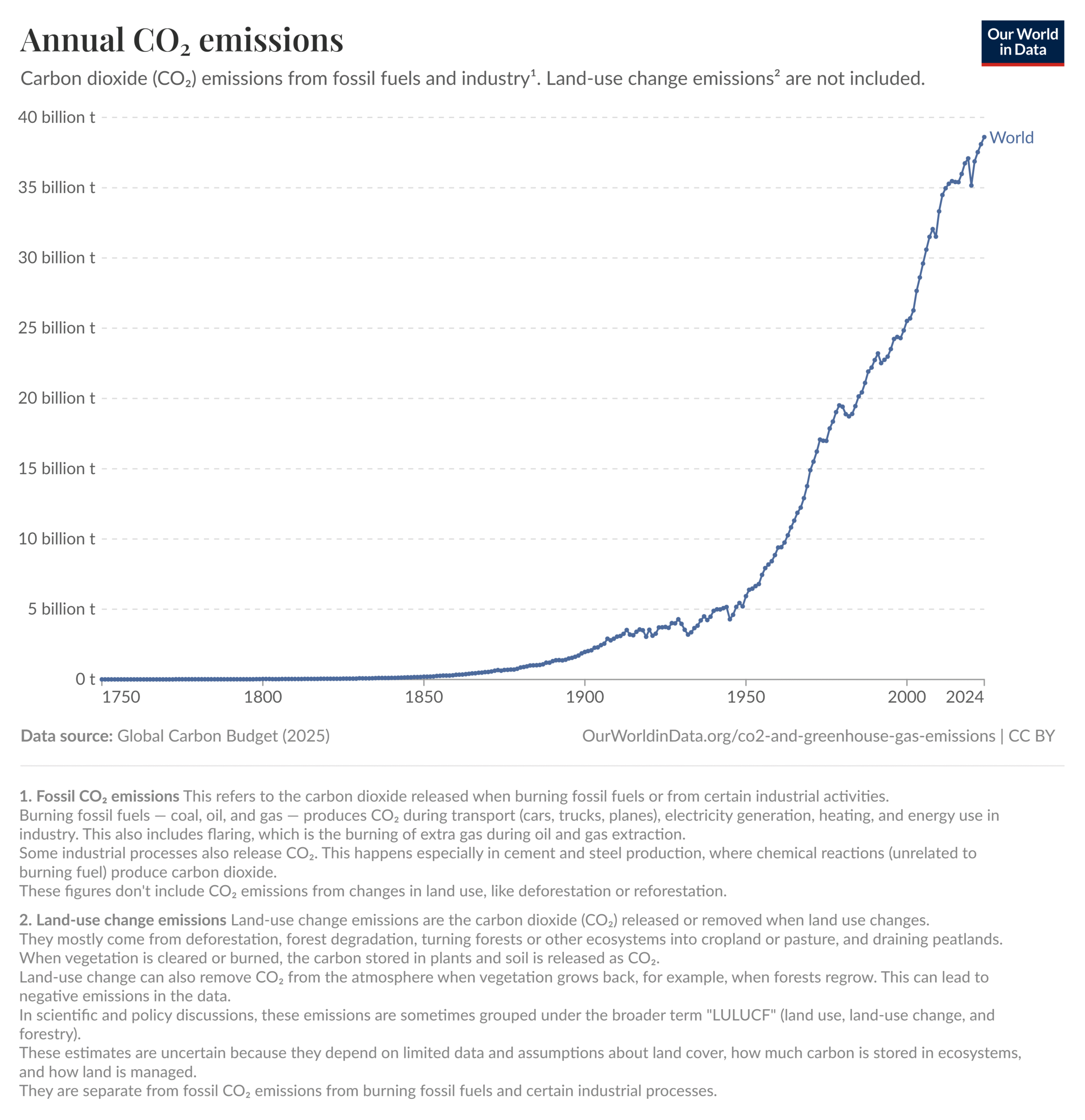
Paris didn’t change emissions, but it did unlock a permanent justification for climate taxation, energy rationing and the dismantling of cheap, reliable power — the foundation of economic prosperity.
COP30 needs a victory to justify its existence. So it has rewritten history: invent a 4C trajectory, pretend Paris knocked it down, and congratulate itself for saving humanity.
The world was never heading for RCP8.5. Paris didn’t change emissions.
Lies.


more news
A Good Article About the AMOC, Just in Time for the El Niño
The El Niño will arrive, the thermometers will spike, and the AMOC-on-the-brink stories will spike along with them, says Charles Rotter. But even Science recently concluded that “the Atlantic’s vital circulation may withstand climate warming better than feared”.

Winning the war on LCOE: wind and solar were never the cheapest power sources
Many organizations now acknowledge that generating electricity is not the same as building an affordable and reliable electricity system. Isaac Orr and Mitch Rolling explain that this is an admission that wind and solar were never the cheapest electricity sources — the hidden costs were simply being ignored by using the LCOE metric.
Can we turn “climate science” into science?
Demetris Koutsoyiannis presents a preview of the new Chapter 7, "Radiation in the atmosphere", of his book “Stochastics as Physics”.

