
COP30 Is Lying To Justify Its Existence
COP30 is building its case on climate misinformation that rewrites the past to claim a victory it never earned.

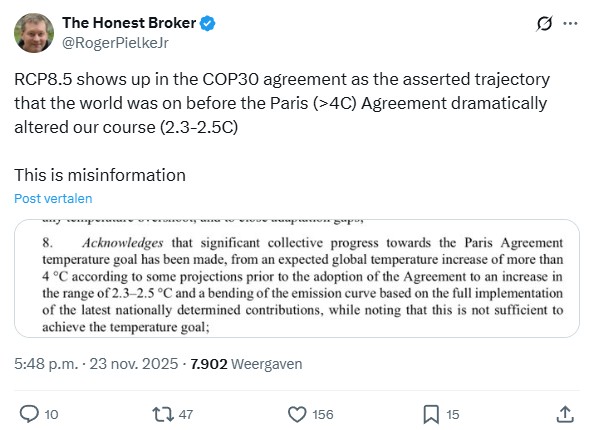
The COP30 agreement claims the world was previously on track for more than 4C of warming until the Paris Agreement heroically “bent” that trajectory down to 2.3–2.5C:

However, “this is misinformation,” says Roger Pielke Jr., Professor of Environmental Studies at the University of Colorado Boulder. It is a fiction built on the carcass of RCP8.5 — the extreme scenario that scientists quietly abandoned years ago because it required impossible coal use, implausible demographics and an economic collapse that never happened.
COP30 is resurrecting an unrealistic, disowned scenario in order to claim that Paris saved the world. The problem is the data. Real-world emissions show no curve bending, no slowdown and no “Paris effect”.
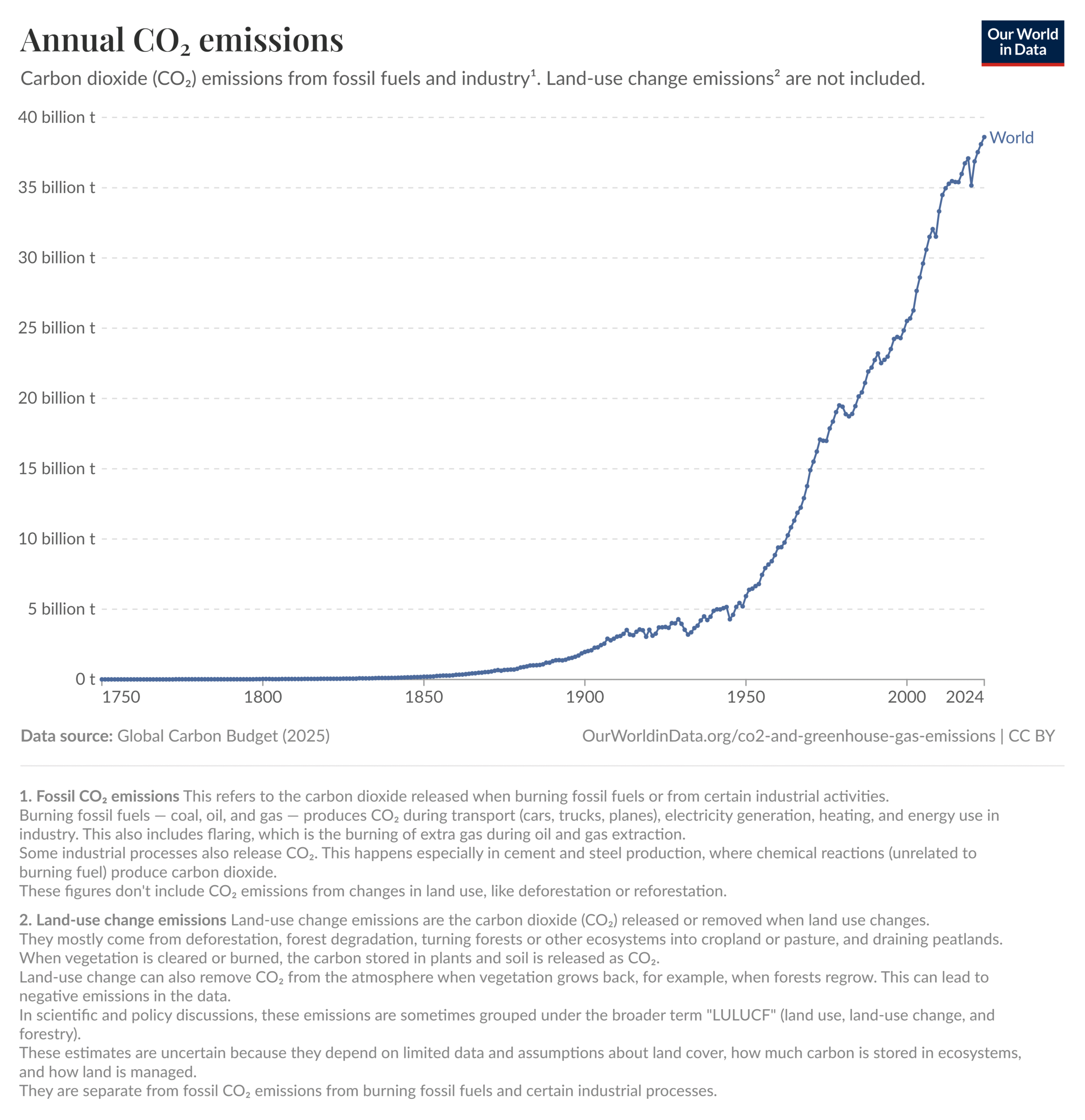
Paris didn’t change emissions, but it did unlock a permanent justification for climate taxation, energy rationing and the dismantling of cheap, reliable power — the foundation of economic prosperity.
COP30 needs a victory to justify its existence. So it has rewritten history: invent a 4C trajectory, pretend Paris knocked it down, and congratulate itself for saving humanity.
The world was never heading for RCP8.5. Paris didn’t change emissions.
Lies.

more news

Can US and India Forge a ‘Big, Beautiful’ Energy Deal?
India has never seriously embraced the fantasy that wind and solar technologies can sustain an industrial economy. A U.S.-India alliance would strike at the heart of the corrupt climate lobby, says Vijay Jayaraj.

“Friends of the Earth sounded like a spoiled child in court appeal against Shell”
Friends of the Earth Netherlands recently filed an appeal with the Dutch Hoge Raad against Shell and the Mens en Milieu Foundation in a last effort to force the company to implement significant worldwide emissions reductions. Lucas Bergkamp, a physician and attorney in Brussels, assisted Mens en Milieu in the proceeding and reported on the hearing: “Friends of the Earth looked tired and sounded like a spoiled child.”
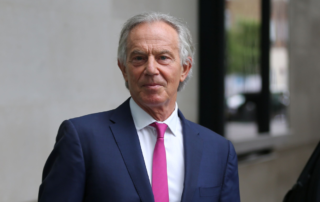
Former British Prime Minister Tony Blair: “Abandon Net Zero and Move Closer to Trump”
In a scathing 5,700-word attack on the current Prime Minister, Tony Blair argued for the British government to abandon Net Zero and smooth relations with Donald Trump.

