Svensmark on Cosmic Rays, Clouds and the Politics of Climate Science
At the EIKE Conference in Halle (Germany), Willie Soon and Ronan Connolly from the CERES Team met with recently fired Danish physicist Henrik Svensmark for a wide-ranging discussion about his research into the relationship between solar activity, cosmic rays, clouds and climate. The cosmic-ray mechanism he proposes deserves to be investigated on its physical merits rather than dismissed because it does not fit comfortably into existing climate-model frameworks.
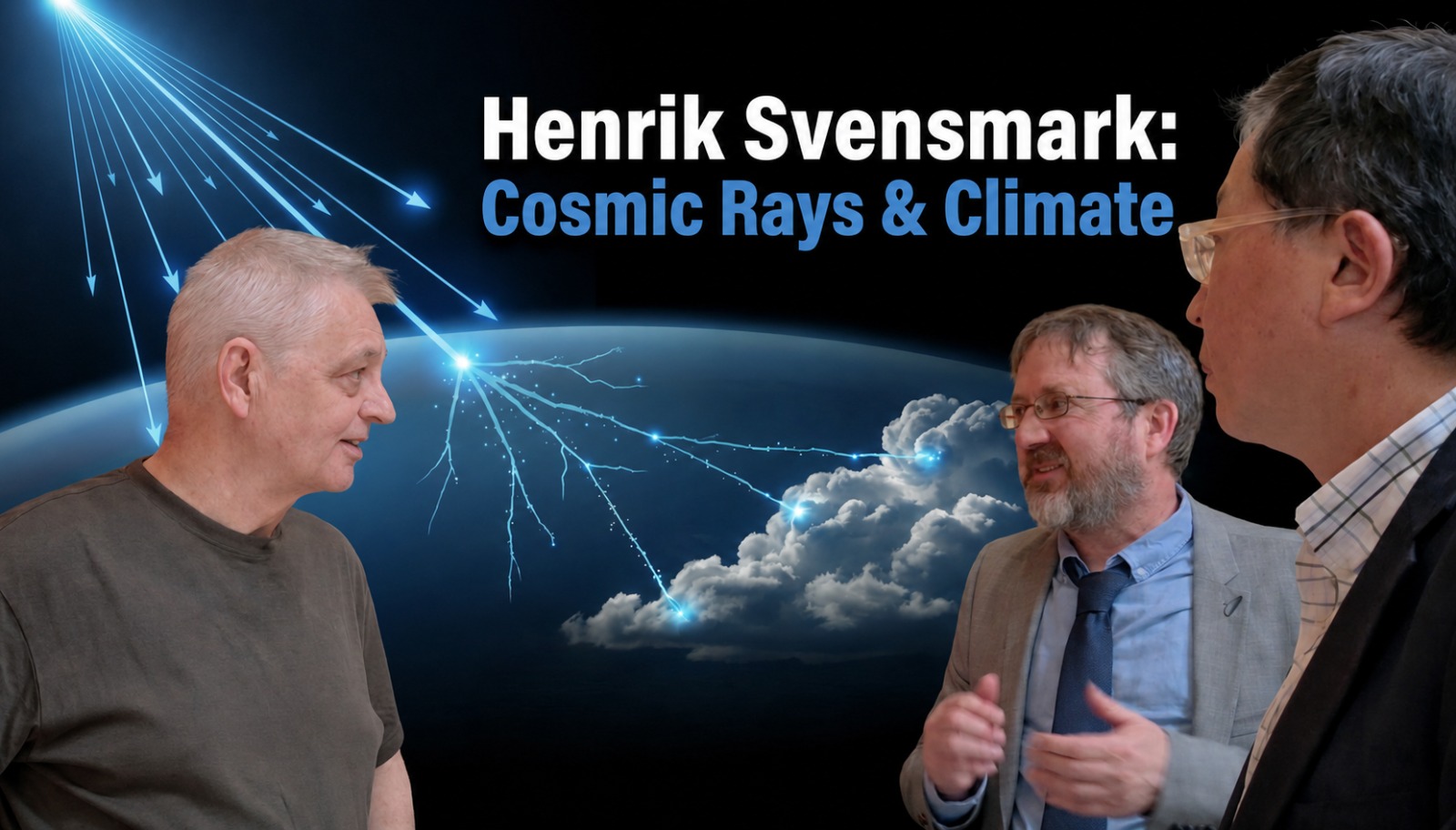
From left to right: Svensmark, Connolly and Soon. (Source: CERES)
Clintel Foundation
Date: 13 August 2026
At the recent EIKE conference in Halle, Willie Soon and Ronan Connolly from the CERES Team met with Danish physicist Henrik Svensmark for a wide-ranging discussion about his research into the relationship between solar activity, cosmic rays, clouds and climate. The conversation spans almost three decades of Svensmark’s scientific career, from his early work at the Danish Meteorological Institute to laboratory experiments, atmospheric observations and research into climate variations on geological timescales.
You can see the entire conversation between Soon, Svensmark and Connolly in the video by CERES Science here:
At the heart of Svensmark’s work is the proposition that variations in solar activity may influence Earth’s climate through a mechanism that is largely absent or inadequately represented in conventional climate models: changes in galactic cosmic rays can affect atmospheric ionization, which in turn can influence the formation of aerosols and cloud condensation nuclei. Because clouds have a major influence on how much solar energy reaches the Earth’s surface, even relatively modest changes in cloud properties could potentially have climatic consequences.
From an unusual correlation to a new hypothesis
Svensmark recalls that his interest in solar effects on climate began while he was working at the Danish Meteorological Institute. He had encountered earlier research by Eigil Friis-Christensen concerning the relationship between solar-cycle length and climate. Although the correlation was regarded with considerable scepticism at the institute, Svensmark found it intriguing and began wondering what physical mechanism could explain it.
At the time, changes in total solar irradiance were thought to be too small to explain substantial climatic effects. This led Svensmark to consider another possibility: perhaps the Sun affected climate indirectly by changing cloud formation.
His attention turned to cosmic rays because their intensity in the atmosphere varies substantially over the approximately 11-year solar cycle. When solar activity is high, the solar wind is stronger and tends to shield the Earth from galactic cosmic rays. When solar activity is weak, more cosmic rays penetrate the atmosphere.
The hypothesis was therefore not simply that the Sun becomes brighter or dimmer, but that solar activity could modify the atmospheric environment in which clouds form.
Soon and Connolly emphasize that this represented a significant departure from the way solar influences are generally treated in climate models. Conventional models largely represent solar forcing through changes in total solar irradiance (TSI). Svensmark’s proposed mechanism, by contrast, involves a chain of physical processes occurring in the atmosphere.
Cosmic rays, ionization and cloud formation
Svensmark explains the proposed mechanism in relatively straightforward terms. Variations in solar activity modulate the flux of galactic cosmic rays reaching Earth. These cosmic rays produce ionization in the atmosphere. The resulting ions can help stabilize small molecular clusters, allowing them to grow into aerosol particles.
Some of these particles can eventually become cloud condensation nuclei (CCN) — the microscopic surfaces on which water vapour condenses to form cloud droplets. Changes in the number of available condensation nuclei can therefore influence cloud microphysics and, ultimately, the amount of solar radiation reflected or absorbed by the Earth system.
The important point is that Svensmark does not claim cosmic rays create clouds from nothing. Clouds are produced by many interacting processes. Instead, cosmic rays may constitute an important contributing factor under particular atmospheric conditions.
Connolly compares this to the concept of a “rate-determining step” in chemistry. A complex process may involve many different reactions, but under particular conditions one factor can exert disproportionate influence on the overall rate. In the same way, cosmic-ray-induced ionization could become particularly important in certain environments.
Svensmark stresses that the mechanism is therefore a modulation of cloud formation, rather than an explanation of all clouds.
Laboratory evidence
One of the central developments in Svensmark’s research was the construction of laboratory facilities designed to reproduce relevant atmospheric conditions.
In experiments carried out in Denmark, researchers created a large chamber containing gases designed to mimic aspects of the atmosphere. They then varied the level of ionization.
The results, according to Svensmark, showed that increasing ionization increased the number of small aerosol particles. This provided experimental evidence for an important part of the proposed mechanism: ionization can influence aerosol formation.
The significance of such experiments is that they move the argument beyond a purely statistical correlation. Instead of simply observing that cosmic rays and some climatic variable vary together, the researchers attempted to demonstrate an underlying physical process.
The CERN CLOUD experiment subsequently provided another important experimental test. CLOUD, led by Jasper Kirkby, used a highly controlled atmospheric chamber to investigate aerosol nucleation. Svensmark notes that CERN’s experiments also found that increasing ionization increased aerosol formation, broadly consistent with the effect observed in his earlier experiments.
The discussion becomes more controversial when the participants recount Svensmark’s relationship with the CLOUD project. Svensmark says he was initially involved in its steering committee but was later removed after being told that his Danish experiment was regarded as being in competition with the CERN project. The conversation presents this episode as an example of the institutional tensions that can arise when research challenges an established interpretation.
The atmosphere as a natural laboratory
A major criticism of laboratory experiments is obvious: even if a mechanism works under controlled conditions, does it operate in the real atmosphere?
Svensmark and his collaborators attempted to address precisely this question by studying Forbush decreases. These are temporary reductions in cosmic-ray intensity associated with solar eruptions, particularly coronal mass ejections. When such an event reaches Earth, the solar plasma can temporarily shield the planet from galactic cosmic rays.
The resulting change in atmospheric ionization can be substantial — Svensmark refers to changes of up to roughly 30 percent. Unlike a laboratory experiment, these events occur naturally and affect the atmosphere on a relatively short timescale.
This makes them useful as what the researchers regard as “natural experiments.” Researchers can examine what happens to atmospheric aerosols and clouds before, during and after a Forbush decrease.
According to Svensmark, observations from satellites and other datasets show a response particularly in low-level liquid clouds, especially over remote oceanic regions. That geographical pattern is important because these areas are relatively free from many of the anthropogenic and terrestrial influences that complicate observations elsewhere.
The advantage of Forbush decreases is also statistical. Changes associated with the 11-year solar cycle are relatively slow and are easily contaminated by other long-term changes in the climate system. A Forbush event, by contrast, produces a comparatively sharp disturbance followed by recovery, making it easier to examine whether atmospheric variables respond on the expected timescale.
The difficulty of measuring clouds
The conversation then turns to one of the most persistent problems in climate science: clouds.
Connolly points out that modern global climate models typically have horizontal grid dimensions of roughly 100 kilometres. Individual clouds and many aerosol processes occur on scales vastly smaller than this. A model therefore cannot explicitly resolve them.
Instead, clouds must be parameterized — represented through mathematical approximations that attempt to describe the average behaviour of unresolved processes.
This creates a fundamental uncertainty. If the physical processes governing cloud formation are not sufficiently understood, parameterizations necessarily contain assumptions and simplifications.
For Svensmark’s hypothesis this is especially important because the proposed mechanism operates precisely through aerosols and cloud microphysics. The interviewers argue that it is difficult to dismiss a mechanism because it does not appear prominently in models when the models themselves cannot directly resolve the relevant processes.
Svensmark agrees that clouds remain one of the major unresolved problems in climate modelling.
The IPCC controversy
The discussion becomes more pointed when the participants consider how the Intergovernmental Panel on Climate Change has treated Svensmark’s research.
Soon makes an important qualification: it would be inaccurate simply to claim that the IPCC has never included cosmic-ray effects in its modelling. The issue, in his view, is how they have been represented. He argues that some attempts to incorporate the mechanism into models have been so simplified that they do not constitute a serious test of Svensmark’s empirical findings.
Svensmark says that the IPCC’s treatment of his work has generally been dismissive. He recalls discussions surrounding the selection of authors for relevant sections of the assessment reports and says that one proposed author was described as qualified partly because he was “anti-Svensmark.”
The interviewers portray this as evidence of an institutional tendency to treat Svensmark’s hypothesis as something to be rebutted rather than investigated neutrally. They also discuss what they see as a recurring pattern in the scientific literature: when a paper supports Svensmark’s findings it may receive limited attention, whereas a study reporting a negative result can be presented as decisive.
Whatever one’s interpretation of these institutional disputes, the underlying scientific issue remains whether the cosmic-ray/cloud mechanism can have a climate effect large enough to matter at longer timescales.
From the solar cycle to the history of the Earth
Svensmark’s work does not stop with the approximately 11-year solar cycle. The interview moves into research on much longer timescales, including geological history.
Here the discussion introduces the work of Nir Shaviv and Jan Veizer. Galactic cosmic rays originate largely from energetic astrophysical processes, including exploding massive stars. As the Solar System moves through the Milky Way, it passes through regions with different levels of star formation, including the galaxy’s spiral arms.
If cosmic rays influence cloud formation, these large variations in cosmic-ray intensity could potentially leave a climatic signature on geological timescales.
Svensmark describes research suggesting that major glaciation periods in Earth’s history correspond reasonably well with the Solar System’s passage through regions of the galaxy associated with higher cosmic-ray fluxes.
The proposed mechanism would operate independently of changes in solar activity. The Sun acts as a modulator of cosmic-ray penetration on shorter timescales, while the galactic environment could produce much larger changes over millions of years.
This line of research also illustrates why Svensmark became interested in climate as a broader astrophysical problem. He says that geological climate variations are enormous compared with those observed in the modern instrumental era and may reveal connections between astronomical processes and the conditions necessary for life on Earth.
The personal cost of controversial research
The final part of the interview becomes deeply personal. Svensmark says that pursuing this research has had serious consequences for his academic career. He describes being demoted from professor in 2016, facing an attempt to dismiss him in 2021 and subsequently losing his salary. He then states that he was fired from his position in 2026, shortly before the interview.
He also says that his son, who shares the Svensmark surname, has encountered difficulties finding an academic position and is now teaching at a high school.
The participants reject the idea that Svensmark’s work was motivated by financial support from the fossil-fuel industry.
For Svensmark, the irony is that the scientific principle he says he has followed — pursuing evidence wherever it leads — can become politically problematic when the subject is climate change.
Science versus politics
The interview ends with a broader reflection on scientific freedom. Svensmark says he is nevertheless grateful that he has been able to pursue research that he finds intellectually fascinating. His interest is ultimately not simply in attacking a particular climate theory, but in understanding the physical mechanisms that govern Earth’s climate and its relationship with the wider cosmos.
Soon and Connolly argue that the experience illustrates a broader problem: when scientific questions become politically charged, scientists may find themselves under pressure to conform to an established narrative.
Their final message is that genuine scientific inquiry requires following evidence rather than political expectations. As Connolly puts it, if research is conducted in a politically charged field and the results contradict prevailing political assumptions, the science itself can become “politically incorrect.”
Svensmark agrees. The conversation closes on the principle that, “if you are a real scientist, you follow the science where it leads.”
The interview therefore presents Svensmark’s career as both a scientific investigation and a case study in the difficulties faced by researchers proposing mechanisms outside the dominant climate paradigm. Its central scientific claim is that solar variability may influence climate not only through small changes in total solar irradiance, but through cosmic rays, atmospheric ionization, aerosol formation and cloud microphysics. The laboratory experiments, Forbush-decrease observations and geological research are presented as different lines of evidence for that broader hypothesis.
Whether the magnitude of the resulting climatic effect is sufficient to challenge the dominant attribution of modern climate change is a separate scientific question. What the interview makes clear, however, is that the cosmic-ray mechanism deserves to be investigated on its physical merits rather than dismissed because it does not fit comfortably into existing climate-model frameworks.
The article you have just read was made possible by our donors.
Every day, Clintel publishes articles on climate, energy and science. We also translate and share international analyses in multiple languages, produce videos, publish reports and organize conferences and events around the world.
We receive no government funding and rely entirely on the support of our donors. Your support helps us promote independent research and contribute to a more open and balanced debate on climate and energy issues.
Would you like to support our work? Choose the option that suits you best:
• Become a Friend of Clintel – support us with an annual contribution
• Make a recurring donation – provide ongoing support and help us plan ahead
• Make a one-time donation – every contribution helps
Thank you for your support.

more news

What a Joke: Big Tech on the Path to Net Zero
Big Tech's promises to achieve net-zero emissions are colliding with the energy demands of the AI boom. Carbon footprints at Google and Meta continue to rise, raising uncomfortable questions about whether their climate commitments were ever realistic, says Francis Menton.

There are no real fingerprints of man-made warming
Chris Martz, meteorologist and “anti-Greta Thunberg”, thinks at least some of the recent global warming is man-made. “But I'm also not running around like a hysterical chicken either.”

Wildfires in Spain have decreased over the last 50 years
According to a recent study, global fire numbers, intensity, and burned area declined overall from 2003 to 2023. Spain has been no exception, says Fernando del Pino Calvo Sotelo. According to the Ministry of Ecological Transition itself, the area burned by fires over the past 50 years has also decreased.