
Meteorologist Dr. Ryan Maue Warns “Germany Won’t Make It” If Winter Turns Severe
Meteorologist Dr. Ryan Maue warns at X that if the winter of 1962-1963 happened again with today’s Europeean energy system, then “Germany won’t make it”. The country has “exceptional energy shortfalls.”

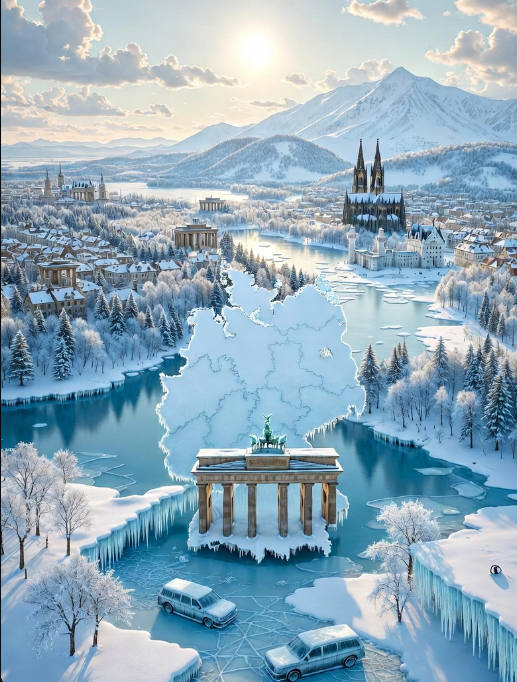
Image generated by Grok AI
P Gosselin
Date: 26 December 2025
And, suddenly, the weather models are hinting at severe winter conditions across Europe for early January.
Maue’s claim leans on a paper titled: “On the Link Between Weather Regimes and Energy Shortfall During Winter for 28 European Countries,” published in Meteorological Applications (2025) by Emmanuel Rouges, Marlene Kretschmer, and Theodore G. Shepherd. The authors examine how specific atmospheric patterns affect the balance between energy demand and renewable energy production across Europe.
Update: so what would happen with today’s Europeean energy system if the Winter of 1962-1963 happened again?
Not good! Germany 🇩🇪 won’t make it … exceptional energy shortfalls https://t.co/xh1jb13TJo https://t.co/X3EHlDqwTC pic.twitter.com/zheCnTaZlk
— Ryan Maue (@RyanMaue) December 25, 2025
The study focuses on energy shortfall, defined as periods when electricity demand significantly exceeds renewable energy production (specifically wind and solar). It analyzes 28 European countries using a “fixed electricity system” model (based on current infrastructure) and historical weather data (reanalysis) to see how past weather would affect today’s grid.
The researchers found that the primary driver of shortfall varies by region. In cold-climate, low-windd capacity countries, a shortfall is primarily demand-driven (e.g., increased heating needs during cold snaps).
In warm climate, high wind capacity countries, a shortfall is primarily production-driven (e.g., periods of low wind speed or “Dunkelflaute”).
The study categorized winter weather into six specific “regimes.” Only a subset of these—primarily those involving atmospheric blocking (which brings cold, still air)—are responsible for the majority of high-shortfall days. These critical weather regimes often affect large portions of the continent simultaneously, meaning many European countries experience energy stress at the same time.
There is a high level of spatial correlation in energy shortfalls. If one country is experiencing a shortfall, its neighbors are highly likely to be in the same situation. This highlights a potential challenge for “sharing” energy across borders during extreme weather events, as many potential exporters might also be facing deficits.
The authors simulated what would happen if the 1962/1963 winter (the coldest of the 20th century in Europe) occurred with today’s energy system. They concluded that the persistent blocking conditions of that winter would lead to extreme and prolonged energy shortfalls across almost all of Europe, far exceeding the stress seen in more recent decades.
The paper emphasizes that as Europe transitions to renewable energy, understanding the meteorological drivers of shortfall is critical. It suggests that energy planners must account for the fact that extreme weather events can cause simultaneous, continent-wide energy crises that current interconnected grids may struggle to mitigate through simple cross-border trading.
Merry Christmas everyone, stay warm!

more news
Clintel President Václav Klaus warns: “No radical change in Europe in the near future”
We must not be naïve optimists about climate policy and should not overestimate the recent positive signals, like those from President Trump. This is the view of Clintel President Václav Klaus: “Nothing has changed in the European Union. We, with a background in the social sciences, cannot imagine that any radical change will take place in Europe in the near future.” Klaus made these remarks in his speech at the annual meeting of the Norwegian Klimarealistene in Oslo on March 15.
New study finds low CO2-sensitivity again
A new paper by Frank Stefani compares solar variability and CO₂ emissions as drivers of global sea surface temperatures. Using the solar aa geomagnetic index alongside CO₂ data, the study estimates a transient climate response (TCR) of about 1.1–1.4 K, near the lower end of the IPCC range. The results align closely with other observation-based estimates and highlight the continuing scientific debate about the relative roles of solar activity and greenhouse gases in recent climate change.
Clintel Ambassador Ian Plimer on popular Triggernometry podcast: “Climate science is the biggest cult in scientific history”
Clintel-ambassador for Australia, prof. Ian Plimer, didn’t hold back in his recent interview on the popular Triggernometry podcast: “There’s a very large body of people out there who are actually using science to promote scams. It’s absolutely crippling Western countries. You can’t run an industrial society on sea breezes and sunbeams.”

