
Paris Climate Accord’s Demise – James Hansen was Right
Robert L. Bradley Jr. explores why the Paris Climate Agreement is faltering—and why James Hansen may have been right all along.


The Paris Climate Agreement turns ten this month. But COP21’s outcome — in which 195 countries pledged to reduce their greenhouse gas emissions to achieve a global temperature outcome — is in serious peril. COP30, now in session, finds almost all signatories out of compliance with their “nationally determined contributions.” Major emitters such as the United States and Russia are not participating in the annual meeting either. How much longer can “Net Zero” and like UN global aspirations continue?
Specifically, only one of the 40 major reporting groups (accounting for 85% of global emissions) is on track, and most of the rest have not even submitted a target. “This lack of progress is deeply concerning,” Climate Action Tracker reported, citing a need to “step up mitigation efforts and avoid weakening targets by relying on offsets and sinks….”
The U.S. is rated “critically insufficient,” joining Russia, Saudi Arabia, Argentina, and six others. Canada, China, India, Argentina, and three others are “highly insufficient,” and the trend is negative for virtually all countries with growing economies.
Little Surprise
Like the Kyoto Protocol of 1997, the Paris Climate Accords were destined for failure. James Hansen, the father of the global warming alarm with his 1988 Congressional testimony, predicted as much. The 2015 agreement, he said at the time, is “a fraud really, a fake.”
“It’s just bullshit for them to say: ‘We’ll have a 2°C warming target and then try to do a little better every five years.’ It’s just worthless words. There is no action, just promises. As long as fossil fuels appear to be the cheapest fuels out there, they will be continued to be burned.”
What was a photo-op, in retrospect, was negated by superior, consumer-chosen, taxpayer-neutral energies. Should this be surprising?
“Clean” Energy Focus?
At COP30, “clean” energy is in, and emissions targets are out. James Hansen has offered a realistic opinion here as well: “Suggesting that renewables will let us phase rapidly off fossil fuels in the United States, China, India, or the world as a whole is almost the equivalent of believing in the Easter Bunny and Tooth Fairy.”
China is the new role model with “clean” energy, from renewables to vehicle electrification. But why emulate a centrally planned economy that loses money at the expense of its citizens? China depends on fossil fuels for 87% of its energy usage, in any case.
At best, China is “greenwashing” its coal boom. Coal, after all, the world’s leading source of electrical generation, is powering China’s drive to ‘clean’ energy.
Politics
Climate activism starts and ends with politics, which introduces government failure in the quest to address alleged market failure. Hansen had some choice words here, too.
“Big Green consists of several “environmental” organizations, including Environmental Defense Fund (EDF) and National Resources Defense Council (NRDC), each with $100+M budgets, each springing from high-minded useful beginnings, each with more high-priced lawyers than you can shake a stick at. EDF …was chief architect of the disastrous Kyoto lemon. NRDC proudly claims credit for Obama’s EPA strategy and foolishly allows it to migrate to Paris.”
Compare this to the Grassroots Green movement blocking wind, solar, and battery projects (1,126 and counting) that create blight and lower property values. Will ecologists belatedly stand up against industrial wind, solar, and batteries — and the Climate Industrial Complex writ large?
Conclusion
It is past time to get realistic and repeal the Paris Agreement and Net Zero. The path forward under any climate scenario is adaptation, where the best energies and societal wealth anticipate, ameliorate, and recover from weather extremes. The last word belongs to Alex Epstein, who stated in The Moral Case for Fossil Fuels:
“The popular climate discussion … looks at man as a destructive force for climate livability … because we use fossil fuels. In fact, the truth is the exact opposite; we don’t take a safe climate and make it dangerous; we take a dangerous climate and make it safe. High-energy civilization, not climate, is the driver of climate livability.”
This article by Robert L. Bradley, Jr. was published on 13 November on instituteforenergyresearch.org.

more news

“It’s the sun, stupid!” gets new relevance
A new report from the World Meteorological Organization once again led to apocalyptic headlines in the newspapers last week. Unintentionally, writes Marcel Crok, the report opens the door to the most important factor in our climate: the sun.

Yet Another Reason Why Wind And Solar Will Never Work
The idea that wind and solar power can easily replace fossil fuels sounds appealing. But behind this optimistic narrative lie complex technical challenges, such as intermittency, grid stability, and the crucial roles of synchronization and inertia in maintaining a reliable electricity system, concludes Francis Menton after a powerful presentation by Kathryn Porter.
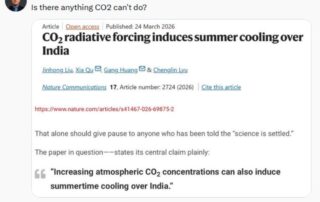
CO₂ Can Cause Cooling Too? Climate Models Say Yes (Sometimes)
As Dr. Matthew Wielicki dryly put it: “Is there anything CO₂ can’t do?” The study behind that remark claims that rising CO₂ levels may even lead to regional cooling under certain conditions—highlighting just how flexible—and uncertain—climate model outcomes can be.

