Press release GWPF: Event Attribution Studies are “a blot on science”, says Ralph B. Alexander
Extreme weather attribution studies are based on flawed logic and misleading statistical practices, according to a new report by The Global Warming Policy Foundation (GWPF). Author Ralph B. Alexander argues that these studies, which link individual weather events to climate change, are driven more by political and legal agendas than by robust scientific evidence.
The Global Warming Policy Foundation
Date: 29 March 2026
Flawed Logic Behind Extreme Weather Attribution Studies
London, 24 March. Extreme weather attribution studies are based on flawed logic and generate misleading headlines, according to a new briefing paper from The Global Warming Policy Foundation (GWPF).
In Contorted Science: The Flawed Logic of Extreme Event Attribution, Dr. Ralph B. Alexander argues that studies attempting to link specific heatwaves, hurricanes and floods to human-caused climate change are fundamentally misleading and have been created for legal and political, rather than scientific reasons.
The paper scrutinises recent high-profile studies by World Weather Attribution and the Grantham Institute. In 2025 alone, World Weather Attribution claimed that 24 of 29 extreme events examined were made more severe or more likely by climate change.
Alexander shows how such conclusions depend heavily on climate models that struggle to reproduce historical climate patterns and assume scientists can accurately simulate a “natural” climate without human emissions.
Questionable Methods and Statistical Practices
Some key recurring weaknesses are identified within attribution studies:
- Flawed logic: attribution claims involve “begging the question”, the act of simply assuming the conclusion you are trying to investigate.
- Statistical practices that inflate headline probability claims while downplaying uncertainty.
- The neglect of historical records showing comparable extreme events long before modern emissions levels.
Political Drivers and Scientific Concerns
The report traces the growth of rapid event attribution to political frustration with the cautious conclusions of the Intergovernmental Panel on Climate Change (IPCC), which has expressed low confidence in long-term global trends for most types of extreme weather. It recognises the role of a 2012 meeting convened by the Union of Concerned Scientists. The meeting was aimed at strengthening the perceived link between extreme weather and climate change in order to pursue litigation against fossil fuel companies.
The report’s author, Ralph Alexander, said:
“Extreme event attribution studies are a blot on science, the hallmarks of which are empirical evidence and logic. Neither feature is central to attribution studies, which were created for legal and political not scientific reasons.”
Harry Wilkinson, Head of Policy at The Global Warming Policy Foundation said:
“It is disturbing that event attribution studies have got so much traction in the international media, despite their underlying flaws. This is a major scientific scandal.”
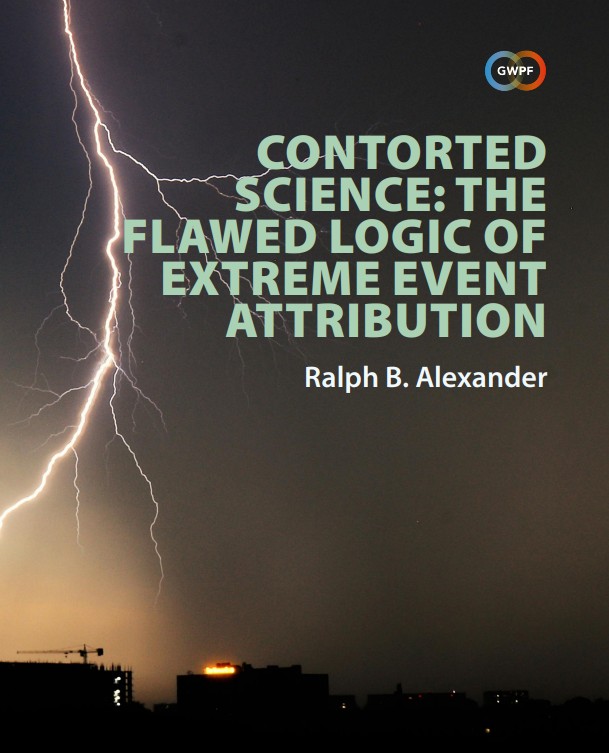
Read the full report: Contorted Science: The Flawed Logic of Extreme Event Attribution (pdf)
This press release was published by The Global Warming Policy Foundation on 24 March 2026. Our editorial team has added subheadings for readability.

more news

Late summer Arctic sea ice stable in the last 20 years!
Why are the climate ambulance chasers now way out in Nepal? The reason is that there’s little weather action anywhere else that would support the alarmist climate narrative – not even in the Arctic, says Pierre Gosselin.

What does it take to stop landslides in Nepal (especially terrible ones 800 years ago?)
Already the Climate Porn industry is using the ghastly death and destruction in Nepal to sell Net Zero and Socialism, even though landslides have always happened, and there was a far worse one in 1190 AD, says Jo Nova.

EU Decarbonization Is a Security Threat for the West
Europe refuses to take full advantage of domestic energy reserves, clinging to economically destructive policies that can only undermine the security of the West, says Samuel Furfari. Energy security is inseparable from military power.