
The ‘green’ transition is running red with the blood of animals
We must stop the reckless expansion of low-density energy projects (wind and solar) in valuable ecosystems, says Vijay Jayaray. The ‘green’ transition is running red with the blood of the creatures we are supposed to protect.

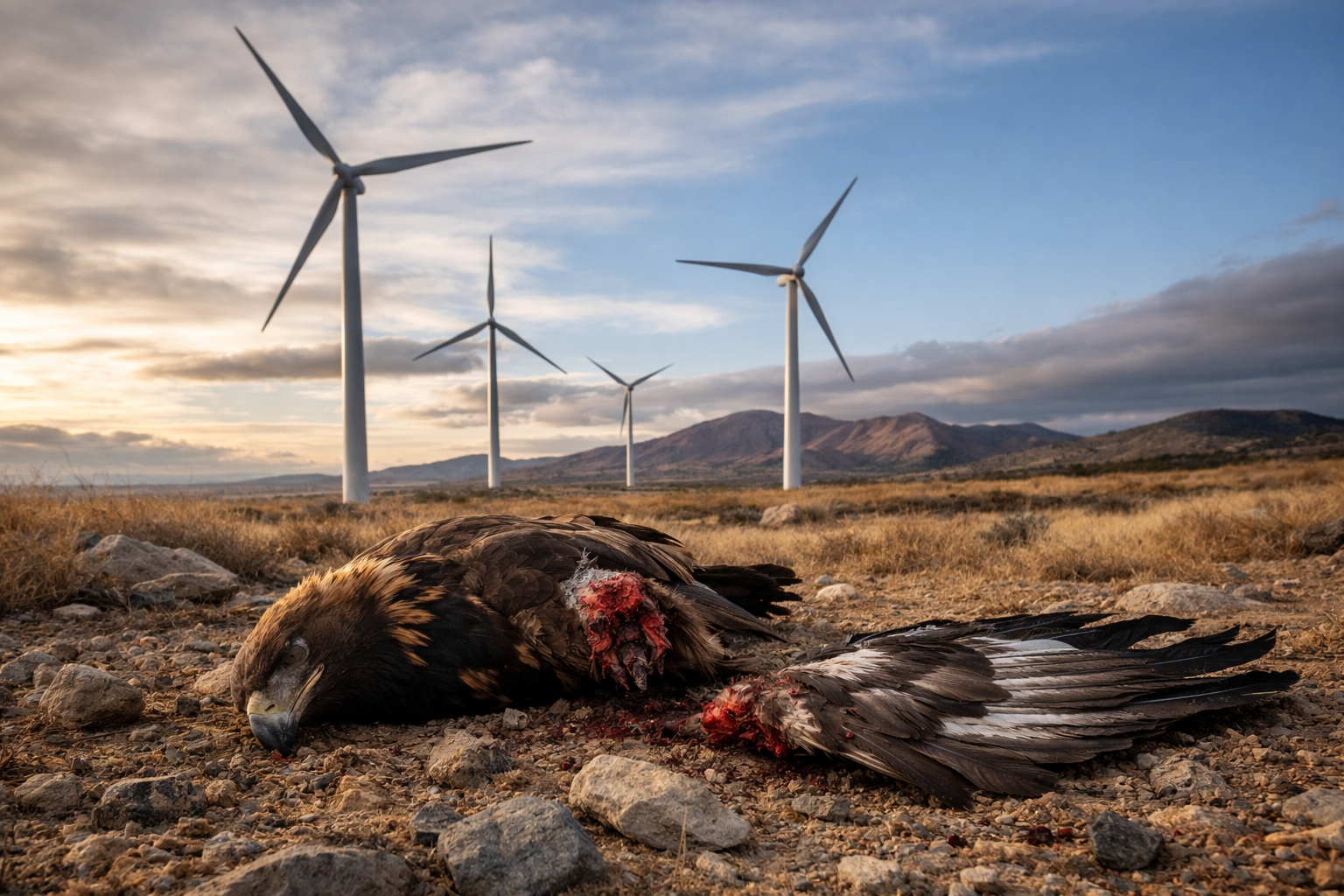
Image created using ChatGPT
Vijay Jayaraj
Date: 9 April 2026
Numerous studies by biologists and ornithologists are unequivocal in expressing rising concern about the slaughter of birds and other creatures by so-called eco-friendly technologies. Many of the researchers, while not opposed to the concept of alternative sources of energy, are dropping the pretense that wind and solar energy are benign.
The fundamental flaw of these technologies is their low energy density. To generate the same amount of reliable electricity as a natural gas-fired generator or a nuclear power plant, thousands of acres of additional land are required by wind and solar. This is a matter of physics. Yet, in a rush to meet arbitrary ‘net zero’ targets, the environment supposedly being protected is destroyed.
Wind and solar facilities devastate wildlife, destroy habitats, fragment ecosystems and leave ecological wreckage that extends far beyond what the green lobby cares to acknowledge. The narrative of politicians and well-heeled environmental NGOs – that wind and solar are the saviors of the natural world – is a lie. The data prove that these projects are not just displacing wildlife but are killing it on an industrial scale.
Shocking
A shocking assessment reveals the extent of this encroachment. Wind and solar farms overlap with 2,310 threatened amphibians, birds, mammals and reptiles globally. This accounts for 36% of the world’s threatened species. The ‘green’ utopia is being built on the graves of the vulnerable.
A study analyzing the footprints of ‘renewable’ energy projects found that 2,206 operational facilities had degraded 886 protected areas, 749 ‘key biodiversity areas’ and 40 distinct wilderness areas. The researchers project a 30% expansion of this footprint as natural refuges are further industrialized.
Another study did an examination of 84 peer-reviewed studies of onshore wind installations, documenting 160 cases of species displacement affecting birds, bats and various mammalian species.
For the golden eagle, a symbol of wild majesty, the impact is death. In the western United States, documented mortalities more than doubled between 2013 and 2024, from 110 to 270.
An assessment of 42 African raptor species documented an 88% decline over a 20-40 year period. The study identified wind farms as a major factor. In China, the rush for wind power has resulted in a nearly 10% decline in overall bird populations following the construction of wind farms. In Changdao County, located on a critical migration route for 330 bird species, local communities reported reduced bird populations and increased pest activity. In a stunning admission of failure, 80 wind turbines were demolished to save the ecosystem.
Solar plants
Recent research shows that in humid regions, large-scale solar plants cause near-total vegetation collapse. The panels block the sun, altering the microclimate and leading to soil instability. Without the roots to hold the earth, foundation of the ecosystem is lost.
In desert ecosystems, localized alterations caused by solar arrays disrupt the growth cycles of plants and the lives of microorganisms that keep the desert healthy. In China, photovoltaic development has caused fragmentation and habitat loss across more than 2,100 square miles of agricultural, sandy and grassy areas.
Solar development on intact landscapes reduces species richness. Perimeter fencing creates impassable barriers, trapping animals and preventing the genetic flow necessary for healthy populations.
In the United States, solar energy alone is estimated to cause between 37,800 and 138,600 bird deaths annually. Why? Because from the air, vast fields of solar panels look like water.
A study from Poland confirms this ‘lake effect,’ showing that photovoltaic farms attract waterfowl due to water-like reflections. These birds descend, expecting a cool lake, and instead crash into scorching glass. The study identified 70 bird species at risk across six sites, with high-collision risk concentrated within 650 feet of the installations.
A Mojave Desert tortoise, an ancient survivor of harsh conditions, is losing to the solar boom. From 2004 to 2014, the species experienced a 39% loss in population. Industrial-scale solar has destroyed approximately 100,000 acres of their habitat. We are evicting a species that has lived in the Mojave for millions of years to make room for panels that will be obsolete in 20 years.
We must stop the reckless expansion of low-density energy projects in valuable ecosystems. The ‘green’ transition is running red with the blood of the creatures we are supposed to protect.

This commentary was first published at Blaze Media on 27 March.

Vijay Jayaraj
Vijay Jayaraj is a Science and Research Associate at the CO2 Coalition, Fairfax, Virginia. He holds an M.S. in environmental sciences from the University of East Anglia and a postgraduate degree in energy management from Robert Gordon University, both in the U.K., and a bachelor’s in engineering from Anna University, India. He served as a research associate with the Changing Oceans Research Unit at University of British Columbia, Canada.

more news
Svensmark on Cosmic Rays, Clouds and the Politics of Climate Science
At the EIKE Conference in Halle (Germany), Willie Soon and Ronan Connolly from the CERES Team met with recently fired Danish physicist Henrik Svensmark for a wide-ranging discussion about his research into the relationship between solar activity, cosmic rays, clouds and climate. The cosmic-ray mechanism he proposes deserves to be investigated on its physical merits rather than dismissed because it does not fit comfortably into existing climate-model frameworks.

Central Banks Double Down on Climate Regulation
The ECB has quietly expanded its “climate factor”. This is a rear-guard action by a green priesthood that senses the ground shifting but cannot bring itself to abandon the climate faith, says Tilak Doshi.
Global Greening Hits New Record as Climate Emergency Fails to Materialise
Global greening, due to CO2, has hit a new record high, according to research recently published in Nature. Meanwhile activists refuse to accept that the 'climate emergency' has failed to materialise, says Chris Morrison.

