
We can still avoid the Net Zero trap
Former politician prof. Kees de Lange and Clintel co-founder prof. Guus Berkhout state in a new essay that there is no reason to swim further into the Net Zero trap.

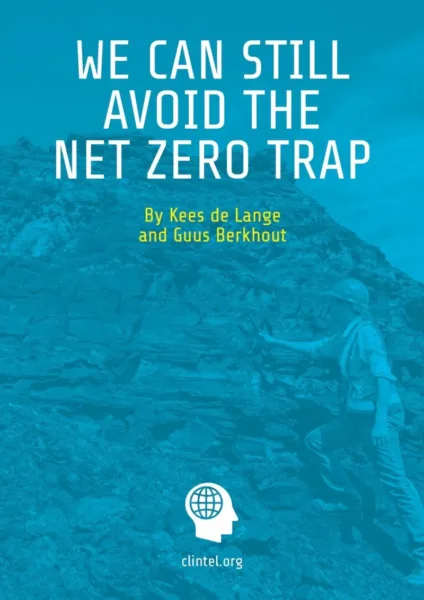
In the first part of their essay they show extensively that there is no climate emergency because of the emission of the greenhouse gas CO2. Amongst other things, they conclude that the focus of climate alarmists on CO2 is very one-sided. Furthermore, the dampening saturation effect that occurs with al greenhouse gasses, is left out deliberately in the fear-inspiring narrative.
The limitations of the current climate models are of such that, for now, they are no serious basis for climate policy. Their premise that the human contribution to CO2 production would be the recipe for a future climate disaster, is not supported by observations. Besides the saturation effect of CO2, the many assumptions on the very complex role of clouds is just as important. Clearly, clouds are the Achilles heel of climate science.
So, De Lange and Berkhout conclude that there is no climate crisis. We are however at the beginning of a self-made energy crisis. That is the focus of the second part of this essay. The reliability of demand-driven fossil energy is currently being sacrificed to supply-driven illusions, like wind and solar energy. The West is apparently prepared to risk prosperity for this. The rest of the world watches in amazement.
A new Dutch cabinet must stop the model-based doom stories about climate disasters and make new choices in energy policy. Amongst other things, De Lange and Berkhout argue for the further development of nuclear energy, with special attention given to the option based on the thorium cycle and its associated advantages. In the long term, this is the only rational way to adequately supply the world with energy. There is therefore no reason to swim further into the Net Zero trap. We can still go back.
Essay by Kees de Lange and Guus Berkhout
For the essay, click here

more news
Svensmark on Cosmic Rays, Clouds and the Politics of Climate Science
At the EIKE Conference in Halle (Germany), Willie Soon and Ronan Connolly from the CERES Team met with recently fired Danish physicist Henrik Svensmark for a wide-ranging discussion about his research into the relationship between solar activity, cosmic rays, clouds and climate. The cosmic-ray mechanism he proposes deserves to be investigated on its physical merits rather than dismissed because it does not fit comfortably into existing climate-model frameworks.
Central Banks Double Down on Climate Regulation
The ECB has quietly expanded its “climate factor”. This is a rear-guard action by a green priesthood that senses the ground shifting but cannot bring itself to abandon the climate faith, says Tilak Doshi.
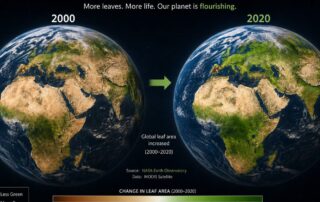
Global Greening Hits New Record as Climate Emergency Fails to Materialise
Global greening, due to CO2, has hit a new record high, according to research recently published in Nature. Meanwhile activists refuse to accept that the 'climate emergency' has failed to materialise, says Chris Morrison.

