
What is a “climate crisis?”
Before we declare a ‘climate crisis,’ perhaps we need a clear definition — grounded not in fear, but in evidence. This piece argues for quantifiable metrics over rhetoric.

Andy May
Date: 27 November 2025
In a new paper by Gianluca Alimonti and Luigi Mariani, they argue that the public needs a proper definition of precisely what a climate crisis is to make rational decisions about how to address potential climate change threats (Alimonti & Mariani, 2025). They propose a set of measurable “Response Indicators” (RINDs) based on the IPCC AR6 Climate Impact drivers (IPCC, 2021, pp. 1851-1856).
Their intent is to switch from subjective perceptions of possible dangers to quantifiable metrics. Potentially this could put climate change debates on track and ensure that both sides are arguing about the same thing as opposed to talking past each other due to each of the debaters arguing from different definitions. It might also lead to real solutions to real problems, rather than flights of ideologically-based fancy.
The IPCC defines climate impact drivers (CIDs) as climate events that affect society. The impact on any affected society can be detrimental, beneficial, or neutral (IPCC, 2021, p. 1770). They define 33 categories of CIDs and have found that most of them have not emerged from the expected range of natural variability.
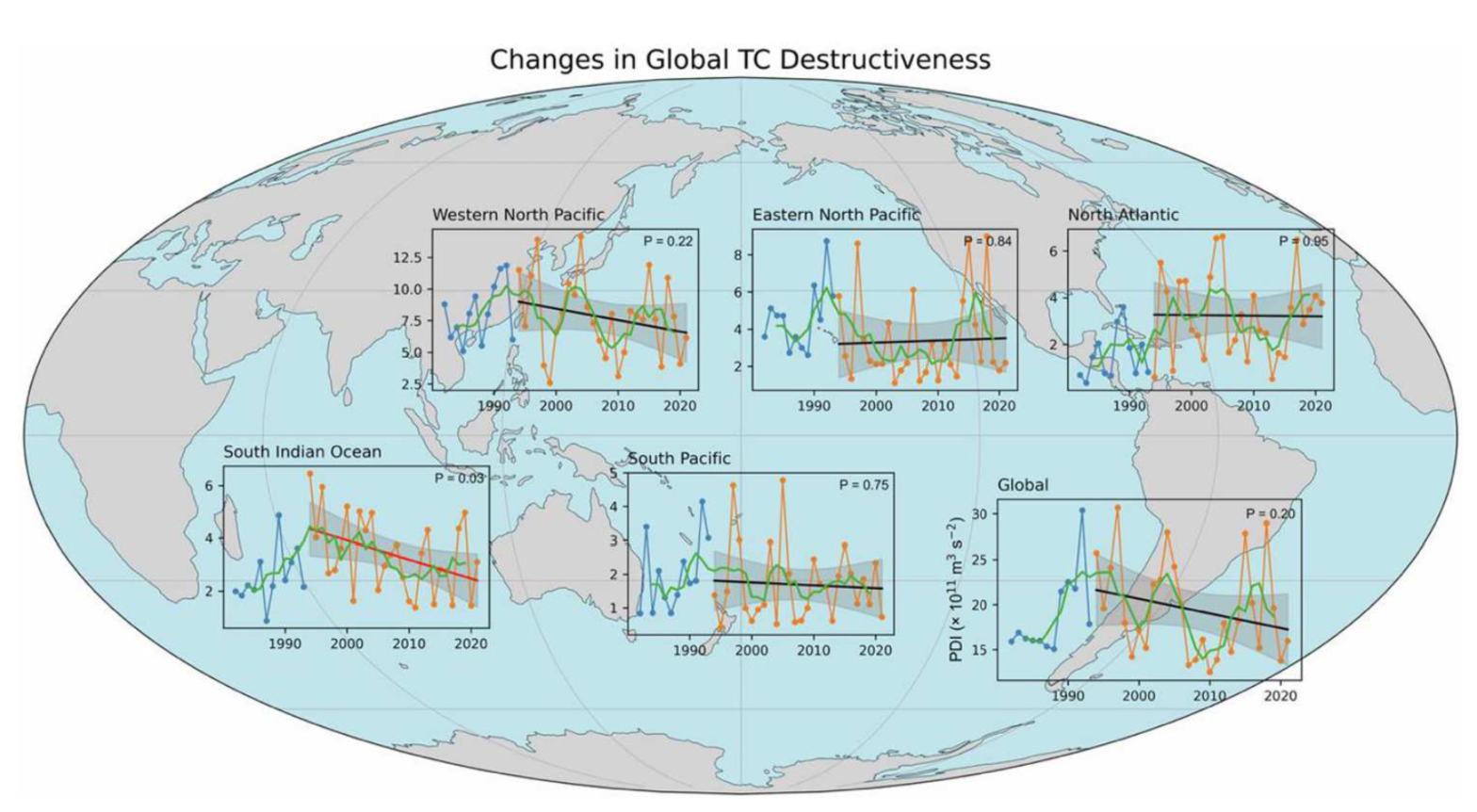
Alimonti and Mariani examined the EM-DAT disaster database, managed by the Centre for Research on the Epidemiology of Disasters from the year 2000 to the present. In this period, they detected no trend in deaths due to weather-related disasters. Just as important, there were clear improvements in global health over the period, once the growth in population was accounted for.
Temperature-related mortality accounts for 8% of the total weather-related deaths, of these 91% were due to cold and 9% to excess heat. From 2000-03 to 2016-19 cold related deaths decreased by 0.5% and heat related deaths increased by 0.2%, very small changes.
As Alimonti and Mariani’s Table 1 indicates, most measures of their climate change response indicators show no change, including cyclones, drought, floods, and wildfires. They show global GDP is improving, as is food availability.
The paper emphasizes that the reduction in climate-related deaths can be partially attributed to improvements in civil protection systems (levees, seawalls, forest management, etc.) which demonstrates that adaptation to climate change often proves more effective than mitigation. Most objective measures of the human-welfare impact of climate changes show no change, and most of the rest show improvement or an ambiguous impact, rather than detrimental effects.
The paper is worth the time to read; it is time for less subjectivity and more harder objective measures of the impact of climate change.
We remember that Alimonti and Mariani were the first two authors of the shamefully retracted but excellent article (Alimonti, Mariani, Prodi, & Ricci, 2022). My assessment of that article was that it was excellent and no less an authority than Roger Pielke Jr. called the retraction “one of the most egregious failures of scientific publishing.” This retraction is the posterchild of the extreme bias in SpringerNature.
Works Cited
Alimonti, G., & Mariani, L. (2025). Quantifying the climate crisis: a data-driven framework using response indicators for evidence-based adaptation policies. Environmental Hazards. doi:10.1080/17477891.2025.2571708
Alimonti, G., Mariani, L., Prodi, F., & Ricci, R. A. (2022). A critical assessment of extreme events trends in times of global warming. The European Physical Journal Plus, 137(112). doi:10.1140/epjp/s13360-021-02243-9
IPCC. (2021). Climate Change 2021: The Physical Science Basis. In V. Masson-Delmotte, P. Zhai, A. Pirani, S. L. Connors, C. Péan, S. Berger, . . . B. Zhou (Ed.)., WG1. Retrieved from https://www.ipcc.ch/report/ar6/wg1/
This article was previously published on Andy May Petrophysicist.

Andy May
Andy May is a retired petrophysicist and has published six books. He worked on oil, gas and CO2 fields in the USA, Argentina, Brazil, Indonesia, Thailand, China, UK North Sea, Canada, Mexico, Venezuela and Russia. He specialized in shale petrophysics, fractured reservoirs, wireline and core image interpretation, and capillary pressure analysis, besides conventional log analysis. His full resume is here: AndyMay

more news

Clintel President Václav Klaus warns: “No radical change in Europe in the near future”
We must not be naïve optimists about climate policy and should not overestimate the recent positive signals, like those from President Trump. This is the view of Clintel President Václav Klaus: “Nothing has changed in the European Union. We, with a background in the social sciences, cannot imagine that any radical change will take place in Europe in the near future.” Klaus made these remarks in his speech at the annual meeting of the Norwegian Klimarealistene in Oslo on March 15.

New study finds low CO2-sensitivity again
A new paper by Frank Stefani compares solar variability and CO₂ emissions as drivers of global sea surface temperatures. Using the solar aa geomagnetic index alongside CO₂ data, the study estimates a transient climate response (TCR) of about 1.1–1.4 K, near the lower end of the IPCC range. The results align closely with other observation-based estimates and highlight the continuing scientific debate about the relative roles of solar activity and greenhouse gases in recent climate change.
Clintel Ambassador Ian Plimer on popular Triggernometry podcast: “Climate science is the biggest cult in scientific history”
Clintel-ambassador for Australia, prof. Ian Plimer, didn’t hold back in his recent interview on the popular Triggernometry podcast: “There’s a very large body of people out there who are actually using science to promote scams. It’s absolutely crippling Western countries. You can’t run an industrial society on sea breezes and sunbeams.”

