
Clintel Ambassador Ian Plimer on popular Triggernometry podcast: “Climate science is the biggest cult in scientific history”
Clintel-ambassador for Australia, prof. Ian Plimer, didn’t hold back in his recent interview on the popular Triggernometry podcast: “There’s a very large body of people out there who are actually using science to promote scams. It’s absolutely crippling Western countries. You can’t run an industrial society on sea breezes and sunbeams.”

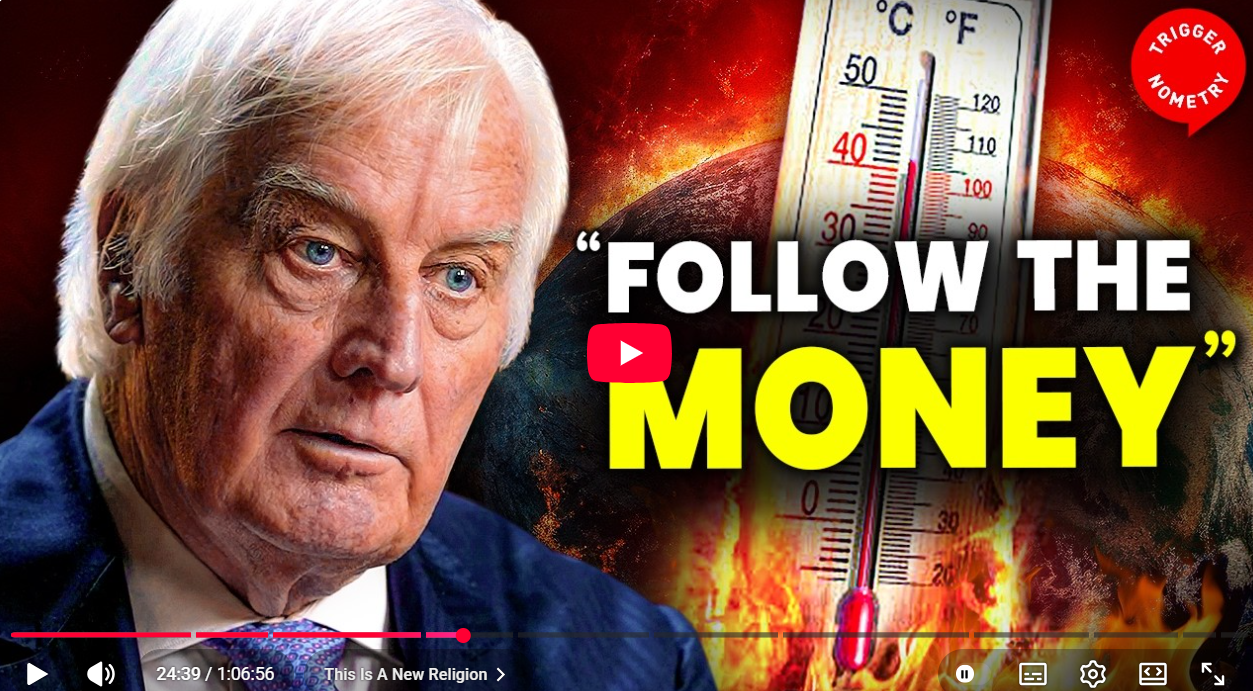
Podcast screenshot – YouTube
Clintel Foundation
Date: 13 March 2026
In the interview on Triggernometry (1,75 million subscribers on YouTube), Australian geologist Ian Plimer argues that the climate debate increasingly resembles a belief system. It has elements such as moral guilt, sacrifice, and authority figures. Plimer says that climate change is often framed in moral or ideological terms rather than purely scientific ones.
A central element of Plimer’s argument is that the idea that human CO₂ emissions are the primary driver of climate change, does not align with geological evidence. He argues that scientific theories must be consistent with other well-established scientific knowledge. According to him, the current climate narrative does not meet that standard. “If you were to promote an idea in science, it has to be commensurate with all the other validated work in science.”
Geological records
Plimer, the Clintel Ambassador for Australia, argues that geological records demonstrate that Earth’s climate has changed dramatically many times in the past due to natural causes. He emphasizes that the planet has experienced periods that were both far warmer and far colder than today. For example, he refers to the long history of ice ages: “We’ve had six major ice ages. We’re currently in one of those ice ages.” He also points out that atmospheric carbon dioxide levels were far higher in the distant past without necessarily causing extreme warming. “We’ve had times in the past when the carbon dioxide content of the atmosphere was at least 10%.” From this perspective, he argues that the relationship between CO₂ and temperature is not straightforward.
Natural Climate Cycles
Plimer emphasizes that geologists work on time scales of millions of years. In his view, much of the climate debate focuses on relatively short periods of measurement, which can lead to misinterpretations of natural variability. He points to a range of natural factors that he believes play major roles in climate change: variations in Earth’s orbit (Milankovitch cycles), solar activity, tectonic movements, volcanic activity and ocean cycles.
According to Plimer, these natural drivers are often overlooked or underestimated in climate models. He summarizes his criticism with the following statement: “All of that is being reduced to saying traces of a trace gas in the atmosphere drive a major planetary system.” By this he means that he finds it implausible that relatively small increases in atmospheric CO₂ could dominate such a complex global system.
Criticism of Climate Models
Plimer also criticizes the use of climate models in modern climate science. He claims that many climate researchers rely heavily on mathematical modeling to predict future scenarios. According to him, these models have not accurately predicted observed changes: “Of the 102 major models we have, not one of them has told us what we’ve measured over the last 40 years.” He argues that the models fail because they assume that carbon dioxide drives temperature. If that assumption is incorrect, he suggests, the resulting predictions will also be unreliable. Plimer further claims that there is no definitive scientific proof that human CO₂ emissions cause global warming.
Politics and Funding in Science
Another major theme in the interview is the influence of politics and financial incentives on scientific research. Plimer suggests that government funding strongly shapes the direction of climate research. According to him, research grants are more likely to be awarded to projects that frame their work in terms of climate change. He summarizes this dynamic with a short phrase: “Follow the Money.”
He argues that many universities now host climate institutes because these attract significant funding. As a result, he believes researchers may be incentivized to produce findings that align with political priorities. Plimer stresses that scientists, like all people, respond to incentives: “Scientists have the same weaknesses as everyone else.” He warns that the politicization of science can undermine public trust in scientific institutions. “Once science is politicized, that’s the end result.”
Economic Consequences of Climate Policy
Plimer also strongly criticizes current climate policies, particularly efforts to achieve ‘net zero’ carbon emissions. In his view, replacing fossil fuels with renewable energy sources risks making energy systems less reliable and significantly more expensive. “You cannot run an industrial economy on sea breezes and sunbeams.” According to Plimer, large-scale transitions to renewable energy require enormous investments in new infrastructure. “We’re completely recapitalizing grids and generation of electricity.” He believes that these costs weaken Western economies and lead to rising energy prices for consumers.
Adaptation Instead of Prevention
Rather than trying to stop climate change, Plimer thinks that societies should focus on adapting to it. “We can’t stop climate change.” From his perspective, climate has always changed throughout Earth’s history and will continue to do so regardless of human activity.
He says that humanity has repeatedly adapted to changing environmental conditions and will continue to do so through technology and innovation.
Energy and Technological Development
Although Plimer is skeptical about many renewable energy technologies, he acknowledges that research and experimentation are still valuable. “With all new technologies, you’ve got to fund it to a point where you can say it doesn’t work.” In his view, technological innovation will eventually lead to more efficient energy systems. He specifically highlights nuclear energy as a promising option that he believes has been unfairly stigmatized.
Culture and Society
Toward the end of the interview, Plimer expands the discussion to broader cultural and societal trends. He suggests that Western societies are losing their capacity for critical thinking and historical awareness. According to him, this makes it easier for large segments of the public to accept simplified narratives about complex scientific issues.
Overall, Plimer argues that the dominant climate narrative is scientifically incomplete and heavily influenced by political and economic forces. He concludes by emphasizing that scientific debate should remain open and that consensus alone should not determine scientific truth: “Once you’ve got consensus, it isn’t science.”
You can see the full interview with prof. Ian Plimer: here


more news
India Builds a ‘Fossil Future’
While Western governments continue to speak the language of net zero, India is rapidly expanding coal, oil and natural gas production to secure long-term energy security and economic growth. By strengthening hydrocarbon trade with the United States and other partners, India is building what the author calls a “fossil future,” prioritizing reliable and affordable energy over climate pledges.

Interview with Dr. Guus Berkhout: A Different Perspective on Climate Science and Energy Policy
The big problem today is that climate models are not fit-for-purpose, says Clintel co-founder dr. Guus Berkhout. They do not reflect the real world. That is the reason why the Net Zero policy does not work. We need fundamental changes in climate science and climate policies. We now see that this message gets more and more support.

Judge Rejects Climate Dogma, Begins to Restore Integrity
In a significant move for scientific accountability, a U.S. federal judge has removed a controversial climate change chapter from a key judicial reference manual. The decision challenges the dominance of model-based climate narratives in the courts and signals a renewed emphasis on empirical evidence and institutional integrity.

