
European energy policy: full speed towards the wall
What do you do when you realise you are heading in the wrong direction? Hit the brakes, right? In Europe, this is not the case. Instead, the answer of European leaders is to accelerate further, opting for an energy transition that is even faster, more ambitious, and more radical. In the meantime, the problems are piling up. A summary of the key facts, makes you wonder desperately: why isn’t anyone hitting the brakes?

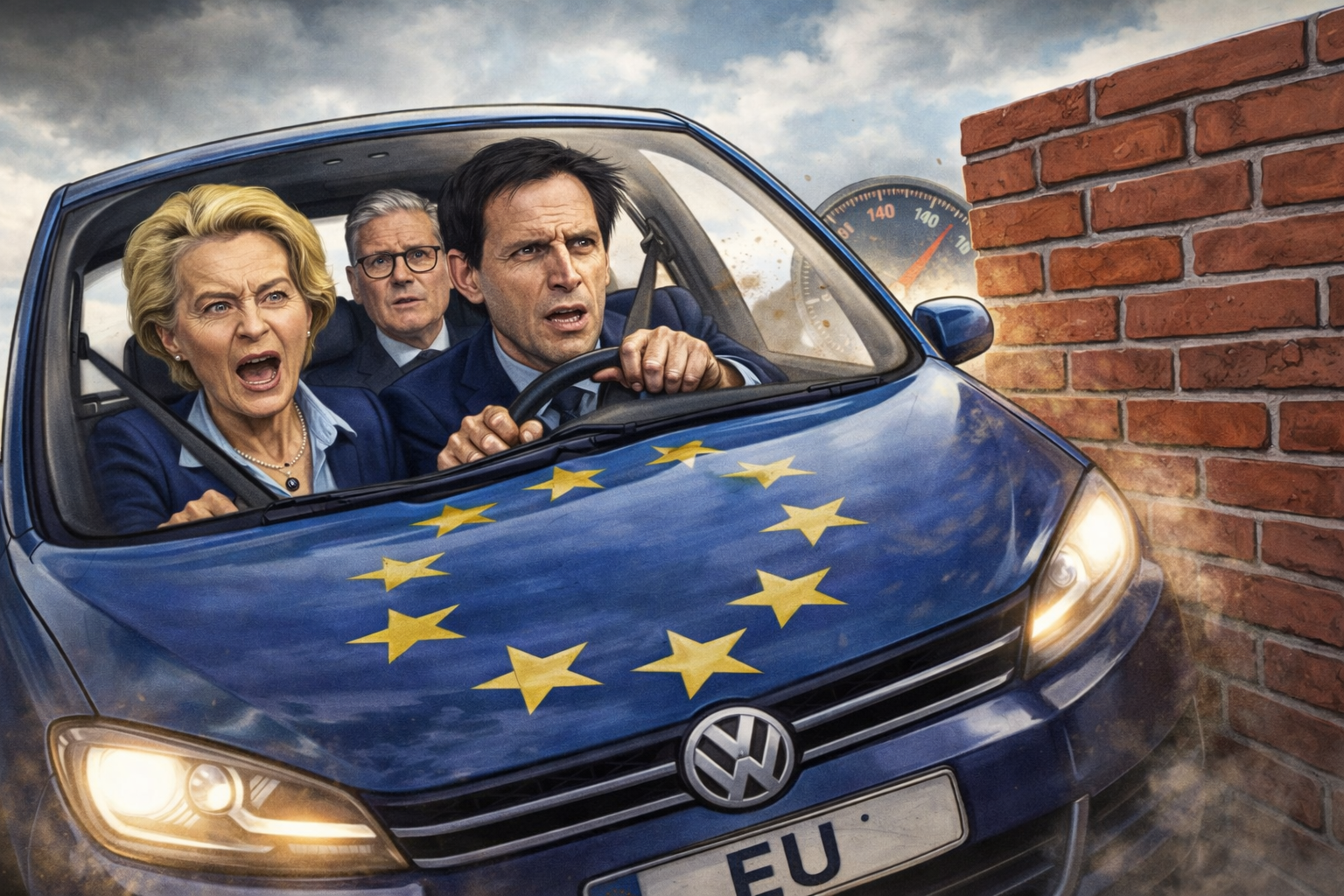
European energy policy: full throttle towards an inevitable collision. Image created with ChatGPT.
Evert Doornhof
Date: 25 april 2026
The signals in Europe are crystal clear. Energy prices are structurally higher than in the United States; the electricity grid is grinding to a halt; industry is leaving Europe; and dependence on imports is growing. These are not isolated incidents. This is how the system works. And yet, one message is echoing from Brussels and The Hague: let’s accelerate the process.
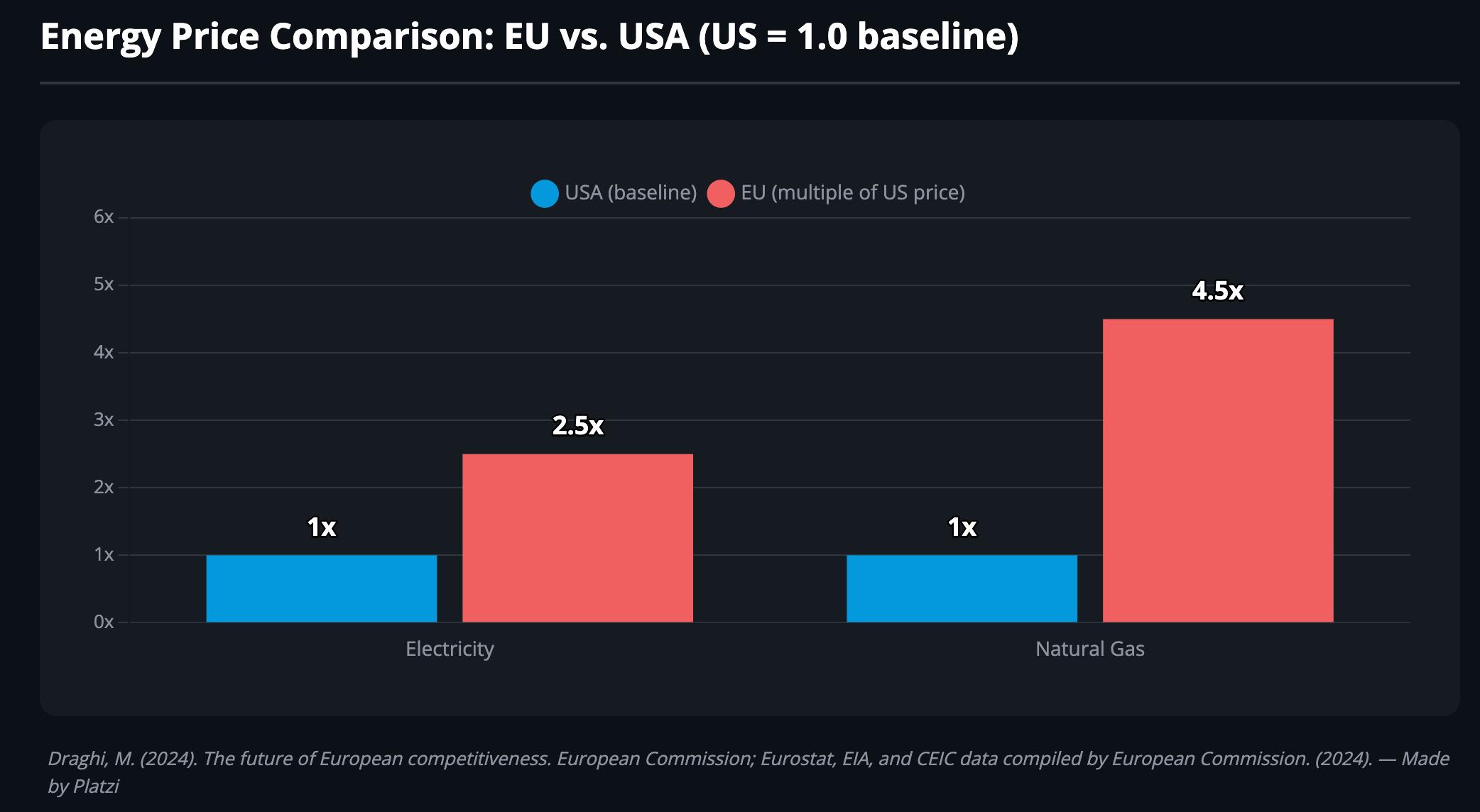
European energy prices are structurally much higher than in the US, a direct consequence of policy choices.
Source: European Commission (Draghi Report, 2024), based on Eurostat, EIA and CEIC data (adaptation).
This is not bad luck, but policy
In recent years, Europe has deliberately chosen to:
• Close nuclear power plants
• Phase out domestic gas production
• Replace reliable energy sources with weather-dependent alternatives
This is not a technical development, but a political choice. The choice is based on the assumption that there is a climate crisis requiring rapid and drastic measures. But that assumption is by no means certain — and is rarely seriously questioned. Our World Climate Declaration (WCD) — now signed by 2,062 experts — states explicitly that there is no climate crisis that justifies this policy. And so the need for a hasty energy transition disappears.
France vs Germany: the difference between theory and practice
Within Europe, the evidence is clear. France opted for nuclear energy, with the following consequences: approximately 70% of electricity is generated by nuclear power plants; there is a stable, predictable system, and there are low CO2 emissions per kWh.
Germany, on the other hand, chose the Energiewende, in which nuclear power plants have been closed, hundreds of billions have been invested in wind and solar, energy prices are higher than in France, and, ironically, CO2 emissions are higher than in France.
Even within the logic of climate policy, the conclusion is inconvenient: Germany is performing worse than France, at much higher costs. This is not a subtle difference. It’s a fundamental failure of policy.
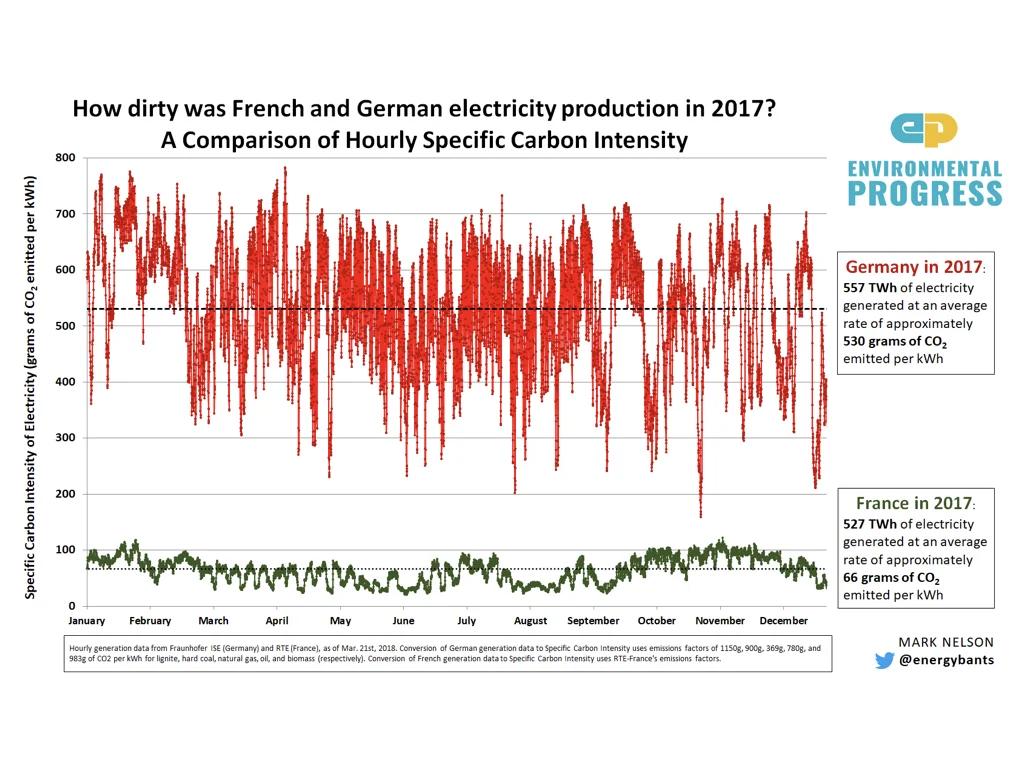
CO₂ intensity of electricity in France and Germany (2017). France produces electricity structurally cleaner and more stable than Germany—source: Environmental Progress, based on Fraunhofer ISE and RTE.
Recent figures confirm that this difference still exists: France emits around 20–30 g CO₂/kWh, while Germany emits around 300 g CO₂/kWh (source: RTE France, Ember, Fraunhofer ISE).
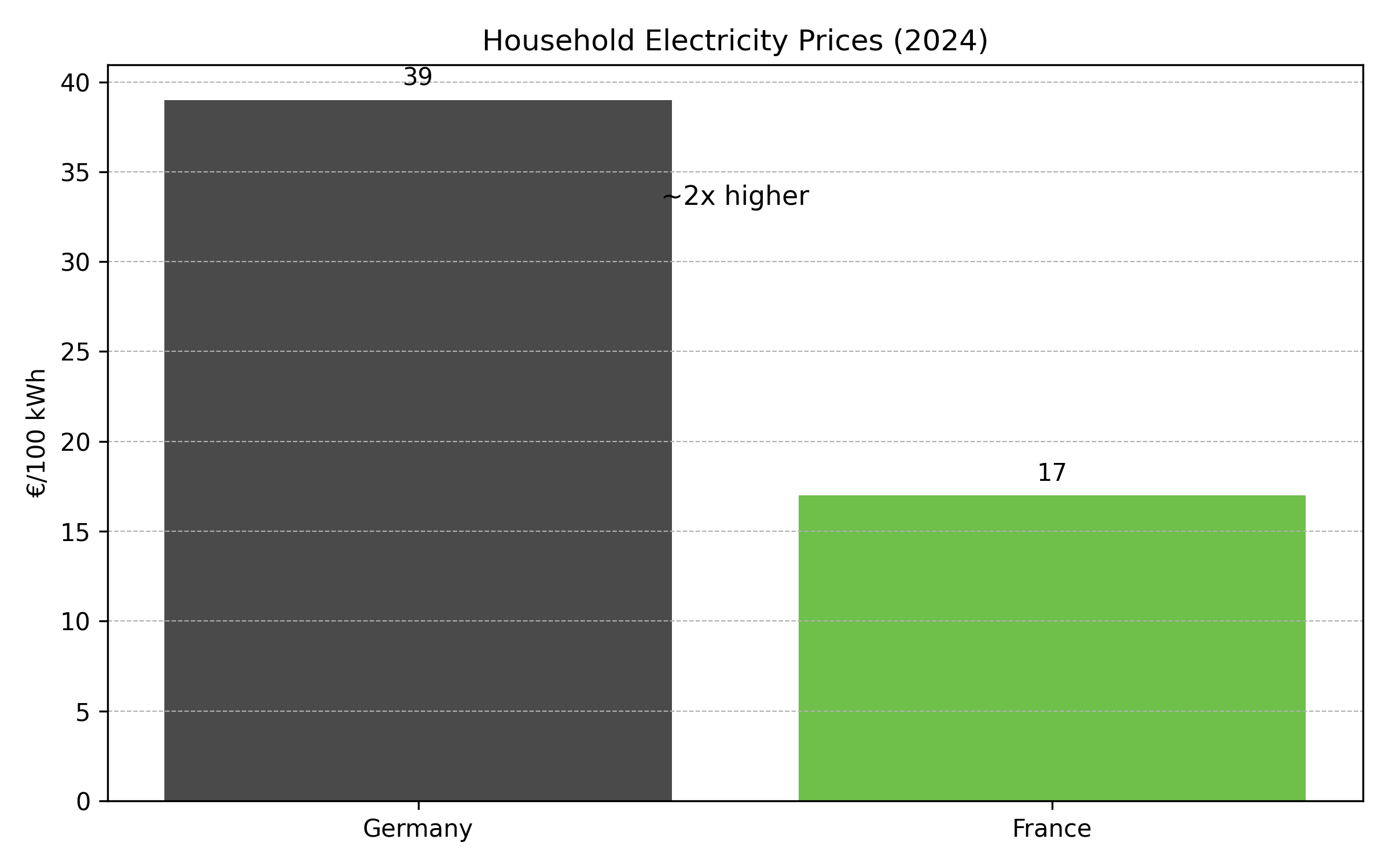
Electricity prices reflect energy policy: German households pay approximately twice as much as French households. Source: Eurostat (2024).
The difference between France and Germany shows that energy policy actually matters. France opted for nuclear energy and has a stable system with low emissions and relatively moderate prices. Germany closed its nuclear power plants and invested hundreds of billions in wind and solar, and now faces higher prices, greater dependence on fossil fuels, and even higher CO2 emissions per kWh. Two countries, two choices, two outcomes.
What people prefer not to mention
The downside of the energy transition remains remarkably underexposed in Europe. Examples include:
• Periods lasting weeks without sun and wind
• Fossil fuel backup remains necessary
• A dual infrastructure is therefore required
• There is enormous pressure on the electricity grid
• We remain dependent on raw materials and mining
• The degradation of the landscape and nature
These are not marginal issues. This is how the system works. But anyone who points this out, is quickly labelled as being “on the wrong side of the debate.”
The fallacy
Europe is trying to replace a stable energy system with an unstable one. And it thinks it can solve this by rolling it out even faster. That is not a strategy. It’s stubbornness. As our director Marcel Crok states: “sustainable” is not automatically a solution.
The alternative
In 2019, Clintel presented the World Climate Declaration to European leaders. The message was clear:
• There is no climate crisis
• and therefore no reason for panic policies
• Focus on reliable and affordable energy
If it had taken this advice, Europe would probably have a more stable energy system today, with lower energy prices, fewer power grid problems, and, last but not least, a stronger industry.
In addition, nuclear energy could have served as the backbone, while domestic gas could have served as a strategic buffer and renewable sources as a supplement rather than a foundation.
The true cost is becoming apparent
The gap with the United States is widening. After all, the US benefits from cheap energy, a strong industry and therefore higher economic growth. At the same time, Europe struggles with expensive energy, is losing its industry and lags economically.
This is reflected in the development of the gross domestic product in the US versus the EU. The energy price is a major factor in this. This is no coincidence. This is policy. And policy has consequences.
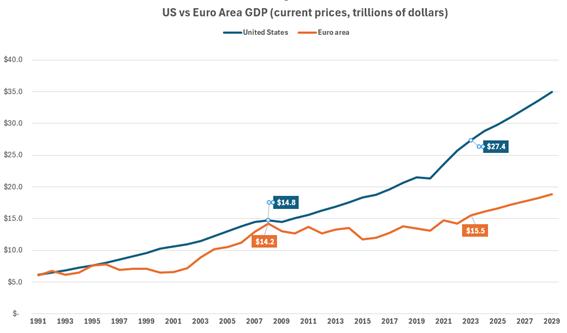
Cheap energy and policy make the difference — the US continues to grow, Europe lags. Source: IMF WEO (adaptation).
Europe’s crisis is not that the energy transition isn’t happening fast enough. Its crisis is that the entire policy is detached from the physical and economic reality. Yet in Brussels and in the European capitals politicians keep slamming the pedal to the floor, accelerating full speed towards the wall.
A version of this article was previously published by theliberum.com.
Evert Doornhof has long been active in the financial world in commercial and management roles. After the COVID pandemic, he changed course when he observed how quickly personal freedoms can be restricted. He is now committed to shedding light on crises that appear to be manufactured or exaggerated. Among other things, he is active with the Clintel Foundation, where he manages social media and has written several articles.

more news

Dramatic Fall in Global Temperatures Ignored by Narrative-Captured Mainstream Media
While public debate remains fixated on ever-rising temperatures, the data tell a different story: the Earth is cooling. Yet this striking fact is largely ignored by media, politics, and the established climate science community.

Africa’s Pipeline Rejects Climate Dogma and Foreign Control
Political powers in the United Nations and European Union have spent decades lecturing Africa on climate “virtue.” Net-zero pledges, renewable targets, ESG frameworks and more make up the ever-growing list of prescriptions for “healing the planet.”
Dismantlement of South Africa’s Ferrochrome Industry
South Africa’s once dominant ferrochrome industry is on the brink of collapse and requires a government bailout. That decline is not because the world no longer needs ferrochrome. It is because South Africa’s leaders tied their industrial policy to a “green” agenda that undermines reliable, affordable energy and sacrifices economic strength.

