
“Friends of the Earth sounded like a spoiled child in court appeal against Shell”
Friends of the Earth Netherlands recently filed an appeal with the Dutch Hoge Raad against Shell and the Mens en Milieu Foundation in a last effort to force the company to implement significant worldwide emissions reductions. Lucas Bergkamp, a physician and attorney in Brussels, assisted Mens en Milieu in the proceeding and reported on the hearing: “Friends of the Earth looked tired and sounded like a spoiled child.”


Source: Shutterstock
Clintel Foundation
Date: 2 June 2026
On the Dutch website Wynia’s Week, Lucas Bergkamp discussed the appeal of May 22 by Friends of The Earth Netherlands against Shell. The organisation filed an appeal in cassation before the Hoge Raad, the Netherlands’ highest court (more or less comparable to the Supreme Court). This after the Court of Appeal in The Hague had, in 2024, overturned an earlier ruling that had required Shell to reduce its emissions worldwide by 45% by 2030. The Mens en Milieu Foundation, which intervened in support of Shell, represents the interests of citizens and businesses affected by ambitious climate policy and the energy transition.
According to Bergkamp, the hearing focused less on legal arguments than on fundamental questions about the role of the judiciary in climate policy. In his view, Friends of the Earth (called Milieudefensie in the Netherlands) looked tired, appeared legally weak, ideologically driven, and insufficiently capable of convincingly substantiating its central claims.
After all, in the Netherlands an appeal like this is exclusively about the correct application of the law and not about facts or political convictions. Precisely for that reason, one would have expected Friends of the Earth to explain in detail why the Court of Appeal had misapplied the law. Instead, the organization mainly repeated general warnings about climate change. Bergkamp even finds their argument “shameful.” The lawyers got no further than “a litany of climate alarmism and conspiracy theories about the oil and gas sector.”
At a loss for words
Bergkamp’s main point of criticism concerns the legal basis for the court-ordered emissions reduction. During the hearing, the judges asked how a specific percentage of 45% for Shell could be derived from open legal norms such as the Dutch tort-law doctrine of hazardous endangerment and “intergenerational justice.” A clear answer was not forthcoming. The lawyers of Friends of the Earth were “at a loss for words” and merely referred to scenarios and minimum percentages. As a result, the core of the case lacks sufficient legal foundation. According to Bergkamp, the suggestion that IPCC scenarios should function as legal standards is also problematic because scientific projections are not democratically legitimized legislation.
In contrast, Shell and the Mens en Milieu Foundation presented a more rational and legally consistent argument. Shell pointed to existing European climate policy, particularly the ETS system for emissions trading. That system operates precisely with a general emissions budget and tradable rights, whereas Friends of the Earth demands individual reduction obligations for a single company. This demonstrates that its demands conflict with the structure of existing European policy.
Political role
Another key point of criticism is that Friends of the Earth wants the court to fulfil a political role that does not belong to the judiciary. When it became clear that only a small portion of Shell customers’ emissions occur in Europe, Friends of the Earth indicated that the case is actually intended for countries without strict climate policies. In doing so, Bergkamp argues, the Dutch court is transformed into a sort of global climate legislator. He speaks of “a sort of global climate government in The Hague.” In his view, Friends of the Earth is thereby overstepping the boundaries of the democratic rule of law and the separation of powers.
Bergkamp also criticizes the way Friends of the Earth presents the economic and social consequences of the energy transition. The organization claims that the energy transition leads to greater energy security and lower prices, while Bergkamp knows that this transition actually makes energy more expensive and causes energy poverty. He also accuses Friends of the Earth of hypocrisy because the organization has campaigned against nuclear energy for years, even though nuclear energy is actually a stable, CO2-free energy source.
Ideology
The article in Wynia’s Week also delves into the ideological side of Friends of the Earth. A statement by the organization that “private actors are more dangerous than states” is cited as an example of a radical view of businesses and society. In doing so, Friends of the Earth fails to recognize that consumers voluntarily purchase products and that government policy is established democratically. As a result, the organization implicitly views citizens themselves as the problem.
The emotional tone of the argument also draws criticism. A lawyer of Friends of the Earth addressed the judges directly with the message that “judges have a major role to play” in saving the world. Bergkamp calls this “emotional blackmail with a totalitarian character” and refers to Hannah Arendt to warn against arguments that invoke a future that cannot yet be proven.
Whining child
In the conclusion of the article, Bergkamp contrasts Friends of the Earth with the Milieu en Mens Foundation. While he portrays Friends of the Earth as a “whining child,” the foundation, according to him, presents itself as a rational defender of the separation of powers. The foundation cited, among other things, recent German case law in which climate policy was explicitly described as the task of the legislature. The conclusion is that climate policy belongs with democratically elected politicians and not with judges who impose general rules through lawsuits.
Bergkamp concludes by arguing that strategic climate cases are becoming increasingly incompatible with the rule of law. According to him, Friends of the Earth attempts to exert political pressure through legal proceedings rather than pursuing legally compelling cases. Therefore, the most important task of the Hoge Raad lies in safeguarding the separation of powers “as Montesquieu intended it.”

more news

Microsoft Pauses Its Carbon Indulgence Spending. The Usual Suspects Are Upset.
Reports have emerged that Microsoft has quietly paused future carbon removal purchases, sending shockwaves through a market it effectively dominates. What might appear as a routine financial decision has instead exposed the fragility of an industry built around a single buyer—and triggered a swift, organized backlash from climate advocates.
Roger Pielke Jr.: “The correction came far too slowly”
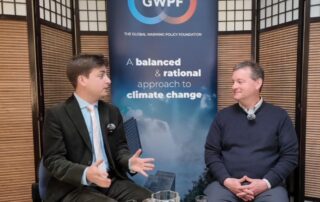
Now that the extreme climate scenario RCP 8.5 has finally been abandoned, the debate has shifted significantly, says Roger Pielke Jr. The American researcher recently gave an interview to the Global Warming Policy Foundation.
Germany’s Nuclear Confession Is a Crack in Net Zero Pretense
When the next prolonged cold spell, drought, or demand surge hits, the weakness of the anti-fossil fuel approach will show up in higher bills, rolling blackouts, and public anger. The political class cannot keep dodging reality forever, says Vijay Jayaraj.

