
Fritz Vahrenholts Newsletter: Eine Lehre aus dem Terroranschlag
Der Newsletter von Fritz Vahrenholt bietet persönliche Kommentare zu globalen Temperaturveränderungen und energiepolitischen Themen direkt vom Verfasser.


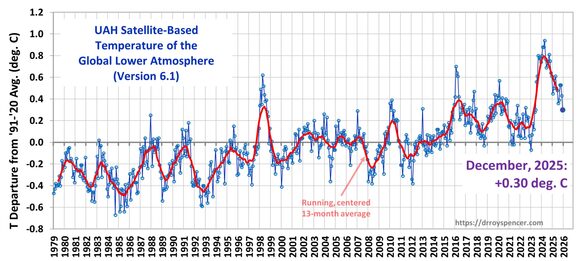
Die globale Temperatur hat sich im Dezember 2025 weiter deutlich verringert. Sie beträgt nur noch um 0,3 Grad Celsius höher als das langjährige Mittel. Das Jahr 2025 war insgesamt deutlich kühler als 2024. Der Abkühlungstrend wird fortgesetzt.
Eine grundsätzliche Lehre aus dem Terroranschlag auf das Berliner Stromnetz


Dr. Fritz Vahrenholt
Die oben genannten Artikel sind dem Rundbrief von Dr. Fritz Vahrenholt vom 7. Januar 2026 entnommen. Hier können Sie sich für diesen Rundbrief anmelden.

more news

The Case for Abolishing the EU Emissions Trading System
For two decades, the EU Emissions Trading System (EU ETS) has been at the heart of the European Union's climate policy. Yet Samuel Furfari, former senior official at the European Commission's Directorate-General for Energy and emeritus professor of energy geopolitics, argues that the system rests on shaky legal foundations, undermines Europe's competitiveness and has evolved into an expensive political instrument. His conclusion is clear: the EU Emissions Trading System should be abolished.

The Pseudoscience behind Extreme Weather Attribution
Extreme weather attribution studies claim to determine how much human-caused climate change influences individual events such as hurricanes, floods and heatwaves. In this article, Ralph B. Alexander examines the scientific methods behind these studies and questions whether their conclusions are supported by reliable evidence.

Great Barrier Reef escapes UNESCO ‘In Danger’ listing again
UNESCO has once again decided not to place the Great Barrier Reef on its "In Danger" World Heritage List. Yet much of the international coverage continues to focus on climate warnings rather than on the broader picture of coral recovery. In this opinion article, Australian commentator Jo Nova argues that political narratives increasingly overshadow the underlying monitoring data. Drawing on Peter Ridd's analysis of Australian Institute of Marine Science (AIMS) data, she contends that the Great Barrier Reef remains in far better condition than is commonly portrayed.

