
Good News Everyone! We hit ‘Peak Climate’ – Media Articles are in Decline
Good news to start 2026 with: globally, we have passed the peak of media coverage of climate alarmism.

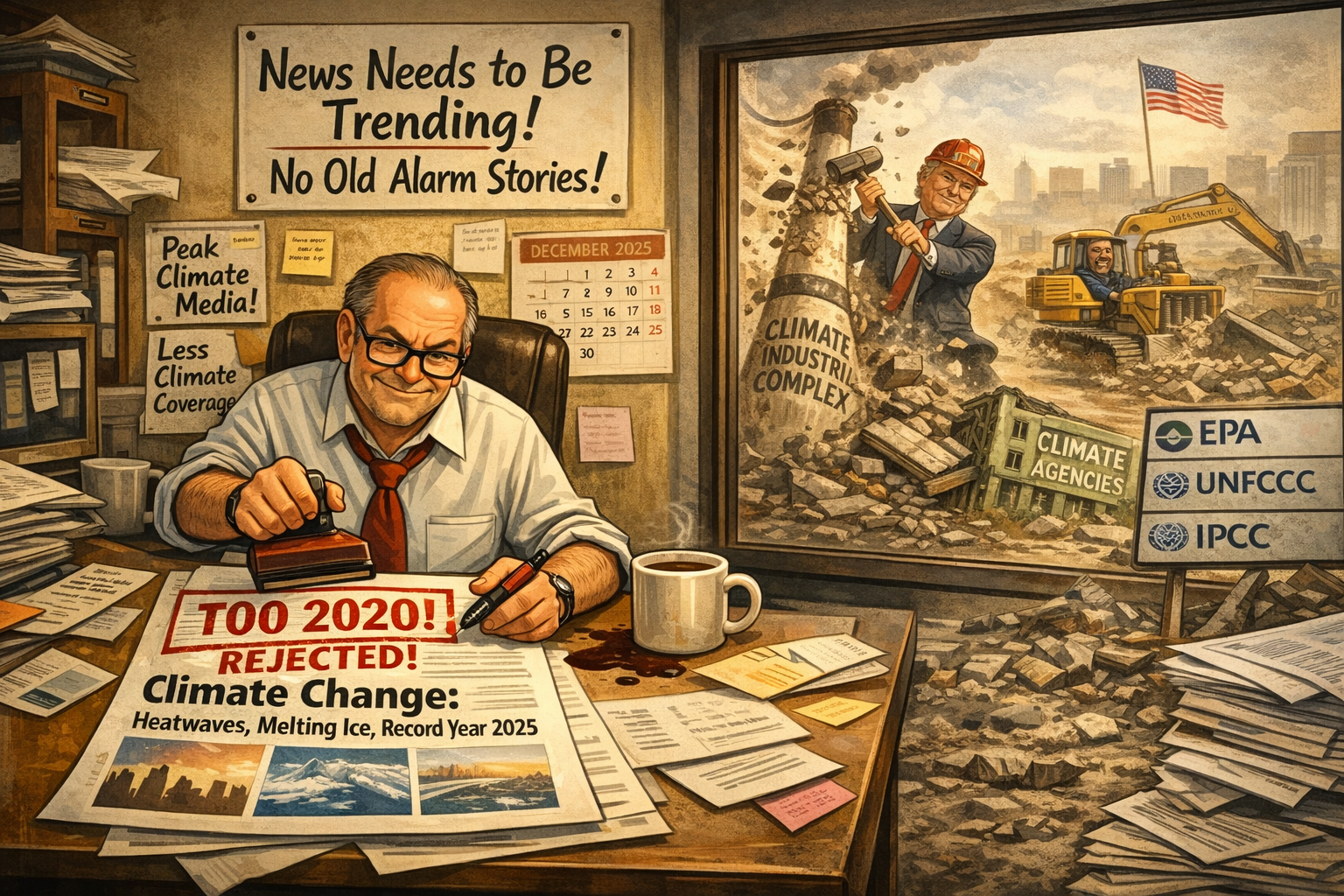
Image created with ChatGPT
Anthony Watts
Date: 1 January 2026
I know many of you have been feeling it. I certainly have, especially when I go look for stories to debunk from media outlets that take some press release and massage it so it reads like “turbo doom clickbait.” There’s less of those these days and the data suggests a downward trend.
Our friend, Steve Milloy of junkscience.com posted a very interesting plot on X yesterday. Given the clues he left, I was able to replicate it with Grok. It goes from 1988 (when Dr. James Hansen first testified before Congress about the climate scare,) to the present post-Biden era where Trump is effectively replicating Sherman’s march to the sea in the climate world.
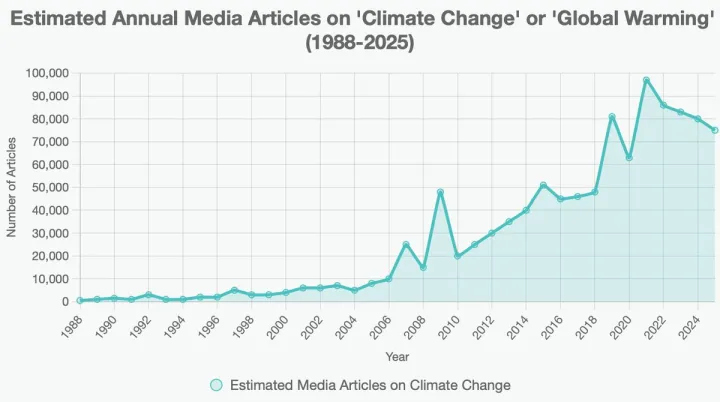
Numbers are approximate and scaled to represent total articles across monitored sources, normalized for consistency across periods (e.g., fewer sources pre-2020 expansion).
The data comes from Media and Climate Change Observatory (MeCCO) which tracks media coverage of “climate change” or “global warming” in newspapers, radio, and TV across dozens of sources worldwide, with data starting in 2004 for global monitoring (and 2000 for US-specific). Pre-2004 data comes from earlier studies by MeCCO founder Max Boykoff and colleagues, which analyzed English-language newspapers from 1988 onward. Absolute article counts are not publicly available without accessing their datasets, but trends show low coverage in the late 1980s, spikes around key events (e.g., IPCC reports in 1990, 1995, 2001; Kyoto Protocol in 1997), and overall increases with major peaks in 2007, 2009, 2015, 2019, and especially 2021 (the highest since tracking began).
The peak around 2006-2007 is likely due to Al Gore’s climate movie An Inconvenient Truth gaining traction. The peak in 2009 is clearly due to Climategate, which as you may recall, WUWT broke that story. The plunge afterwards was the loss of faith in “The Hockey Team” of climate scientists. Since then, climate as a topic in media coverage has clawed its way back uphill, peaking in 2021 with Biden’s green agenda and EV mandate.
Coverage dipped during the 2018-2020 COVID-19 pandemic but has fluctuated with events like COP summits.
Whether this short down trend will hold depends on us. We have to keep fighting climate alarmism, calling out nonsense, be it scientific or political, when we see it.

Previously published on wattsupwiththat.com.

Anthony Watts
Anthony Watts is a senior fellow for environment and climate at The Heartland Institute. Watts has been in the weather business both in front of, and behind the camera as an on-air television meteorologist since 1978, and currently does daily radio forecasts. He has created weather graphics presentation systems for television, specialized weather instrumentation, as well as co-authored peer-reviewed papers on climate issues. He operates the most viewed website in the world on climate, the award-winning website wattsupwiththat.com.

more news

Jonathan Cohler: “The rise in atmospheric CO2 is not caused by humans.”
Physicist Jonathan Cohler has put forward a controversial and uncompromising challenge to one of the central assumptions of modern climate science and policy. He argues that the rise in atmospheric carbon dioxide over the past few decades is not due to human emissions, but is the result of natural processes.

New Solar Religion Is Devastating to Wildlife, Farmland
The state of New York is tearing up rural communities, wiping out wildlife sanctuaries, and burying prime agricultural soil under solar installation in the name of green energy.

From “Demon” to “Dinner”: Willie Soon’s Case for CO2 and Fossil Fuels
“CO2 is not a satanic gas, nor a demon. It is simply dinner for plants”, said Willie Soon at the recent EIKE Conference.

