
Matthew Wielicki on Climate Debrief: “The human condition has never been better”
Students were crying during conversations about the future, their fears largely driven by repeated exposure to highly negative messaging about climate change, recalls ‘professor in exile’ Matthew Wielicki on the Climate Debrief Podcast. He encourages young people to approach environmental and climate concerns with balance, optimism, and practical action rather than despair.

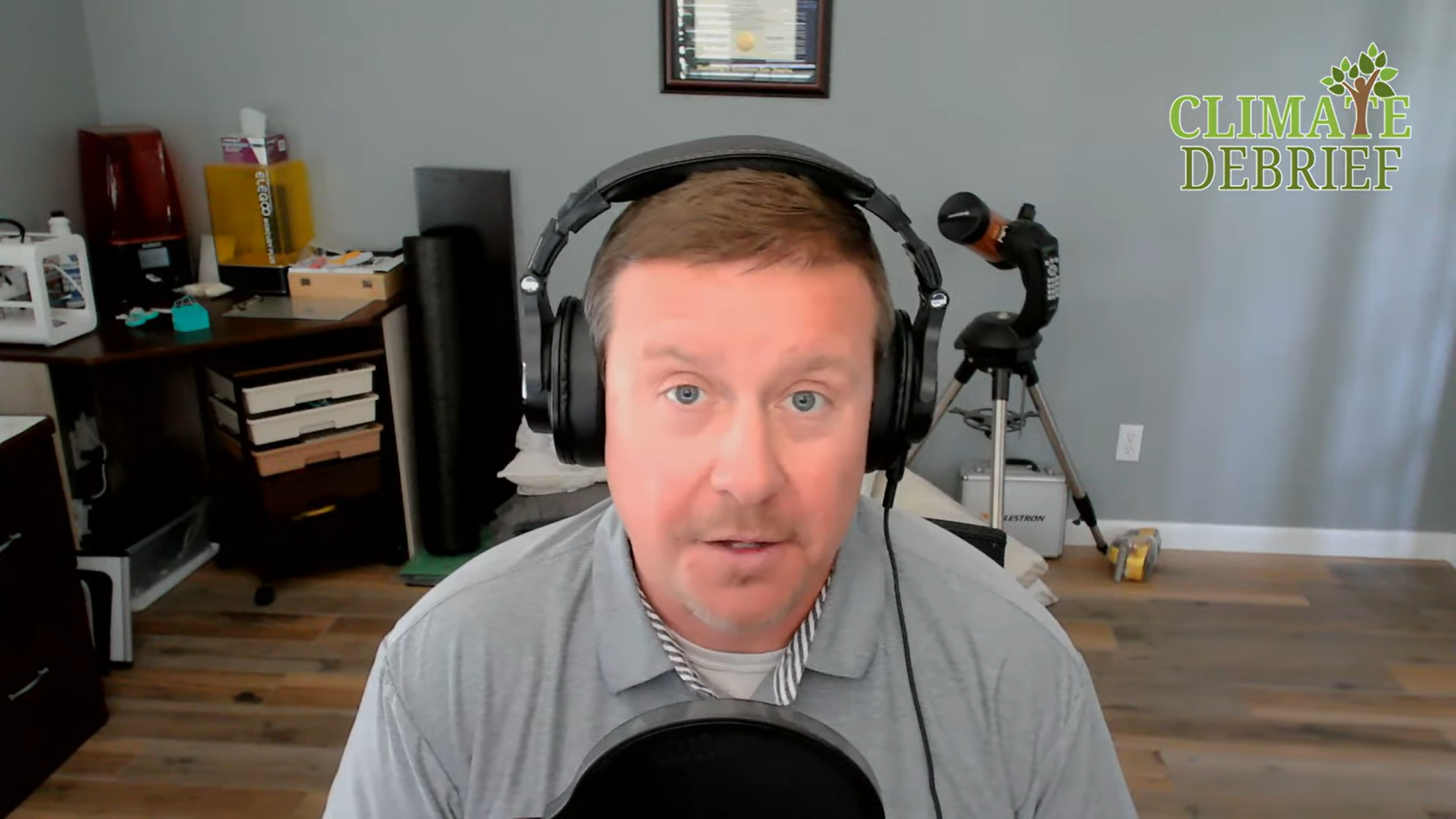
Matthew Wielicki on Climate Debrief
Clintel Foundation
Date: 8 June 2026
Dr. Matthew Wielicki, a former assistant professor of geological sciences at the University of Alabama and a postdoctoral researcher at UCLA, recently discussed his views on academia, climate science, and public discourse in an interview with Angela Wheeler of the CO2 Coalition.
You can see the full interview (in the series Climate Debrief by the CO2 Coalition) below:
Throughout the conversation, Wielicki described himself as an “earth science professor in exile,” arguing that universities have become increasingly hostile to open debate on controversial subjects such as climate change, diversity policies, and social issues.
Wielicki explained that his departure from academia was partly voluntary and partly driven by institutional pressures. According to him, his skepticism toward dominant narratives in climate science made it unlikely that he would receive tenure. He reflected on the academic climate by stating, “I think if I would have tried to stay and pursue tenure, I wouldn’t have got it.” He added that many colleagues privately agreed with some of his criticisms but were unwilling to speak publicly because of concerns about career consequences. Academia has become less tolerant of dissent and more influenced by ideological conformity.
Poland
A major influence on Wielicki’s perspective was his family’s experience emigrating from communist Poland in the early 1980s. He described how his father, an academic, feared political repression and could not safely return to Poland after martial law was imposed. These experiences shaped Wielicki’s appreciation for intellectual freedom and open discussion. He emphasized that universities should be places where ideas can be debated freely, even when disagreements are intense. Instead, he believes many institutions now discourage questioning on politically sensitive topics.
The conversation then shifted toward climate science and public communication. Wielicki argued that there is a significant disconnect between scientific complexity and the simplified narratives often promoted by the media. Scientific studies challenging dominant assumptions about climate change tend to receive less attention than those supporting alarming conclusions. In his words: “The narrative is that the planet is warming at an unprecedented rate.” However, the climate data are more nuanced and many uncertainties remain unresolved.
Two papers
As an example, Wielicki discussed two peer-reviewed papers analyzing the same global temperature data but reaching opposite conclusions about whether global warming is accelerating. One paper, widely publicized in the media, argued that warming had accelerated in recent years. Another, published in a respected journal, found no statistically significant acceleration when natural climate variability was taken into account. Wielicki argued that this contrast demonstrates how scientific uncertainty is often downplayed in public discussions. He said: “They’re looking identical data sets… coming to totally opposite conclusions.” In his view, this should encourage further scientific debate rather than claims that “the science is settled.”
Wielicki also criticized climate models and statistical methods that can be adjusted to support predetermined conclusions. He emphasized the complexity of Earth’s climate system and warned against reducing climate change to a single controlling factor such as carbon dioxide. He suggested that researchers, funding institutions, and media organizations are incentivized to amplify findings that fit a catastrophic narrative because such narratives attract attention, funding, and policy influence. This dynamic creates what he described as a “manufactured consensus.”
Young people
Another major theme of the interview was climate anxiety among young people. Wielicki described being surprised by the level of fear expressed by college students during the COVID-19 pandemic. Many students told him they were uncertain about having children because they believed the planet faced imminent catastrophe from climate change. He recalled students crying during conversations about the future and family life. Wielicki believes these fears were largely driven by repeated exposure to highly negative messaging about climate change.
To address these anxieties, Wielicki said he began presenting students with observational data showing improvements in human well-being over time. He emphasized trends such as increased food abundance, better access to energy, and reduced vulnerability to weather-related disasters compared with previous generations. Many students felt relieved after hearing a more optimistic interpretation of environmental data. He argued that constantly portraying humanity as harmful to the planet discourages young people from becoming responsible environmental stewards.
Wielicki strongly defended the importance of questioning prevailing assumptions within science. He argued that the scientific method depends on testing hypotheses, debating evidence, and revising conclusions when new information becomes available. Yet climate change, diversity policies, and gender issues had become “taboo subjects” in universities. Questioning dominant narratives often leads to professional risks and social ostracism. He compared this atmosphere to ideological systems that discourage dissent rather than encourage inquiry.
Stewardship
Toward the end of the interview, Wielicki focused on practical environmental stewardship rather than global climate activism. He encouraged young people to concentrate on local environmental improvements that they can directly influence, such as cleaning rivers, planting trees, and improving neighbourhoods. He argued that symbolic protests and acts of disruption do little to help the environment in meaningful ways. Instead, he promoted what he called a more traditional conservation ethic centered on clean air, clean water, and community responsibility.
Wielicki concluded on an optimistic note, emphasizing his belief that humanity’s future remains bright despite widespread fears about climate catastrophe. “The human condition has never been better,” he said, pointing to advances in medicine, technology, and living standards. He encouraged young people to approach environmental concerns with balance, optimism, and practical action rather than despair.

more news
Roger Pielke Jr.: “The correction came far too slowly”
Now that the extreme climate scenario RCP 8.5 has finally been abandoned, the debate has shifted significantly, says Roger Pielke Jr. The American researcher recently gave an interview to the Global Warming Policy Foundation.
Germany’s Nuclear Confession Is a Crack in Net Zero Pretense
When the next prolonged cold spell, drought, or demand surge hits, the weakness of the anti-fossil fuel approach will show up in higher bills, rolling blackouts, and public anger. The political class cannot keep dodging reality forever, says Vijay Jayaraj.
“Masculine Behavior Bad for the Planet,” says Phys.org
The worldwide climate debate seems to turn in favour of the sceptics. But, as Charles Rotter shows below, the other side is still pushing some pretty extreme and crazy climate stories.

