Norway keeps on drilling in the Arctic
Norway’s Minister of Energy Terje Aasland has told Reuters that his country will keep developing oil and gas in the Barents Sea irrespective of a European Union (EU) ban on Arctic drilling.

Offshore-platform in Norway. (Source: Shutterstock)
Vijay Jayaraj
Date: 14 September 2026
“In today’s geopolitical and security environment…I believe continued activity in the Barents Sea serves both Norwegian and European interests,” said Norway’s Minister of Energy Aasland.
Although not an EU member, Norway is a close ally and Europe’s largest gas supplier, meeting about 30% of the demand across the European Union and Britain. Last year Norwegian gas output ran near record levels and oil production hit its highest mark since 2009.
Without new fields, however, official projections show output dropping sharply after 2030. But Aasland intends to hold production and exports near current levels until at least 2035, and he has said that the Arctic is important to Norway remaining a long-term supplier.
The EU currently backs a ban on new Arctic drilling on environmental grounds, while buying the gas that keeps its factories running. Anders Opedal, CEO of Norwegian multinational energy company Equinor, has said that producers of Barents Sea oil and natural gas will find buyers somewhere else if Europe refuses to buy.
Even Fatih Birol, head of the International Energy Agency (IEA) and a promoter of transitioning away from fossil fuels, has urged the EU to reconsider its opposition to Arctic development for the sake of energy security.
Europe already has suffered economic damage from its “green” pretense. The IEA reports that EU electricity prices for energy-intensive industry averaged more than double American levels in 2025 and were nearly 50% above China’s. A 2024 report on European competitiveness warned that such costs are hollowing out manufacturing.
2.39 trillion dollars
Here is where the story stops being about the Arctic and becomes about everyone else.
Norway is not a struggling petro-state rationalizing a bad habit. It is among the richest societies ever built, with per capita gross domestic product above $105,000 and a sovereign wealth fund that crossed $2.39 trillion in June. Five and a half million people have converted seabed hydrocarbons into universal healthcare, free universities, and pensions for grandchildren not yet born.
If Norway considers oil and gas indispensable to its economic position, it is unreasonable to demand that poorer countries abandon their own resources. This matters enormously for Africa, South Asia, and other rapidly developing regions. For many African households, unreliable energy can be catastrophic.
Delay of fossil fuel projects costs in ways spreadsheets miss. A gas project blocked by climate posturing means that engineering teams disband, drilling rigs go elsewhere, borrowing costs rise, and the fertilizer plant that would have used the hydrocarbon feedstock never gets built. A decade of compounding benefits is lost to a national balance sheet.
Western proponents of climate orthodoxy declare as immoral the ladder their societies climbed to unprecedented prosperity. Every advanced economy industrialized with coal, oil, and gas. Norway is still doing it with a $2 trillion cushion. Norwegian leaders recognize oil and gas are critical to their nation’s future, unlike their counterparts in the EU, Canada, and Australia.
When ministers from developing nations sit down with lenders and donor agencies, they should place the Aasland interview on the table and ask a single question: If continued Arctic development serves Norwegian and European interests, on what basis does a Nigerian gas plant or a Bangladeshi terminal serve a lesser interest?
Norway’s example
Climate alarmists present a false choice between affordable, dependable energy and environmental stewardship. Norway rejects that trap. A country can cut waste, improve technologies, protect ecosystems, and maintain the reliable fuel base that modern life requires.
Energy abundance and human flourishing track together in every dataset anyone has assembled. Norway understands this and acts on it. Poor nations understand it too. What they lack is not evidence but permission, and permission is not something a sovereign state should have to request. Leaders of developing nations should leverage Norway’s example and build on it.
This commentary was first published at PJ Media on 4 September 2026.

Vijay Jayaraj
Vijay Jayaraj is a Science and Research Associate at the CO2 Coalition, Fairfax, Virginia. He holds an M.S. in environmental sciences from the University of East Anglia and a postgraduate degree in energy management from Robert Gordon University, both in the U.K., and a bachelor’s in engineering from Anna University, India. He served as a research associate with the Changing Oceans Research Unit at University of British Columbia, Canada.
The article you have just read was made possible by our donors.
Every day, Clintel publishes articles on climate, energy and science. We also translate and share international analyses in multiple languages, produce videos, publish reports and organize conferences and events around the world.
We receive no government funding and rely entirely on the support of our donors. Your support helps us promote independent research and contribute to a more open and balanced debate on climate and energy issues.
Would you like to support our work? Choose the option that suits you best:
• Become a Friend of Clintel – support us with an annual contribution
• Make a recurring donation – provide ongoing support and help us plan ahead
• Make a one-time donation – every contribution helps
Thank you for your support.

more news
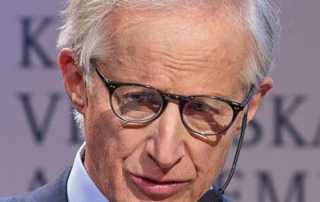
A tribute to Bill Nordhaus
William Nordhaus was an American economist, best known for his work in economic modelling and climate change, and a co-recipient of the 2018 Nobel Memorial Prize in Economic Sciences. He passed away on 30 October, aged 85.
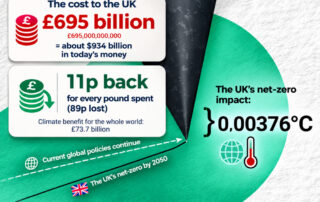
Only £695 billion for 0.00376 °C less warming by 2100
If Britain reaches its Net Zero target in 2050, the world will be 0.00376 °C less warm by 2100. Is that really worth £695 bn?
ICSF/Clintel Lecture: Ireland’s Dangerous Exercise in Wishful Thinking
Ireland’s energy policy has become dangerously unbalanced, according to Kieran O’Brien, former Managing Director of EirGrid. In his recent ICSF/Clintel Lecture, O’Brien argued that the country’s determination to decarbonise has come at the expense of energy security and affordability. “A target without a plan is merely a wish.”