Obsessed anesthesiologists fret over climate change
Scientists at the CO2 Coalition say a fuss over the greenhouse-warming effect of anesthetic gases is much ado about something so close to nothing as to be undetectable, tiny fractions of degrees in temperature. “In fact, compared to the stakes at risk in many surgical procedures, fretting over climate change in an operating room is frivolous at best”, says Gregory Wrightstone of the CO2 Coalition.

Anybody being ‘put under’ for surgery is likely to wonder about the competency and focus of the anesthesiologist. Questions about intelligence and experience come to mind. Or about the level of concern for the poor patient lying helplessly and barely covered in a freezing operating room wondering where he left his wallet and when, or whether, he will awake.
Surely, rendering somebody unconscious with potentially deadly drugs for an extended period and returning them safe and sound to the world of the fully sentient is daunting even for the medically trained. There is no need to add to this responsibility the charge to be sufficiently ‘environmentally friendly’ to avoid overheating the planet.
Yet, doctors are being asked to tend to the pseudo-crisis of climate change as they work at the edge of real disaster, according to pronouncements of health organizations in the U.S. and abroad.
“Inhaled anesthetics are a significant contributor to health care-related greenhouse gas emissions,” says Dr. Jodi Sherman, chair of the American Society of Anesthesiologists (ASA) Committee on Environmental Health and associate professor of anesthesiology at the Yale School of Medicine. “However, it is very achievable for the health care community to minimize their impact on the climate through intervention.”
Recommended actions to ‘mitigate greenhouse gas emissions from inhaled anesthetics’ include avoiding the use of some gases, minimizing doses and considering alternatives to gas inhalation. In Scotland, the National Health Service proudly states that it has “assigned an ambitious target to be net-zero for anaesthetic gases by 2027.” There is even a story about a climate-obsessed man pressuring his pregnant wife to avoid any anesthetic during childbirth. Would he be as environmentally virtuous during a vasectomy?
All this angst is over the warming effect of the anesthetic gases sevoflurane, nitrous oxide, isoflurane and desflurane. The ASA references these gases as being many more times as potent as the much-demonized carbon dioxide, the quintessential environmental bogeyman of climate alarmists.
However, a CO2 Coalition paper says such comparisons fail to quantify the actual atmospheric warming potential of anesthetic gases. To do that, Coalition scientists studied the concentration of the gases in the atmosphere and how much they absorb solar heat and delay its return to outer space, where all solar radiation reaching Earth eventually ends up.
It turns out that the concentrations of anesthetic gases in the atmosphere are exceedingly small, measured in parts per billion and per trillion where carbon dioxide, for example, is measured in parts per million. Because of this and other factors the warming potential caused by anesthetic gases is also quite small. Based on the scientists’ calculations, continued emissions of anesthetic gases would cause a temperature increase of about 0.032 °C in 50 years and of about 0.064 °C in 100 years.
“These temperature increases are negligible and cannot be felt or detected,” the paper concludes. “Therefore, any measures for curbing the emissions of these anesthetic gases into the atmosphere are unnecessary and serve no useful environmental purpose.”
The ASA advises that ‘the collective impact’ on the environment of ‘millions of anesthetics is significant’. In reality, the effect is quite insignificant. It is time for some medical professionals to awaken from the self-imposed stupor of a faux climate emergency.
Gregory Wrightstone is a geologist; executive director of the CO2 Coalition, Arlington, Va.; author of “Inconvenient Facts: The Science That Al Gore Doesn’t Want You to Know” and “A Very Convenient Warming: How modest warming and more CO2 are benefiting humanity.

more news
Svensmark on Cosmic Rays, Clouds and the Politics of Climate Science
At the EIKE Conference in Halle (Germany), Willie Soon and Ronan Connolly from the CERES Team met with recently fired Danish physicist Henrik Svensmark for a wide-ranging discussion about his research into the relationship between solar activity, cosmic rays, clouds and climate. The cosmic-ray mechanism he proposes deserves to be investigated on its physical merits rather than dismissed because it does not fit comfortably into existing climate-model frameworks.

Central Banks Double Down on Climate Regulation
The ECB has quietly expanded its “climate factor”. This is a rear-guard action by a green priesthood that senses the ground shifting but cannot bring itself to abandon the climate faith, says Tilak Doshi.
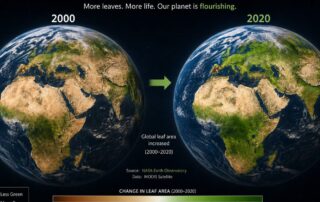
Global Greening Hits New Record as Climate Emergency Fails to Materialise
Global greening, due to CO2, has hit a new record high, according to research recently published in Nature. Meanwhile activists refuse to accept that the 'climate emergency' has failed to materialise, says Chris Morrison.