
Clintel at Heartland Conference: new terminology in climate debate needed
At the Heartland Conference in Washington, D.C., Clintel highlighted new perspectives on climate science, including the benefits of CO₂-driven global greening and the need for a renewed vocabulary in the climate debate, as presented by Marcel Crok.

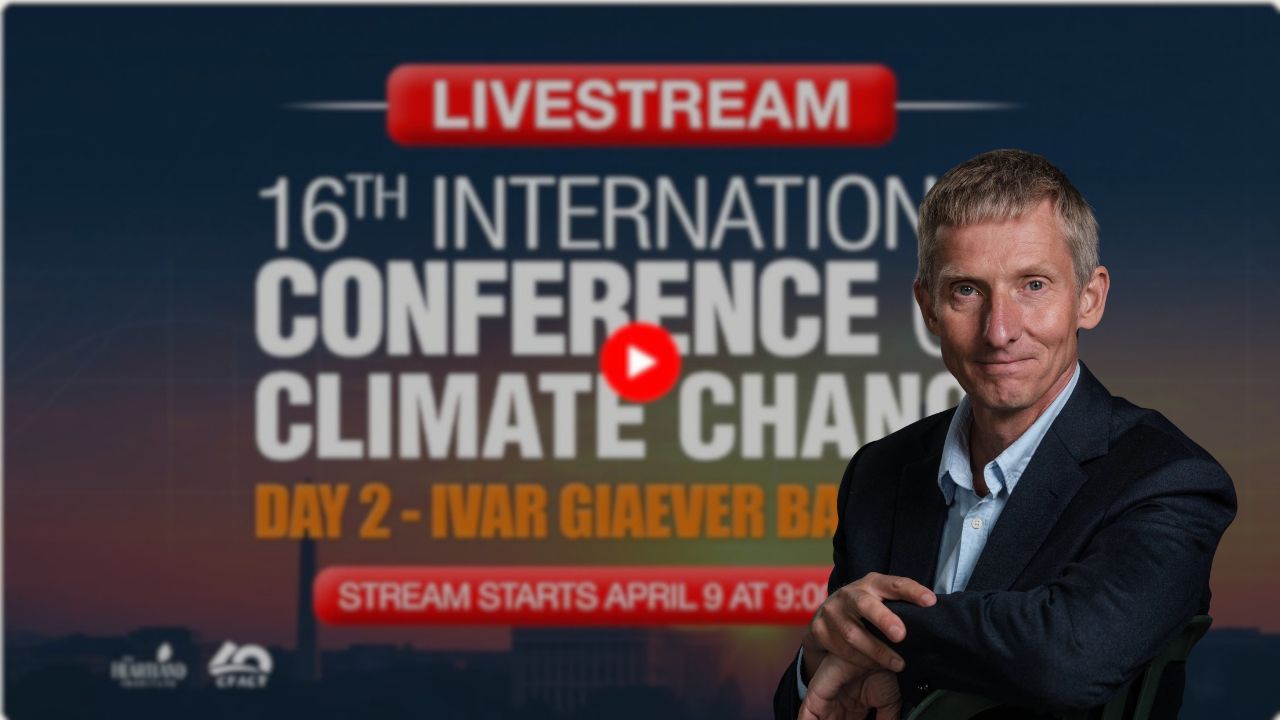
Marcel Crok
Peter Baeten
Date: 11 April 2026
Last week (April 8 and 9), Clintel attended the 16th International Conference on Climate Change in Washington, D.C., organized by the Heartland Institute. Clintel Director Marcel Crok was one of the speakers at this important annual climate-realist conference. The focus of his presentation was on the significant (positive impact of the) greening of the Earth due to the increased concentration of CO2 in the atmosphere. This greening effect is now undeniable and also has a positive impact on global agricultural yields.
New language and vocabulary are needed
Clintel’s American branch, Climate Intel, led by researcher Forrest Frantz, is also closely monitoring this greening effect and contributed to the data presented. Frantz has also put forward striking suggestions regarding the language used in the climate debate, a topic Marcel also addressed in his presentation. Language plays an enormous role in how people experience the climate debate. Climate alarmists have been using this to their advantage since the beginning of the discussion. Crok and Frantz therefore advocate that the climate-realist side also start using new, more positive terms. As a start, Crok offered six concrete suggestions:
Emissions is replaced by: Restoration of CO2 to the air
Fossil fuels becomes: Natural Organic Energy
Carbon dioxide changes into: CO2, Earth’s Oxygen-of-Life
Climate change becomes: climate (because the climate is always changing anyway)
Greenhouse gas is replaced by: Active IR-effect of CO2
H2O and CO2 emissions from power plants becomes: Atmospheric rivers of life
Watch Marcel Crok’s lecture below:


more news
Clintel President Václav Klaus warns: “No radical change in Europe in the near future”
We must not be naïve optimists about climate policy and should not overestimate the recent positive signals, like those from President Trump. This is the view of Clintel President Václav Klaus: “Nothing has changed in the European Union. We, with a background in the social sciences, cannot imagine that any radical change will take place in Europe in the near future.” Klaus made these remarks in his speech at the annual meeting of the Norwegian Klimarealistene in Oslo on March 15.

New study finds low CO2-sensitivity again
A new paper by Frank Stefani compares solar variability and CO₂ emissions as drivers of global sea surface temperatures. Using the solar aa geomagnetic index alongside CO₂ data, the study estimates a transient climate response (TCR) of about 1.1–1.4 K, near the lower end of the IPCC range. The results align closely with other observation-based estimates and highlight the continuing scientific debate about the relative roles of solar activity and greenhouse gases in recent climate change.
Clintel Ambassador Ian Plimer on popular Triggernometry podcast: “Climate science is the biggest cult in scientific history”
Clintel-ambassador for Australia, prof. Ian Plimer, didn’t hold back in his recent interview on the popular Triggernometry podcast: “There’s a very large body of people out there who are actually using science to promote scams. It’s absolutely crippling Western countries. You can’t run an industrial society on sea breezes and sunbeams.”

