
COP30 Is Lying To Justify Its Existence
COP30 is building its case on climate misinformation that rewrites the past to claim a victory it never earned.

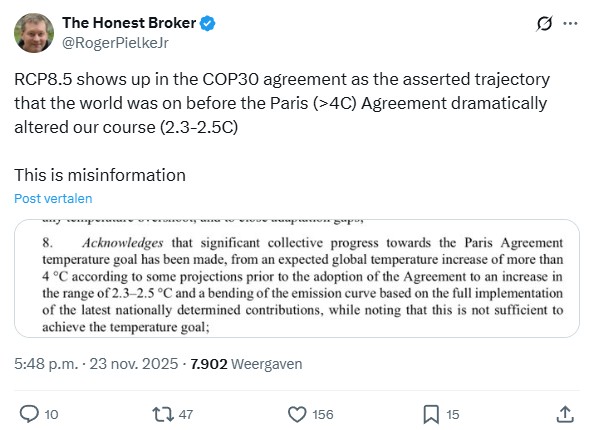
The COP30 agreement claims the world was previously on track for more than 4C of warming until the Paris Agreement heroically “bent” that trajectory down to 2.3–2.5C:

However, “this is misinformation,” says Roger Pielke Jr., Professor of Environmental Studies at the University of Colorado Boulder. It is a fiction built on the carcass of RCP8.5 — the extreme scenario that scientists quietly abandoned years ago because it required impossible coal use, implausible demographics and an economic collapse that never happened.
COP30 is resurrecting an unrealistic, disowned scenario in order to claim that Paris saved the world. The problem is the data. Real-world emissions show no curve bending, no slowdown and no “Paris effect”.
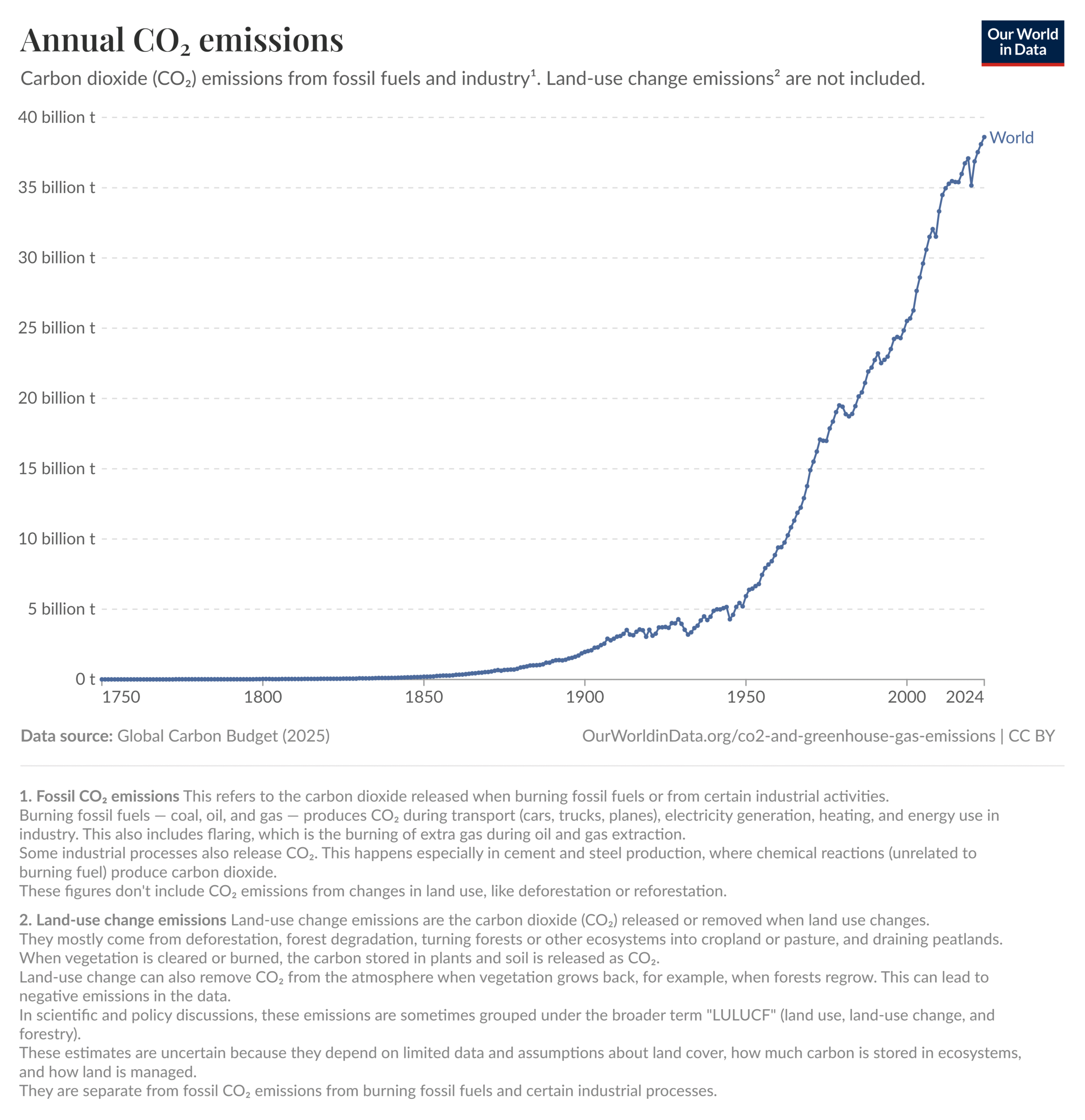
Paris didn’t change emissions, but it did unlock a permanent justification for climate taxation, energy rationing and the dismantling of cheap, reliable power — the foundation of economic prosperity.
COP30 needs a victory to justify its existence. So it has rewritten history: invent a 4C trajectory, pretend Paris knocked it down, and congratulate itself for saving humanity.
The world was never heading for RCP8.5. Paris didn’t change emissions.
Lies.

more news
The Frozen Climate Views of the IPCC by Clintel now also available in French
“This is undoubtedly an essential text that perfectly illustrates the perverse functioning of the IPCC: cherry picking, alarmist summaries betraying the uncertainties of scientists, the sidelining of critical studies, et cetera.”

Time to Stop Pretending Renewables Are Cheap
This article by Tilak Doshi challenges the widely held assumption that wind and solar power are inherently ‘cheap’ — arguing that when their full life-cycle costs, material demands and intermittency are accounted for, renewables may be far more expensive than commonly claimed.

Rationality Returns to Australia as Climate Scare Wanes
Australia’s green energy experiment has left millions of its citizens with a shaky power grid, serving as a case study on how blind allegiance to climate dogma leads to economic and social turmoil.

