
Global Warning, a genuine attempt to be objective about climate
Canadian filmmaker Mathew Embry (Painkiller: Inside the Opioid Crisis) has released a remastered edition of his 2019 climate documentary Global Warning. It is more relevant than ever and is one of the few genuine attempts by the media to take a truly objective look at the climate debate.


Global Warming (screenshot)
Clintel Foundation
Date: 20 June 2026
In 2019, the documentary Global Warning challenged Canada to have a honest conversation about climate change, conventional energy, Indigenous voices, environmental activism, and the future of the country. Today, that conversation matters more than ever. Filmmaker Mathew Embry (Living Proof, Painkiller: Inside the Opioid Crisis) has released a remastered edition of the documentary that dared to ask the questions few others would.
You can see the entire documentary below in the enhanced, remastered edition:
Global Warning returns to a world that has caught up to its message. The fears have shifted. The policies are changing. The stakes have never been higher. And the human cost of how we power our lives has never been more visible. This is a film built on contradictions it refuses to resolve for you. A celebrated climate campaigner who believes Canada has never met a target it couldn’t miss. A self-made business titan watching his life’s work hollowed out. Scientists who question the catastrophe. An indigenous elder who speaks not of carbon or quotas, but of the children we leave behind — “it’s written in rock,” he says, “not on paper.”
Global Warning refuses to pick a side for you. It is, in Embry’s words, a “pro-human” film, one that holds space for the warming planet and the people whose lives are upended by the policies meant to save it. The world hasn’t ended. The conversation is just beginning.
The article you have just read was made possible by our donors.
Every day, Clintel publishes articles on climate, energy and science. We also translate and share international analyses in multiple languages, produce videos, publish reports and organize conferences and events around the world.
We receive no government funding and rely entirely on the support of our donors. Your support helps us promote independent research and contribute to a more open and balanced debate on climate and energy issues.
Would you like to support our work? Choose the option that suits you best:
• Become a Friend of Clintel – support us with an annual contribution
• Make a recurring donation – provide ongoing support and help us plan ahead
• Make a one-time donation – every contribution helps
Thank you for your support.

more news
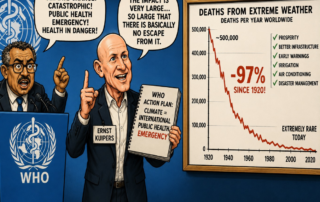
Shameless climate propaganda from the WHO and The Lancet
This week, the WHO tried once again to scare us senseless with fearmongering about climate change. It allegedly poses a catastrophic threat to public health. These claims are easily debunked and raise the question of what the WHO’s real agenda is, says Marcel Crok.

Met Office Faces Fresh Scandal Over its ‘Implausible’ Climate Projections
The Met Office must remove it’s deeply flawed work (UKCP18) with a notification that any policies arising from its discredited figures, should be re-examined, says Chris Morrison.
You can’t be cancelled!
In a recent John Stossel interview, climate policy researcher Roger Pielke Jr. describes how he was professionally punished by the White House, Congress and his own University. He refused to abandon his views: “You can’t be cancelled.”

