
The Polar Bear Narrative: What Scientists Knew Before Frozen Planet Aired
In 2011, BBC viewers were told that polar bears in the Barents Sea were starving due to climate-driven sea ice loss. Later scientific evidence shows that this portrayal was inconsistent with data already available at the time.

Source: Shutterstock
Susan J. Crockford
Date: February 6th, 2026
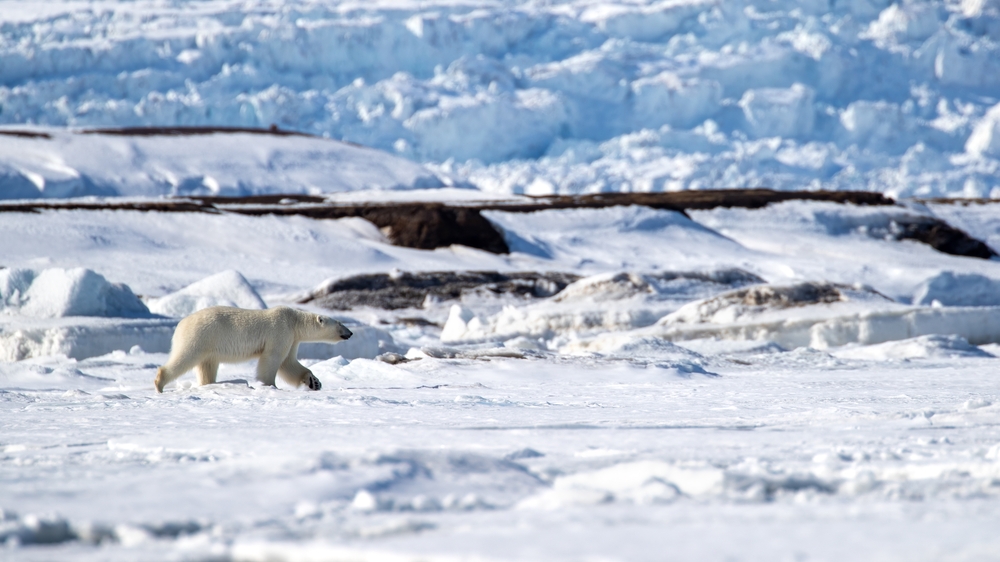
In the climate change episode of his 2011 BBC Frozen Planet series ‘On Thin Ice’, Sir David Attenborough told viewers that polar bear mothers and cubs across the Arctic were starving because climate change was melting the sea ice, even as he sat beside a fat, healthy Barents Sea female.
I wonder how Sir David Attenborough feels now? Has anyone bothered to tell him that Norwegian biologists have finally admitted that Barents Sea polar bears were actually fat and healthy in 2010 when they assisted in the filming of his BBC documentary? Or, did Attenborough know even then that this population of polar bears was thriving despite the large loss of sea ice – but let his viewers think otherwise?
Attenborough took an expedition to Svalbard (in the western Barents Sea, likely the spring of 2010), where he sat with a sedated fat sow while talking about starving polar bears and falling population numbers due to loss of sea ice. This sequence was filmed in the same area where researchers have recently shown that by 2005, at least, bears were in much better condition than they had been in 1995, even though local sea ice had declined dramatically (Aars et al. 2026).
What this also means is that the bears were being handled and measured, so the biologists must have known that the bears in 2010 were not dying of starvation but were actually doing better than they had been in 1995 – even though the sea ice had markedly deteriorated.
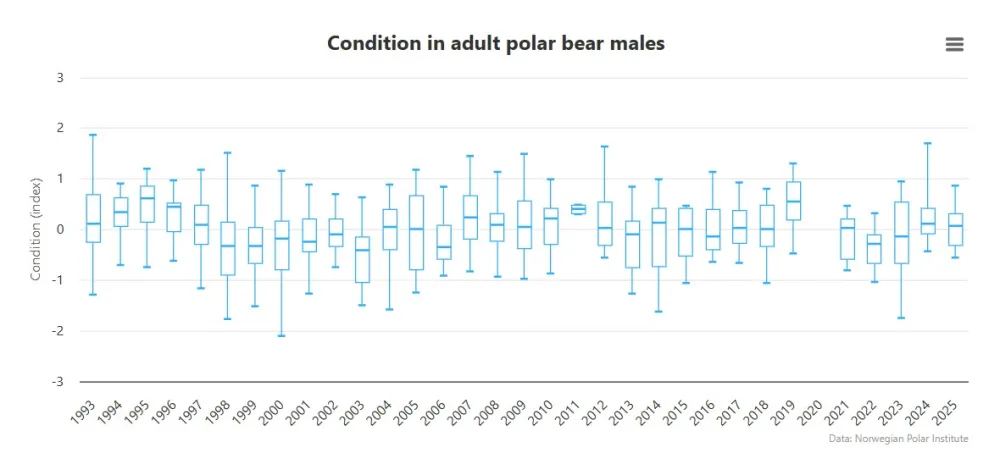
Below is a graph taken from the Norwegian monitoring site that posts their Svalbard polar bear data every year. This graph shows body condition of adult male bears right up to 2025 – seven years beyond the cut-off date for the 2026 Aars study.
Source: polarbearscience.com
The statement below about the population trend vs. sea ice is from the same site:
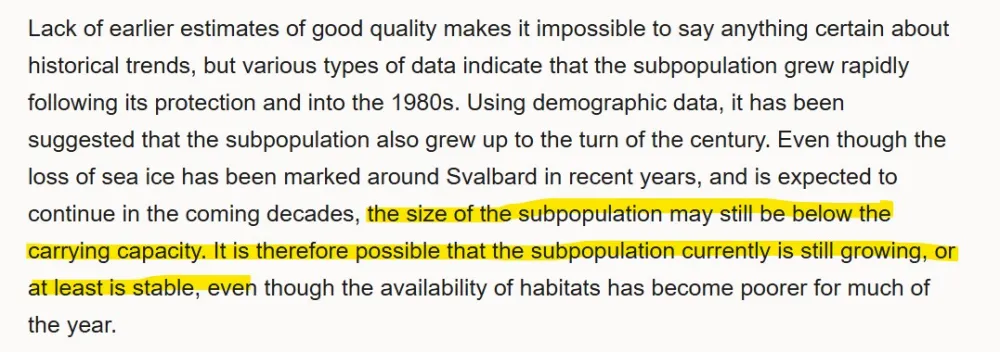
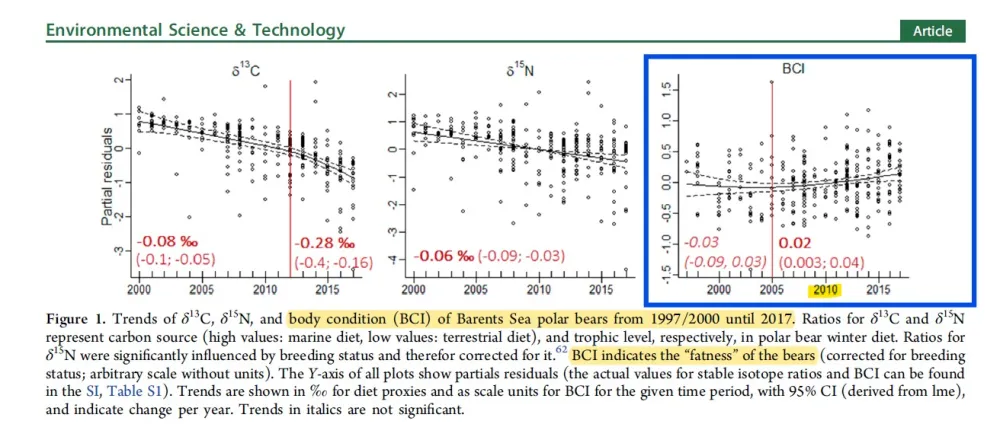
It seems to me that by 2010 when these same authors helped Attenborough make his BBC documentary, these researchers already had the data they needed to determine that sea ice loss was not causing a population decline in the Barents Sea because female bears were not starving (Lippold et al. 2019).
In the figure below, the last panel (“BCI”) shows body condition (i.e., “fatness”) of females over time, from 1997 until 2017. While by 2010, the modest increase in body condition may not have been as strongly apparent as it was a few years later but there was definitely not a decline.
Source: polarbearscience.com
Fat bears mean the population is healthy and thriving, not struggling to exist.
I suggest one of two options: either Norwegian researchers lied to Attenborough about the status of the Barents Sea bears or they went along with his lie that these bears were starving just like “most of the bears” across the Arctic – because they were all invested in the narrative that sea ice loss blamed on human-caused climate change would eventually drive polar bears to near extinction (Crockford 2019).
I guess we won’t know unless someone asks him.
I’ve written about Attenborough’s Arctic Betrayal before, of course, which reached egregious levels in 2019 when he falsely told the world that Russian walrus had hurled themselves off tall cliffs because of climate change – when it was actually because they were being stalked by bears. There was a video (copied below), and then a book (Fallen Icon: Sir David Attenborough and the Walrus Deception).
Attenborough’s Arctic Betrayal video:
References
Aars, J., Ieno, E.N., Andersen, M. et al. 2026. Body condition among Svalbard Polar bears Ursus maritimus during a period of rapid loss of sea ice. Scientific Reports 16, 2182. https://doi.org/10.1038/s41598-025-33227-9 Open access.
Crockford, S.J. 2019. The Polar Bear Catastrophe That Never Happened. Global Warming Policy Foundation, London. Available in paperback and ebook formats.
Crockford, S.J. 2022. Sir David Attenborough and the Walrus Deception. Amazon KDP, Victoria.
Lippold, A., Bourgeon, S., Aars, J., et al. 2019. Temporal trends of persistent organic pollutants in Barents Sea polar bears (Ursus maritimus) in relation to changes in feeding habits and body condition. Environmental Science and Technology 53(2):984-995. https://doi.org/10.1021/acs.est.8b05416


more news

Indonesia and India Are Jointly Planning a Hydrocarbon-Powered Future
India is the world’s most populous nation, and Indonesia the fourth. Together, they represent 1.8 billion people. At the top of their agenda is a massive expansion of energy trade.
Svensmark on Cosmic Rays, Clouds and the Politics of Climate Science
At the EIKE Conference in Halle (Germany), Willie Soon and Ronan Connolly from the CERES Team met with recently fired Danish physicist Henrik Svensmark for a wide-ranging discussion about his research into the relationship between solar activity, cosmic rays, clouds and climate. The cosmic-ray mechanism he proposes deserves to be investigated on its physical merits rather than dismissed because it does not fit comfortably into existing climate-model frameworks.

Central Banks Double Down on Climate Regulation
The ECB has quietly expanded its “climate factor”. This is a rear-guard action by a green priesthood that senses the ground shifting but cannot bring itself to abandon the climate faith, says Tilak Doshi.

