
COP30 Is Lying To Justify Its Existence
COP30 is building its case on climate misinformation that rewrites the past to claim a victory it never earned.

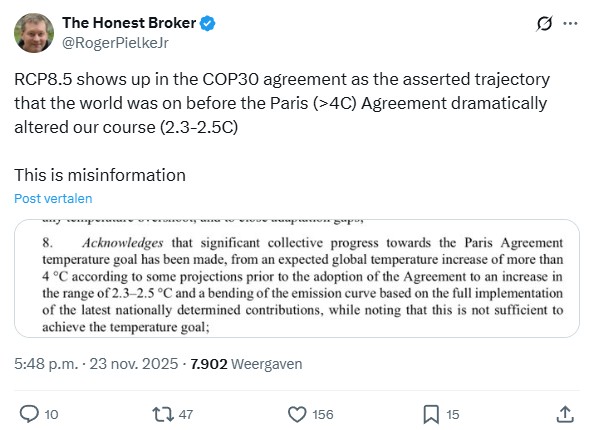
The COP30 agreement claims the world was previously on track for more than 4C of warming until the Paris Agreement heroically “bent” that trajectory down to 2.3–2.5C:

However, “this is misinformation,” says Roger Pielke Jr., Professor of Environmental Studies at the University of Colorado Boulder. It is a fiction built on the carcass of RCP8.5 — the extreme scenario that scientists quietly abandoned years ago because it required impossible coal use, implausible demographics and an economic collapse that never happened.
COP30 is resurrecting an unrealistic, disowned scenario in order to claim that Paris saved the world. The problem is the data. Real-world emissions show no curve bending, no slowdown and no “Paris effect”.
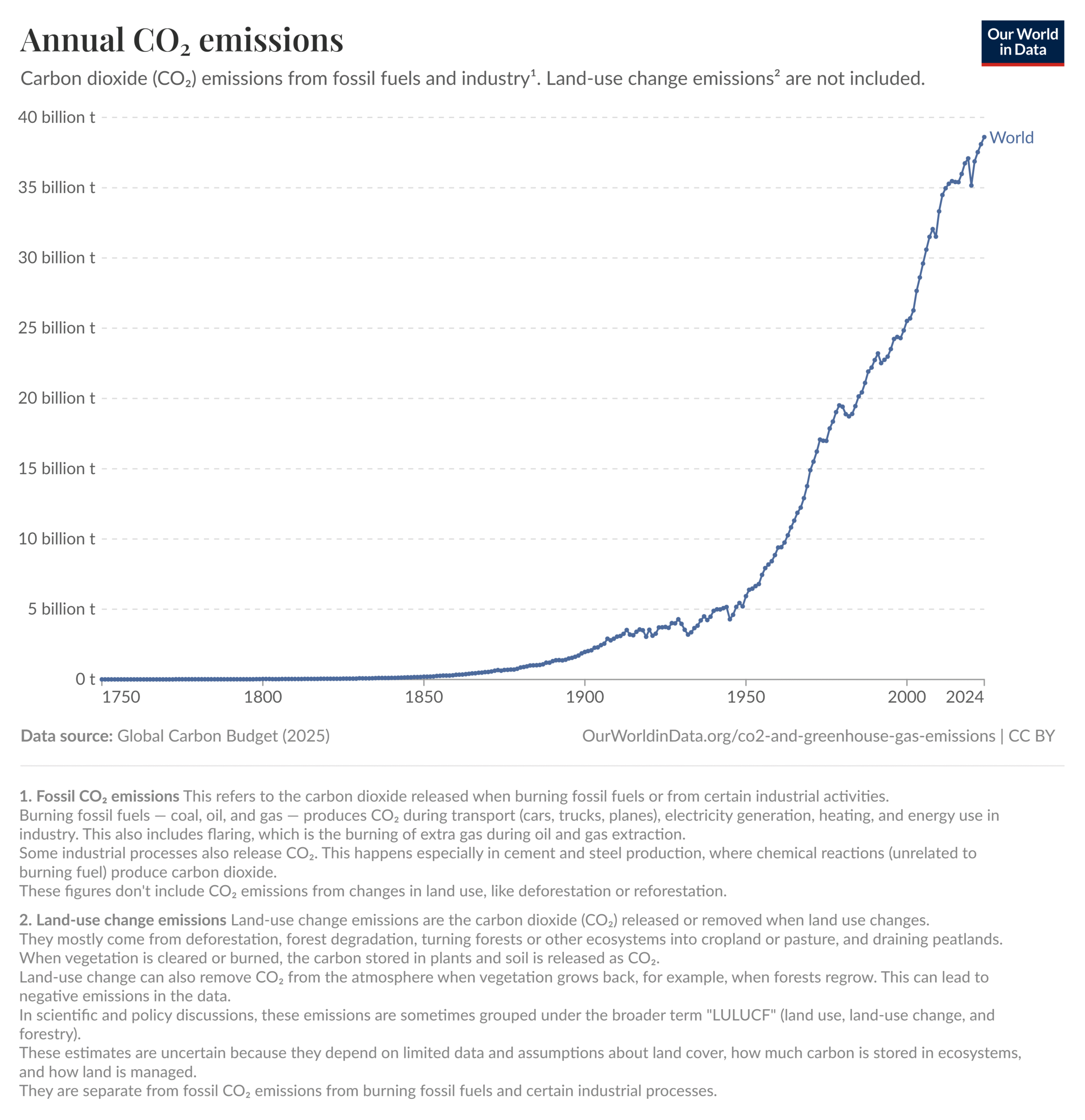
Paris didn’t change emissions, but it did unlock a permanent justification for climate taxation, energy rationing and the dismantling of cheap, reliable power — the foundation of economic prosperity.
COP30 needs a victory to justify its existence. So it has rewritten history: invent a 4C trajectory, pretend Paris knocked it down, and congratulate itself for saving humanity.
The world was never heading for RCP8.5. Paris didn’t change emissions.
Lies.

more news
The Net Zero Transition Is a Tax on the Air You Breathe
Net zero policy is rapidly becoming a tax on the air we breathe, while ignoring humanity’s deep dependence on hydrocarbons. Without fossil fuels, modern civilization, public health and global prosperity simply cannot function.
Canada Returns to Energy Reality as Pipeline Deal Exposes Net Zero Illusion
Canada’s energy policy is colliding with economic reality, as a new pipeline agreement exposes the limits of net zero ideology. Oil, gas and energy abundance remain indispensable to the Canadian economy and its future prosperity.
Interview with Demetris Koutsoyiannis: “The Climate Is Regulated by Nature”
In this interview with the Hungarian magazine Demokrata, Professor Demetris Koutsoyiannis reflects on science, truth, and climate discourse following his lecture at the Hungarian Academy of Sciences. He offers a critical perspective on current climate narratives and emphasizes the role of natural processes in shaping the climate.

