
COP30 Is Lying To Justify Its Existence
COP30 is building its case on climate misinformation that rewrites the past to claim a victory it never earned.

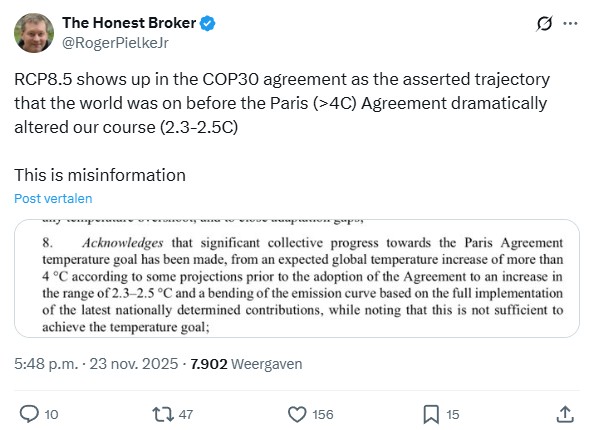
The COP30 agreement claims the world was previously on track for more than 4C of warming until the Paris Agreement heroically “bent” that trajectory down to 2.3–2.5C:

However, “this is misinformation,” says Roger Pielke Jr., Professor of Environmental Studies at the University of Colorado Boulder. It is a fiction built on the carcass of RCP8.5 — the extreme scenario that scientists quietly abandoned years ago because it required impossible coal use, implausible demographics and an economic collapse that never happened.
COP30 is resurrecting an unrealistic, disowned scenario in order to claim that Paris saved the world. The problem is the data. Real-world emissions show no curve bending, no slowdown and no “Paris effect”.
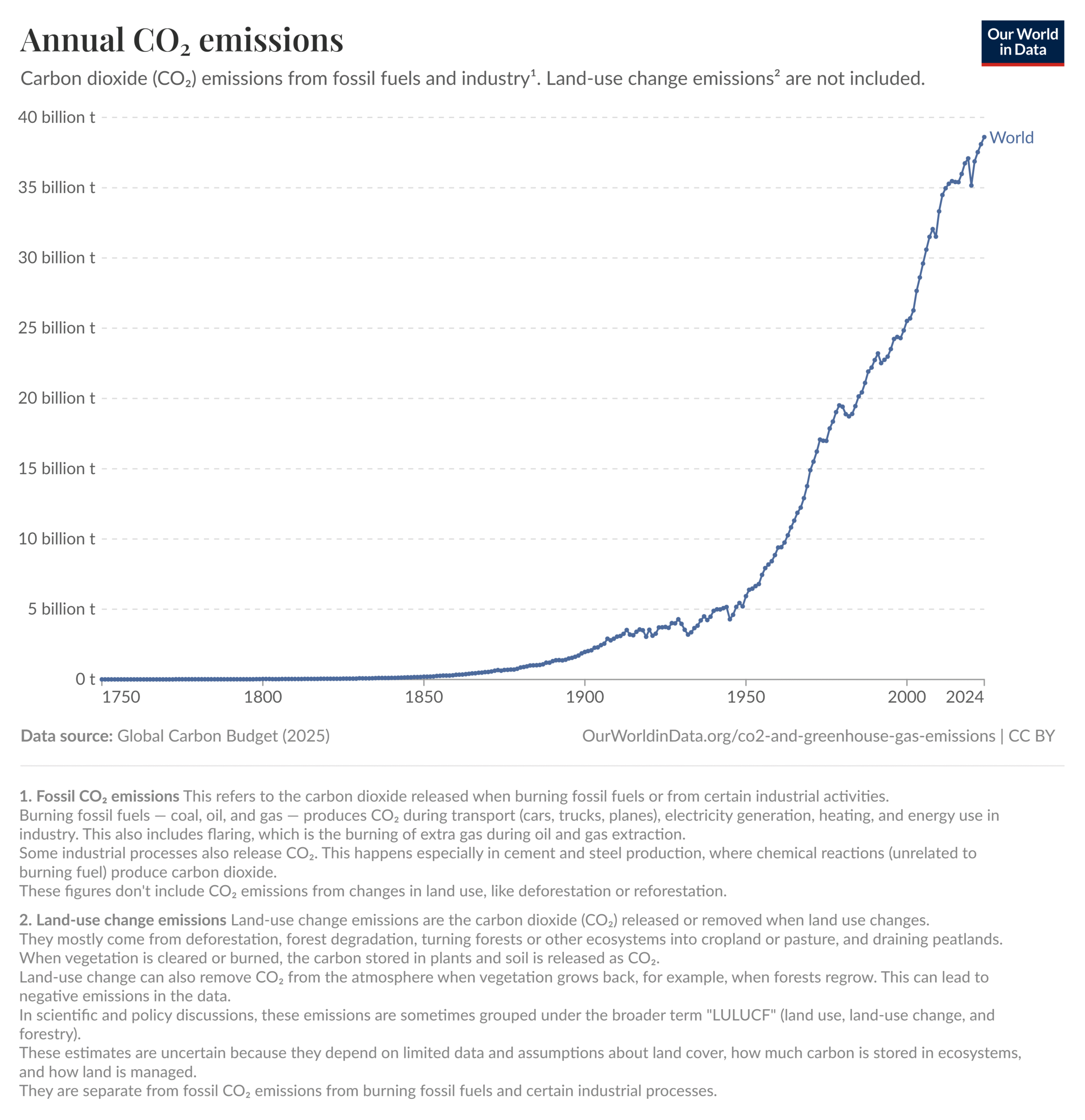
Paris didn’t change emissions, but it did unlock a permanent justification for climate taxation, energy rationing and the dismantling of cheap, reliable power — the foundation of economic prosperity.
COP30 needs a victory to justify its existence. So it has rewritten history: invent a 4C trajectory, pretend Paris knocked it down, and congratulate itself for saving humanity.
The world was never heading for RCP8.5. Paris didn’t change emissions.
Lies.


more news

Groundbreaking New Paper Challenges Foundation of Climate Change Assessments, Revealing Fatal Flaws in Ocean Heat Content Measurements
An international team of scientists has published groundbreaking research revealing that the primary measurement used to support claims of planetary “warming” is fundamentally flawed and scientifically invalid.
The Frontier of Climate Science: Solar Variability, Natural Cycles and Model Uncertainty
Climate scientist Nicola Scafetta has published a new book examining the complex interplay between solar variability, natural climate cycles, and the limits of current climate models. The Frontier of Climate Science explores how natural variability, observational uncertainties, and model limitations shape our understanding of past and future climate change.

Absurd new study: hair salons can be a secret weapon for climate action
Great news! Researchers from several British universities have discovered that ‘hairdressers could be a secret weapon in tackling climate change’. Jo Nova reflects on this absurd finding.

