
COP30 Is Lying To Justify Its Existence
COP30 is building its case on climate misinformation that rewrites the past to claim a victory it never earned.

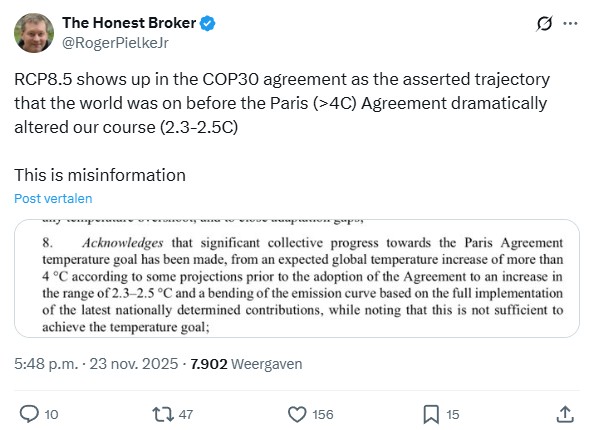
The COP30 agreement claims the world was previously on track for more than 4C of warming until the Paris Agreement heroically “bent” that trajectory down to 2.3–2.5C:

However, “this is misinformation,” says Roger Pielke Jr., Professor of Environmental Studies at the University of Colorado Boulder. It is a fiction built on the carcass of RCP8.5 — the extreme scenario that scientists quietly abandoned years ago because it required impossible coal use, implausible demographics and an economic collapse that never happened.
COP30 is resurrecting an unrealistic, disowned scenario in order to claim that Paris saved the world. The problem is the data. Real-world emissions show no curve bending, no slowdown and no “Paris effect”.
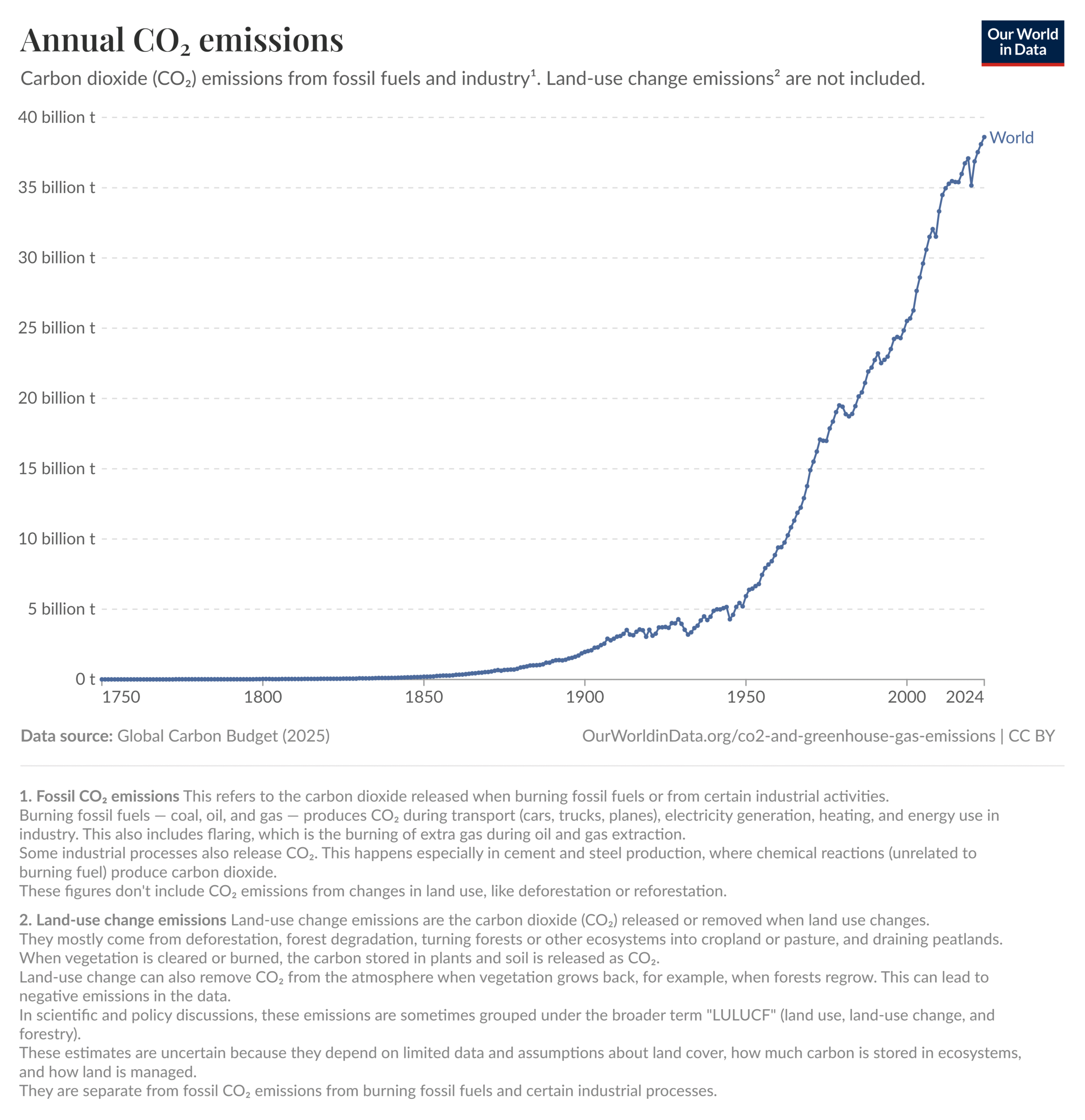
Paris didn’t change emissions, but it did unlock a permanent justification for climate taxation, energy rationing and the dismantling of cheap, reliable power — the foundation of economic prosperity.
COP30 needs a victory to justify its existence. So it has rewritten history: invent a 4C trajectory, pretend Paris knocked it down, and congratulate itself for saving humanity.
The world was never heading for RCP8.5. Paris didn’t change emissions.
Lies.


more news

Great Barrier Reef escapes UNESCO ‘In Danger’ listing again
UNESCO has once again decided not to place the Great Barrier Reef on its "In Danger" World Heritage List. Yet much of the international coverage continues to focus on climate warnings rather than on the broader picture of coral recovery. In this opinion article, Australian commentator Jo Nova argues that political narratives increasingly overshadow the underlying monitoring data. Drawing on Peter Ridd's analysis of Australian Institute of Marine Science (AIMS) data, she contends that the Great Barrier Reef remains in far better condition than is commonly portrayed.

Europe’s Crisis Is Energy Poverty, not a Heat Wave
As Europe experiences another summer heat wave, climate change is once again blamed for extreme temperatures. In this article, Vijay Jayaraj argues that the real crisis is not the heat itself, but energy poverty caused by misguided climate policies. He explains how a natural Omega Block weather pattern drove the recent heat wave and why affordable, reliable energy remains the most effective protection against extreme weather.

Death of Climate Alarmism Has Been Greatly Exaggerated
The Climate Establishment is now pivoting from overt apocalypticism to what might be called ‘non-alarmist alarmism’, says Tilak Doshi. This is a posture that formally disowns the discredited scenario RCP8.5 while preserving every policy conclusion that scenario was used to support.

