
COP30 Is Lying To Justify Its Existence
COP30 is building its case on climate misinformation that rewrites the past to claim a victory it never earned.

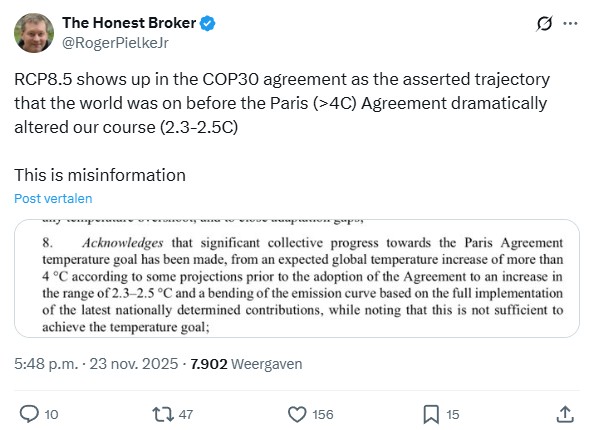
The COP30 agreement claims the world was previously on track for more than 4C of warming until the Paris Agreement heroically “bent” that trajectory down to 2.3–2.5C:

However, “this is misinformation,” says Roger Pielke Jr., Professor of Environmental Studies at the University of Colorado Boulder. It is a fiction built on the carcass of RCP8.5 — the extreme scenario that scientists quietly abandoned years ago because it required impossible coal use, implausible demographics and an economic collapse that never happened.
COP30 is resurrecting an unrealistic, disowned scenario in order to claim that Paris saved the world. The problem is the data. Real-world emissions show no curve bending, no slowdown and no “Paris effect”.
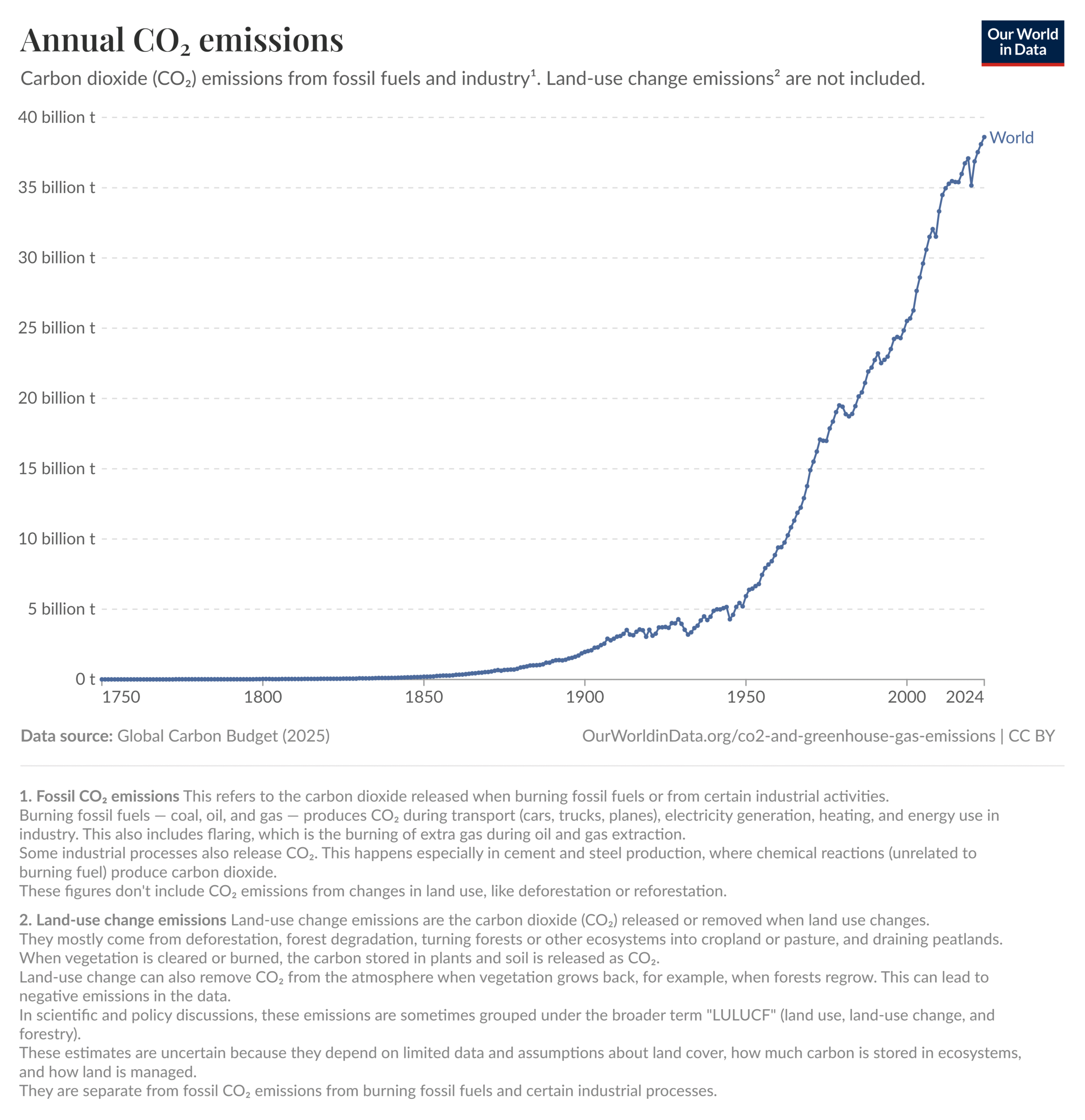
Paris didn’t change emissions, but it did unlock a permanent justification for climate taxation, energy rationing and the dismantling of cheap, reliable power — the foundation of economic prosperity.
COP30 needs a victory to justify its existence. So it has rewritten history: invent a 4C trajectory, pretend Paris knocked it down, and congratulate itself for saving humanity.
The world was never heading for RCP8.5. Paris didn’t change emissions.
Lies.

more news

The Democrats’ Green Delusion: Using the Iran War to Double Down on Renewables
We can now see a familiar rhetorical manoeuvre from the Climate Establishment, says Tilak Doshi: Every crisis becomes a reason to accelerate the energy transition, and every inconvenient cost is attributed to insufficient commitment to the cause.

Europe’s Heat Deaths Are a Policy Failure, not a Climate Failure
More than 90 percent of American homes have air conditioning. Europe chose a different, deadly, path. It pays the price for ideology disguised as environmental policy, says Anthony Watts.

Vatican Newspaper Taints ‘Encounter of Faith and Reason’ With Climate Falsehood
L’Osservatore Romano, the official Vatican newspaper, has joined in the fearmongering of climate alarmists. But, as Frits Byron Soepyan explains, there is no basis for the newspaper’s sensationalism.

